The Chromozone / IAL Biology / Unit 1 / Topic 1
Directed study: starch, glycogen and core practical 1
Work through this on your own after core practical 1. Part 1 checks the last two lessons, part 2 is exam-style questions on a new practical, and part 3 looks back at earlier lessons in the unit. The spec point in brackets after a question tells you where to revise. It takes about 35 minutes (28 marks). Type your answer in the box under each question, then press Hand in at the bottom of the page. The mark schemes open after you hand in: then mark yourself point by point. Teachers: this is the page to set as homework.
Teach these first
This page builds on these lessons. Teach them before students start here:
Part 1: retrieval (7 marks) 7 min
Answer from memory first. Then check your notes for anything you could not remember.
- Name the glycosidic bond at each branch point in amylopectin and glycogen. (1.2) (1)
- Give two differences between the structure of amylose and the structure of glycogen. (1.2) (2)
- Explain why sucrose is a good sugar to carry in the phloem. (1.2) (2)
- Name the reagent used to test for (i) reducing sugars and (ii) starch, and give the colour of a positive result for each. (1.3) (2)
Reveal the mark scheme for part 1
1. Branch points (1)
- α-1,6 glycosidic bond (1)
- ACCEPT 1,6 glycosidic bond
- DO NOT ACCEPT α-1,4
2. Amylose and glycogen (2): any two
- Amylose is unbranched; glycogen is highly branched (1)
- Amylose has only α-1,4 bonds; glycogen also has α-1,6 (1)
- Amylose coils into a helix; glycogen does not (1)
- Glycogen has many more free ends (1)
- Max 2
- DO NOT PIECE TOGETHER a difference from two separate statements; each must compare both molecules
3. Sucrose in the phloem (2)
- It is soluble, so it is carried in solution (1)
- It is not a reducing sugar, so it is less reactive on the way (1)
- IGNORE “it is small” on its own
4. The two tests (2)
- Benedict's reagent (heated): green to brick red (1)
- Iodine solution: blue-black (1)
- ACCEPT orange / red / brown precipitate for brick red
- NB the reagent and its colour are both needed for each mark
Part 2: exam-style questions, ripening mangoes (15 marks) 18 min
A student investigated how the reducing sugar and starch content of mangoes changes as they ripen. For each of three stages of ripening, she mashed 5.0 g of mango flesh with 50 cm3 of distilled water and filtered the mixture to give an extract. She tested 2 cm3 of each extract with 2 cm3 of Benedict's reagent in a water bath at 85 °C for 5 minutes, and two drops of each extract with iodine solution on a spotting tile.
| Stage of ripening | Colour after Benedict's test | Colour with iodine solution |
|---|---|---|
| 1: hard, green fruit | green | blue-black |
| 2: firm, green-yellow fruit | orange | dark blue |
| 3: soft, ripe yellow fruit | brick red | orange-brown |
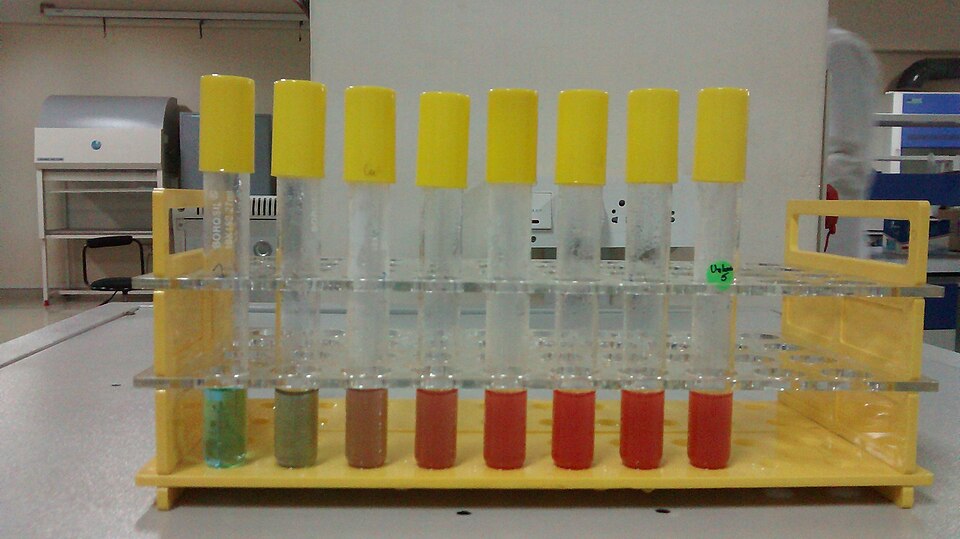

- Describe how the student could make a set of glucose colour standards, so that she could estimate the concentration of reducing sugar in each extract. (1.3) (3)
- She made a 0.4% glucose standard from a 2.0% stock solution. Calculate the volumes of stock and distilled water she needed to make 10 cm3. Show your working. (1.3) (2)
- Describe how the reducing sugar content and the starch content of the mangoes changed as they ripened. (1.3) (2)
- Suggest an explanation for these changes, using your knowledge of starch and glycosidic bonds. (1.2, 1.4) (3)
- Explain why the student used the same mass of mango and the same volume of water for every extract. (1.3) (2)
- Describe how the student could use a colorimeter to make her reducing sugar results quantitative. (1.3) (3)
Reveal the mark scheme for part 2
1. Colour standards (3): max 3
- Make a range of known glucose concentrations, for example 0.25, 0.5, 1.0, 1.5 and 2.0%, by diluting a stock solution with distilled water (1)
- Include a 0% standard of distilled water only (1)
- Test 2 cm3 of each standard with 2 cm3 of Benedict's reagent in the same water bath, at the same temperature, for the same time as the extracts (1)
- Compare the colour of each extract with the standards against a white background (1)
- Max 3
2. The dilution (2)
- Volume of stock = (0.4 ÷ 2.0) × 10 = 2.0 cm3 (1)
- Distilled water = 10 − 2.0 = 8.0 cm3 (1)
- ALLOW ecf for the water volume from a wrong stock volume
- NB both volumes need their units
3. The changes (2)
- The reducing sugar content increased as the mango ripened (green to orange to brick red) (1)
- The starch content decreased (blue-black to orange-brown, so almost no starch at stage 3) (1)
- DO NOT ACCEPT “sugar increased” with no mention of reducing sugar for the first point
4. Explanation (3): max 3
- The starch is broken down by hydrolysis as the mango ripens (1)
- Enzymes (such as amylase) break the glycosidic bonds in amylose and amylopectin (1)
- This releases reducing sugars such as maltose and glucose (1)
- So starch falls and reducing sugar rises; also credit: the sugar is a quick source of energy, or makes the fruit sweeter (1)
- Max 3
- DO NOT ACCEPT condensation for the breakdown
5. Same mass and volume (2)
- The concentration of sugar (or starch) in the extract depends on how much mango was mixed with how much water (1)
- Keeping both the same means any difference in colour is caused by the stage of ripening, so the extracts can be compared fairly (1)
- IGNORE “to make it a fair test” with no explanation
6. Using a colorimeter (3): max 3
- After heating, remove the precipitate from each tube, for example by filtering (1)
- Measure the absorbance (or % transmission) of the remaining blue solution with a colorimeter, using a red filter (1)
- Do the same for the glucose standards and plot a calibration curve of absorbance against glucose concentration (1)
- Read the concentration of each extract from the curve: the less blue the solution, the more reducing sugar (1)
- Max 3
Part 3: looking back (6 marks) 6 min
These come from earlier lessons in Unit 1: water and sugars and glycosidic bonds.
- Lactase hydrolyses lactose, the sugar in milk. Name the two products. (1.4) (2)
- In a mango tree, sugars made in the leaves reach the fruit in the phloem. Explain how the properties of water make this transport possible. (1.1) (2)
- α-glucose and β-glucose are isomers. Explain what this means. (1.2) (2)
Reveal the mark scheme for part 3
1. Lactose (2)
- Glucose (1)
- Galactose (1)
- DO NOT ACCEPT fructose
2. Transport in the phloem (2)
- Sucrose is polar, so it dissolves in water (hydrogen bonds) (1)
- It is carried in solution as the phloem sap flows (1)
- ACCEPT “water is a solvent” for the first point
3. Isomers (2)
- Same molecular formula, C6H12O6 (1)
- Different arrangement: the −OH on carbon 1 is below the ring in α, above in β (1)
- ACCEPT “same atoms, different structure”