Draw the general structure of an amino acid and label the amino group, the carboxyl group, the hydrogen atom and the R group around the central carbon.
Build amino acids with a model kit and show how a molecule of water is removed when a peptide bond forms.
Write and annotate equations for making a dipeptide (condensation) and splitting it (hydrolysis).
Count the peptide bonds and water molecules in a polypeptide (n − 1 for one chain, n − c for c chains) and estimate its relative molecular mass.
You need
Projector
Per pair: a molecular model kit
Notebooks
Before
2.5, active transport
Running order
Time
Phase
What happens
Slides
5 min
Starter
Recap questions in notebooks.
1–2
flex
Today
Spec 2.6;
3
flex
Teach: Structure
Words for amino acids; four groups round one carbon atom.
4–5
4 min
Mini whiteboard round
Find the R group.
6–7
flex
Teach: Peptide bonds
Words for peptide bonds; water leaves and a peptide bond forms.
8–9
12 min
Task 1
Build amino acids and a dipeptide.
10–16
8 min
Exam-style questions
Amino acids and peptide bonds, 7 marks; mark scheme on the next slide.
17–19
extension
Stretch
Peptide bonds in a blood clot, 6 marks.
20–21
close
Checklist
By the end of this lesson I can: 4 points.
22
extension
If you have time
10 marks of exam-style questions, about 10 minutes, with mark schemes.
23
The timed tasks take 29 minutes; the teaching phases (flex) share the other 21.
June 2022 · WBI11/01 · Q5(a)(ii), 3 marks: Draw the full structure of the amino acid cysteine when you are given only its R group.
October 2020 · WBI11/01 · Q1, 7 marks: Complete a short account of primary structure and how peptide bonds form, then match the bond types that hold secondary and 3D structure.
Prints on one A4 sheet. The old layout of this lesson is still here.
The slides down the left are the plan. Click one, or use the arrow keys. Everything under the slide is for you only.
Projector as a second screen: click "Open on projector", drag the new window onto the projector and click "Full screen" in it. It follows your slides; your notes stay on your laptop.
Projector copies your laptop screen: the class sees everything you see. Switch to a second screen: on Windows press the Windows key + P and choose Extend; on a Mac open System Settings, then Displays, and choose Extended display. If you cannot switch, open the projector window full screen and keep this page open on a phone or tablet for your notes, or print the Plan tab.
Slide 1 of 23
Starter 5 min
Answer these three recap questions in your notebook:
1
Describe how a white blood cell takes in a bacterium by phagocytosis. (2.5) (2)
2
A red blood cell is placed in a solution with a lower water potential than its cytoplasm. State what happens to the cell. (2.4) (1)
3
50 α-glucose molecules join to make one unbranched amylose chain. Calculate how many water molecules are released. (1.4) (1)
Words you will need today
Monomer: a small molecule that can join to others like it to make a polymer.
Condensation reaction: two molecules join by a new covalent bond, and a molecule of water is released.
Hydrolysis: a covalent bond is broken by adding a molecule of water.
Slide 2 of 23
Answers: Starter
1
(2)
The cell surface membrane reaches round the bacterium as pseudopodia (1)
The membrane fuses and pinches off, enclosing the bacterium in a {vesicle / vacuole} inside the cell (1)
2
(1)
Water leaves the cell by osmosis, so the cell shrinks and its surface becomes crinkled (crenated) (1)
DO NOT ACCEPT plasmolysis: a red blood cell has no cell wall
3
(1)
49: a chain of n monomers has n − 1 glycosidic bonds, and one water molecule is released for each bond formed (1)
ACCEPT 50 − 1 or 49 for the mark; DO NOT ACCEPT 50
(i) Know the basic structure of an amino acid: an amino group, a carboxyl group, a hydrogen atom and an R group, all joined to a central carbon atom.
(ii) Understand how amino acid monomers join by condensation reactions, forming peptide bonds, to make dipeptides, polypeptides and proteins, and how hydrolysis splits them again.
Use the number of amino acids and chains to work out the number of peptide bonds, the water released and the relative molecular mass of a polypeptide.
Amino acid structure
Amino group, carboxyl group, H and R group
Peptide bonds
Condensation joins amino acids
Hydrolysis splits them
Slide 4 of 23
Key words: amino acids
Amino acid
The monomer that polypeptides and proteins are built from
Organisms use 20 different amino acids in their proteins
Two groups
Amino group, −NH2: basic, accepts H+
Carboxyl group, −COOH: acidic, releases H+
R group
The part that is different in each amino acid
Also called the side chain
Slide 5 of 23
The basic structure of an amino acid
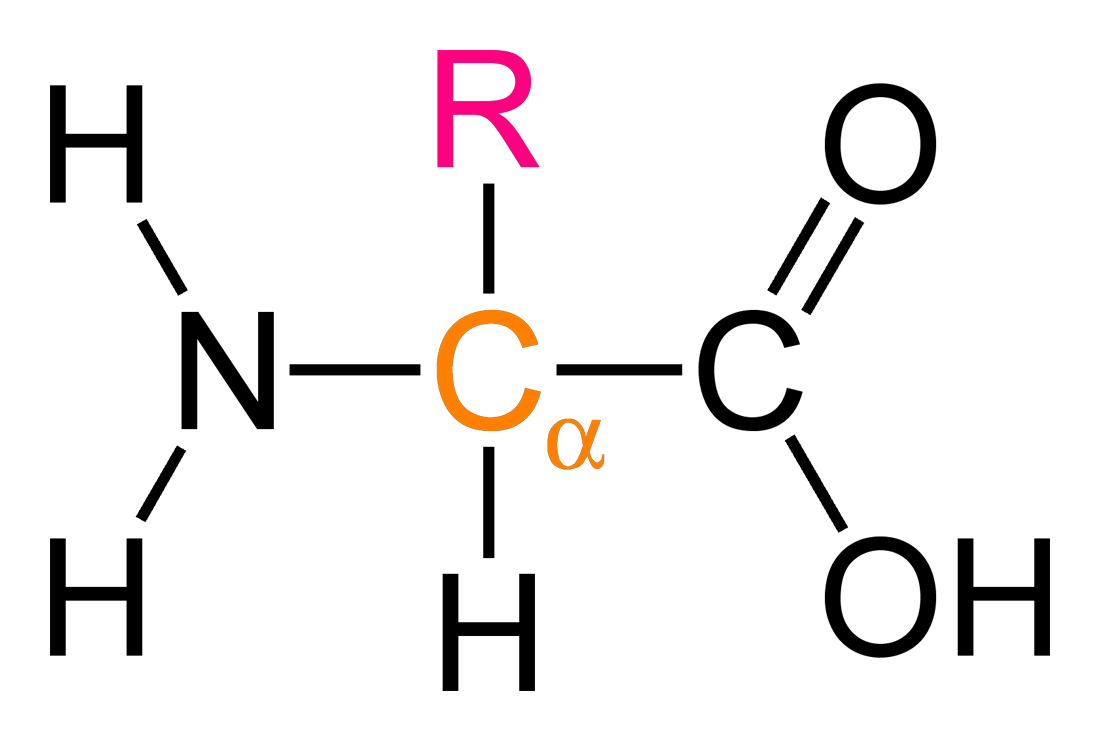
Every amino acid has the same basic structure.
Central carbon
The α-carbon, joined by single covalent bonds to four groups
Four groups
An amino group and a carboxyl group
A hydrogen atom, −H
An R group, different in each amino acid
Exam
Learn the general structure, not particular amino acids
Be ready to pick out the R group
The general structure of an amino acid: the central carbon (Cα, orange) carries an amino group, a carboxyl group, a hydrogen atom and an R group (pink)Image: Ben Mills (Benjah-bmm27), public domain, via Wikimedia Commons
Slide 6 of 23
Mini whiteboard round: find the R group 4 min
Show each formula on the board. Students write the R group, or "not an amino acid" with the reason, and hold up their whiteboards together.
1
H2N−CH(CH3)−COOH
2
H2N−CH2−COOH
3
H2N−CH(CH2OH)−COOH
4
H2N−CH(CH2SH)−COOH
5
H2N−CH2−CH2−OH
Tip: find the carbon atom that carries both the −NH2 and the −COOH. Whatever else is joined to it, apart from one H, is the R group.
Slide 7 of 23
Answers: Mini whiteboard round
01The R group is −CH3. (This is alanine.)
02The R group is −H, so the central carbon carries two hydrogen atoms. (This is glycine.)
03The R group is −CH2OH. (This is serine.)
04The R group is −CH2SH, which contains sulfur. (This is cysteine.)
05
This is not an amino acid, because it has an amino group but no carboxyl group.
The names are for interest only: you never need to recall the structure of a particular amino acid.
Slide 8 of 23
Key words: peptide bonds
Peptide bond
The covalent bond between the C of one carboxyl group and the N of the next amino group
Chains
Dipeptide: two amino acids, one peptide bond
Polypeptide: an unbranched chain of many amino acids
Two reactions
Condensation: a new covalent bond, and water is released
Hydrolysis: a bond is broken by adding water
Slide 9 of 23
Peptide bonds: condensation and hydrolysis
Amino acids join into a polypeptide one at a time.
Condensation
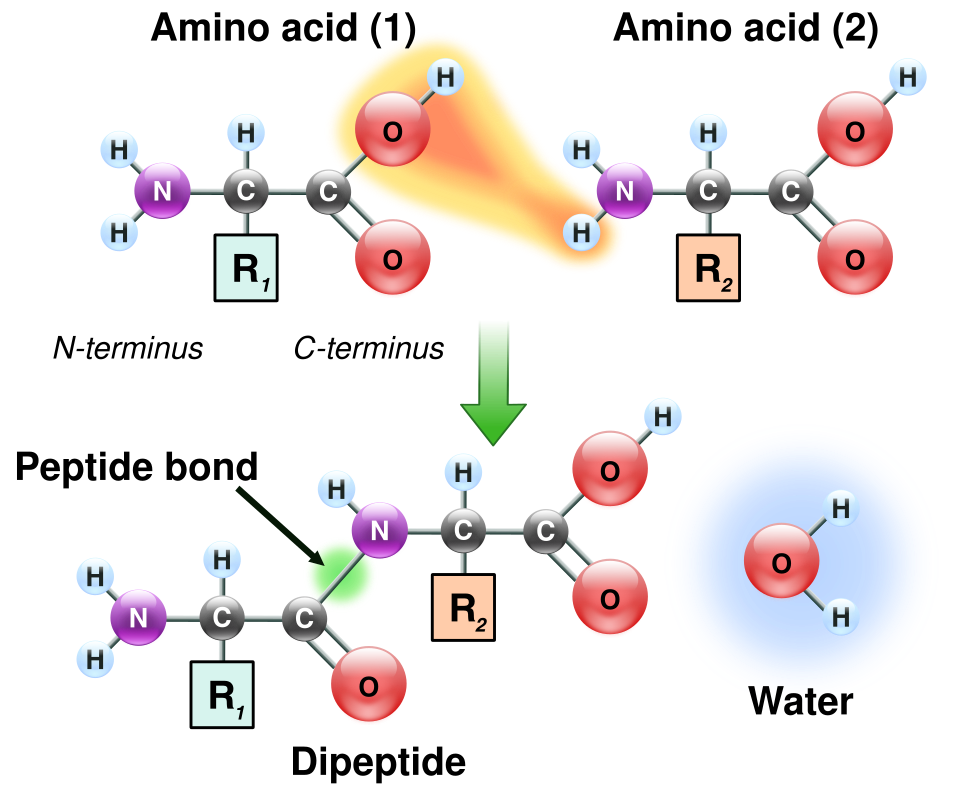
−OH from one carboxyl group and −H from the next amino group
They leave as water; a peptide bond forms between C and N
Ribosomes do this in translation
Hydrolysis
Water is added across the peptide bond
The bond breaks and two complete amino acids are released
Protease enzymes do this in digestion
R groups
Take no part in forming peptide bonds
They stick out from the backbone
Condensation: the −OH of one carboxyl group and an −H of the next amino group leave as a molecule of water, and a peptide bond forms between C and N. Nitrogen is purple here (blue in most model kits)Image: Yassine Mrabet, public domain, via Wikimedia Commons
Slide 10 of 23
Task 1: build amino acids and a dipeptide (1 of 5) 12 min
Work in pairs with a molecular model kit. This is a classroom modelling activity, not one of Pearson's practicals: the recommended practical for spec point 2.6 is estimating protein concentration with biuret reagent and colour standards, which has its own two practical lessons.
Colour key. Most kits use these colours, but check the key that comes with yours.
Colour
Atom
Holes (= bonds)
Black
Carbon (C)
4
Blue
Nitrogen (N)
3 (in an uncharged −NH2 group)
Red
Oxygen (O)
2
White
Hydrogen (H)
1
Slide 11 of 23
Task 1: build amino acids and a dipeptide (2 of 5)
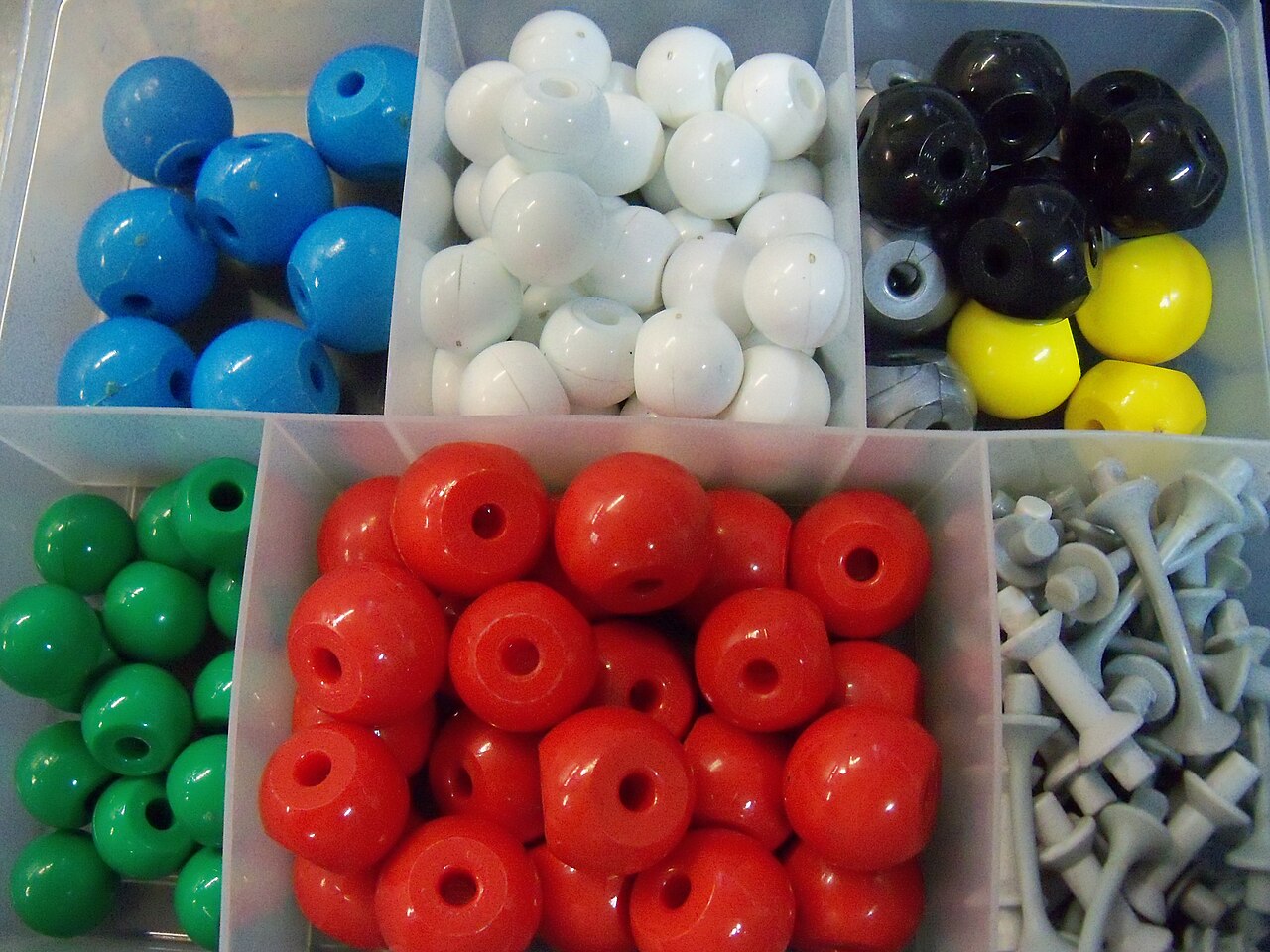
A molecular model kit: black carbon, white hydrogen, red oxygen and blue nitrogen atoms, with grey links for the bonds. The green and yellow atoms are other elements, which you won't need todayImage: Sonia, CC BY 3.0, via Wikimedia Commons
Slide 12 of 23
Task 1: build amino acids and a dipeptide (3 of 5)
Use one rigid link for each single bond and two flexible links for the C=O double bond.
1
Build glycine (R = −H): take a black carbon atom for the centre. Attach:
an amino group (a blue N carrying two white H)
a carboxyl group (a black C joined by two flexible links to one red O, and by a single link to a second red O that carries a white H)
one white H
a second white H as the R group.
2
Build alanine (R = −CH3): build a second amino acid in the same way, but swap the R-group hydrogen for a methyl group (a black C carrying three white H).
3
Condense them into a dipeptide:
take the −OH (red + white) off glycine's carboxyl group and one −H (white) off alanine's amino group
join these three atoms into a water molecule
link glycine's carboxyl carbon to alanine's amino nitrogen: that link is the peptide bond.
4
Make a chain: join your dipeptide to the next pair's dipeptide by another condensation, to make a chain of four amino acids. Keep every water molecule you make on the desk.
Slide 13 of 23
Task 1: build amino acids and a dipeptide (4 of 5)
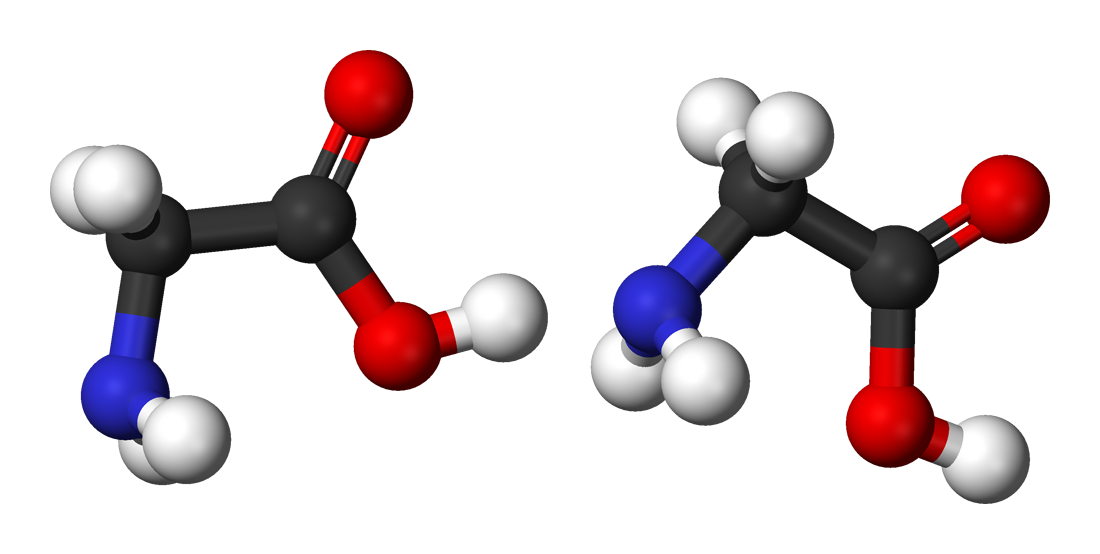
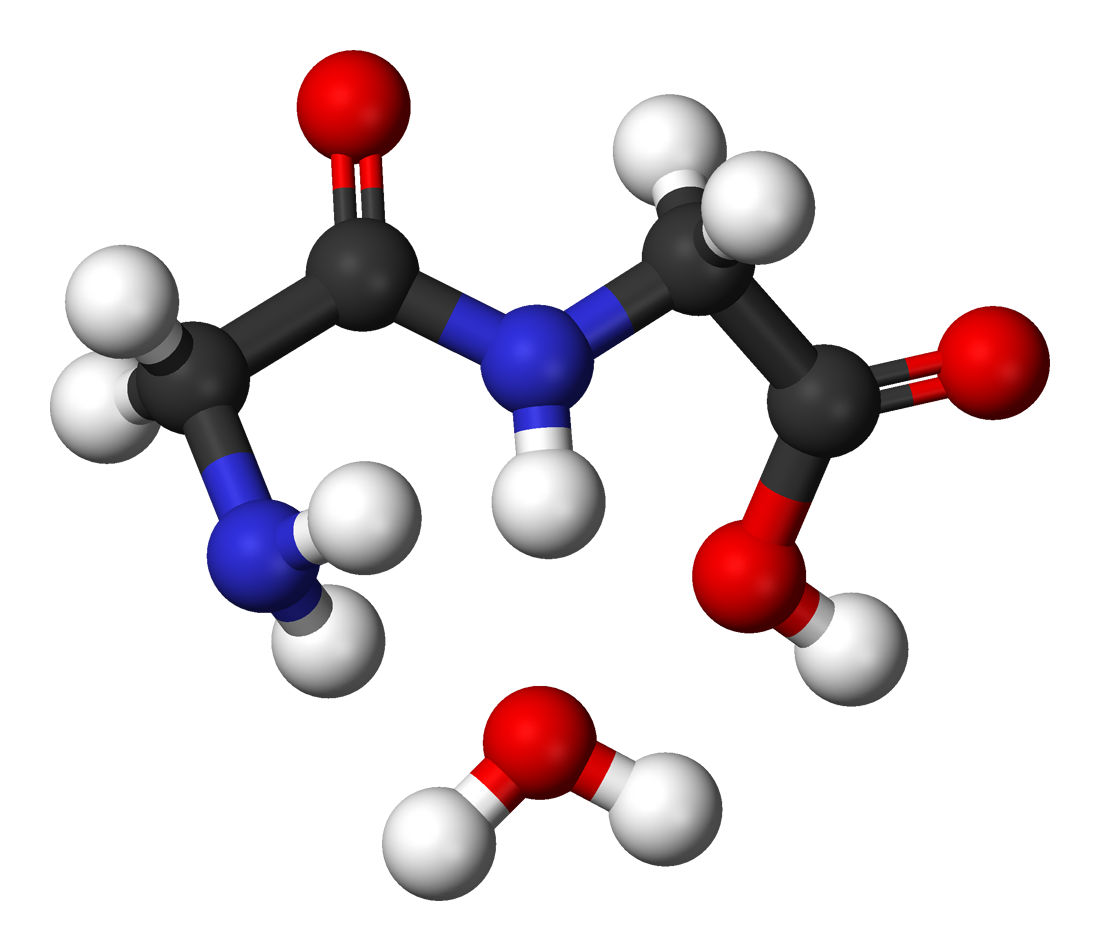
Two glycine molecules (top), then the dipeptide and the water molecule released when they condense (below). Most kits use the same colours: carbon black, hydrogen white, oxygen red, nitrogen blueImage: Ben Mills (Benjah-bmm27), top and bottom, public domain, via Wikimedia Commons
Slide 14 of 23
Task 1: build amino acids and a dipeptide (5 of 5)
Questions (record them in your lab book)
a
Count the black, white, red and blue atoms in your glycine-alanine dipeptide and write its molecular formula. Explain why the formula is not simply glycine (C2H5NO2) + alanine (C3H7NO2).
b
Look at the two ends of your dipeptide. Name the group that is free at each end, and explain why the chain can be made longer.
c
Silk is mostly fibroin, a fibrous protein rich in glycine, alanine and serine. A dipeptide is made of glycine (R = −H) and serine (R = −CH2OH), with glycine's carboxyl group bonded to serine's amino group. Write an equation, showing the structures, for the hydrolysis of this dipeptide into its two amino acids.
d
State how many peptide bonds hold your chain of four amino acids together, and how many water molecules were made in building it.
Slide 15 of 23
Answers: Task 1 (1 of 2)
1(a)
Molecular formula
Glycine + alanine = C5H12N2O4; the dipeptide is C5H10N2O3 (5 black, 10 white, 2 blue, 3 red)
Two hydrogen atoms and one oxygen atom left as a molecule of water in the condensation reaction
ACCEPT H2O lost in the working
1(b)
The two ends
One end has a free amino group (−NH2, the N-terminus) and the other a free carboxyl group (−COOH, the C-terminus)
Either free group can take part in another condensation reaction with a new amino acid, so the chain can keep getting longer
Water shown on the left of the arrow (or over it), and the bond broken is the peptide bond between C and N
Glycine correct, with the −OH back on its carboxyl group: H2N−CH2−COOH
Serine correct, with the H back on its amino group: H2N−CH(CH2OH)−COOH
ACCEPT fully displayed formulae, with every bond drawn, as long as each carbon has four bonds and each nitrogen three
1(d)
The chain of four
3 peptide bonds and 3 water molecules: one fewer than the number of amino acids
NB both numbers are needed for the mark
Slide 17 of 23
Exam-style questions (7 marks) 8 min
1. Which element is present in every amino acid but is not present in glucose? (1)
carbon
nitrogen
phosphorus
sulfur
2. A polypeptide made of one chain is completely hydrolysed to amino acids. 300 molecules of water are used. How many amino acids were in the chain? (1)
299
300
301
600
3. Which statement about the R groups of the amino acids in a polypeptide is correct? (1)
They form the peptide bonds between amino acids.
They are the same in every amino acid.
They take no part in forming peptide bonds.
They are removed as water when a peptide bond forms.
4. The hormone glucagon is a single polypeptide chain of 29 amino acids. (4 marks in total)
a
State the number of peptide bonds in one molecule of glucagon. (1)
b
Describe how a peptide bond forms between two amino acids when glucagon is made. (3)
Slide 18 of 23
Answers: Exam-style questions (1 of 2)
1
(1)
B (nitrogen) (1)
Why not the others: glucose also contains carbon; phosphorus is found in phospholipids and nucleotides, not in amino acids; only two amino acids, cysteine and methionine, contain sulfur.
2
(1)
C (301) (1)
Why: one water molecule is used for each peptide bond broken, and a chain of n amino acids has n − 1 bonds, so 300 bonds means 301 amino acids.
3
(1)
C (they take no part in forming peptide bonds) (1)
Why: peptide bonds form between the carboxyl group of one amino acid and the amino group of the next. The R groups stick out from the chain.
4(a)
(1)
28(1)
Slide 19 of 23
Answers: Exam-style questions (2 of 2)
4(b)
(3)
A condensation reaction (1)
Between the carboxyl group (−COOH) of one amino acid and the amino group (−NH2) of the next (1)
The −OH from the carboxyl group and an −H from the amino group are removed as a molecule of water (1)
A covalent bond forms between the carbon atom and the nitrogen atom (−CO−NH−) (1)
The R groups are not involved (1)
It happens on ribosomes, during translation (1)
DO NOT ACCEPT the R groups join together, or water is added (that describes hydrolysis)
Max 3
Slide 20 of 23
Stretch: peptide bonds in a blood clot (6 marks)
When a blood vessel is damaged, the enzyme thrombin turns the soluble plasma protein fibrinogen into fibrin (1.11). Thrombin does this by hydrolysing four particular peptide bonds in each fibrinogen molecule. This releases four short peptides called fibrinopeptides: two of 16 amino acids and two of 14 amino acids. What is left is a fibrin molecule, which joins with other fibrin molecules to form the fibres of the clot.
Use these values: Mr of fibrinogen = 340,000; mean Mr of a free amino acid = 128; Mr of water = 18.
a
State how many molecules of water are used when one fibrinogen molecule is converted to a fibrin molecule. (1)
b
Calculate the total Mr of the four fibrinopeptides released from one fibrinogen molecule. (3)
c
Calculate the Mr of the fibrin molecule, and explain why it is not simply 340,000 minus your answer to (b). (2)
Slide 21 of 23
Answers: Stretch
1(a)
Water used (1)
4: one molecule of water is used for each peptide bond hydrolysed(1)
1(b)
Mass of the fibrinopeptides (3)
Uses one fewer water molecule than amino acids for each peptide: 15 for a 16-amino-acid peptide and 13 for a 14-amino-acid peptide (1)
ALLOW ecf for the total from a wrong value in the second line
1(c)
Mass of the fibrin molecule (2)
340,000 + (4 × 18) − 6,672 = 333,400 (1)
Hydrolysis adds a molecule of water across each peptide bond broken: the −H and −OH stay on the products, so together the products are 4 × 18 = 72 heavier than the fibrinogen they came from (1)
Slide 22 of 23
Checklist: by the end of this lesson I can
01Draw the general structure of an amino acid and label the amino group, the carboxyl group, the hydrogen atom and the R group around the central carbon.
02Build amino acids with a model kit and show how a molecule of water is removed when a peptide bond forms.
03Write and annotate equations for making a dipeptide (condensation) and splitting it (hydrolysis).
04Count the peptide bonds and water molecules in a polypeptide (n − 1 for one chain, n − c for c chains) and estimate its relative molecular mass.
Slide 23 of 23
If you have time
For classes that finish early or have a longer period: 10 marks of exam-style questions, about 10 minutes, with a mark scheme after each question, on the student page.
The cell surface membrane reaches round the bacterium as pseudopodia (1)
The membrane fuses and pinches off, enclosing the bacterium in a {vesicle / vacuole} inside the cell (1)
Question 2 (1)
Water leaves the cell by osmosis, so the cell shrinks and its surface becomes crinkled (crenated) (1)
DO NOT ACCEPT plasmolysis: a red blood cell has no cell wall
Question 3 (1)
49: a chain of n monomers has n − 1 glycosidic bonds, and one water molecule is released for each bond formed (1)
ACCEPT 50 − 1 or 49 for the mark; DO NOT ACCEPT 50
The same n − 1 rule works for amino acids today.
Say this Teacher only · not on the projector
Nothing extra for this slide.
Say this Teacher only · not on the projector
This is the specification point, word for word: what you need to know by the end of the lesson.
Say this Teacher only · not on the projector
These are the words the mark scheme needs. "Amine" for amino group, or "acid group" for carboxyl group, does not earn the mark. Students must also name the R group, not "the side bit".
Link back to 1.4 and 1.5: a monomer is one unit that joins to others. Glucose is the monomer of a polysaccharide. An amino acid is the monomer of a polypeptide.
Amino acids have both an acidic group and a basic group. The name tells you this: amino for the base, acid for the carboxyl group.
Ask: "What is the same in every amino acid and what is different?" Expected answer: the amino group, the carboxyl group and the hydrogen are the same, and the R group is different.
Say this Teacher only · not on the projector
Why does the structure matter? The R group is the only part that changes, so it is the R group that gives each of the 20 amino acids its own properties, for example whether it is polar or non-polar. Those properties decide how the chain folds later in the topic.
Analogy: a set of keys cut from the same blank. The blank (amino group, carboxyl group, hydrogen and central carbon) is the same for every key. The cuts (R groups) make each key different.
Link back to 1.1: polar and non-polar. An R group may be polar, non-polar or charged, so it will or will not form hydrogen bonds with water.
Ask: "Carbon forms four covalent bonds. How many groups are joined to the central carbon of an amino acid?" Expected answer: four: an amino group, a carboxyl group, a hydrogen atom and an R group.
Common mistake: drawing a carbon atom with five bonds, or an amino group with three hydrogens. Count the bonds on every atom: carbon 4, nitrogen 3, oxygen 2, hydrogen 1.
Watch for
A carbon atom with five bonds. Before finishing any drawn structure, count the bonds on every atom: carbon 4, nitrogen 3 (in −NH2), oxygen 2, hydrogen 1. The usual slips are a central carbon with five bonds and an amino group with three hydrogens.
Say this Teacher only · not on the projector
Nothing extra for this slide.
Answers at a glance
The R group is −CH3. (This is alanine.)
The R group is −H, so the central carbon carries two hydrogen atoms. (This is glycine.)
The R group is −CH2OH. (This is serine.)
The R group is −CH2SH, which contains sulfur. (This is cysteine.)
This is not an amino acid, because it has an amino group but no carboxyl group.
The names are for interest only: you never need to recall the structure of a particular amino acid.
Say this Teacher only · not on the projector
Nothing extra for this slide.
Say this Teacher only · not on the projector
These are the words the mark scheme needs. The bond is a peptide bond, not an amino bond or a protein bond, and it forms between the carboxyl group of one amino acid and the amino group of the next.
Link back to 1.4 and 1.5: condensation and hydrolysis are the same two reactions you met for the glycosidic bond and the ester bond. Only the bond is new.
A dipeptide has two amino acids and one peptide bond. A polypeptide has many. The prefix gives the number of units.
Ask: "What is released when a peptide bond forms, and what is added when it breaks?" Expected answer: water is released in condensation, and water is added in hydrolysis.
Say this Teacher only · not on the projector
Why is water lost? The -OH from the carboxyl group of one amino acid and an -H from the amino group of the next leave together as H2O. The C and the N that are left join as the peptide bond.
The reverse is hydrolysis. Protease enzymes in the gut add water across the peptide bond, so the protein in a meal is broken down into amino acids small enough to be absorbed.
Link back to 1.4 and 1.5: a glycosidic bond and an ester bond form and break in the same way. In each case, condensation releases one water molecule and hydrolysis uses one.
Ask: "A polypeptide made of one chain is completely hydrolysed. 300 water molecules are used. How many amino acids were in the chain?" Expected answer: 301, because a chain of n amino acids has n minus 1 peptide bonds.
Common mistake: writing that the R groups form the peptide bond. The peptide bond joins the backbone only. Also, for a protein with several chains, use n minus c, not n minus 1: haemoglobin has 574 amino acids in 4 chains, so 570 peptide bonds, not 573.
Watch for
"The R groups form the peptide bond." Peptide bonds join the carboxyl group of one amino acid to the amino group of the next, along the backbone. R groups are never involved. When the chain folds, they form hydrogen bonds, ionic bonds, disulfide bridges and hydrophobic interactions instead.
Say this Teacher only · not on the projector
Nothing extra for this slide.
Watch for
Using n − 1 for a protein with several chains. Each chain has one fewer peptide bond than it has amino acids. For a protein with c chains and n amino acids in all, there are n − c peptide bonds: haemoglobin has 574 amino acids in 4 chains, so 570 peptide bonds, not 573.
Answers at a glance
(a) Molecular formula
Glycine + alanine = C5H12N2O4; the dipeptide is C5H10N2O3 (5 black, 10 white, 2 blue, 3 red)
Two hydrogen atoms and one oxygen atom left as a molecule of water in the condensation reaction
ACCEPT H2O lost in the working
(b) The two ends
One end has a free amino group (−NH2, the N-terminus) and the other a free carboxyl group (−COOH, the C-terminus)
Either free group can take part in another condensation reaction with a new amino acid, so the chain can keep getting longer
Water shown on the left of the arrow (or over it), and the bond broken is the peptide bond between C and N
Glycine correct, with the −OH back on its carboxyl group: H2N−CH2−COOH
Serine correct, with the H back on its amino group: H2N−CH(CH2OH)−COOH
ACCEPT fully displayed formulae, with every bond drawn, as long as each carbon has four bonds and each nitrogen three
(d) The chain of four
3 peptide bonds and 3 water molecules: one fewer than the number of amino acids
NB both numbers are needed for the mark
Say this Teacher only · not on the projector
Teacher note: in a model both ends can grow, but on a ribosome the next amino acid is always added to the carboxyl end, so a polypeptide is built from its N-terminus to its C-terminus.
Say this Teacher only · not on the projector
Nothing extra for this slide.
Say this Teacher only · not on the projector
Nothing extra for this slide.
Answers at a glance
Question 1 (1)
B (nitrogen) (1)
Why not the others: glucose also contains carbon; phosphorus is found in phospholipids and nucleotides, not in amino acids; only two amino acids, cysteine and methionine, contain sulfur.
Question 2 (1)
C (301) (1)
Why: one water molecule is used for each peptide bond broken, and a chain of n amino acids has n − 1 bonds, so 300 bonds means 301 amino acids.
Question 3 (1)
C (they take no part in forming peptide bonds) (1)
Why: peptide bonds form between the carboxyl group of one amino acid and the amino group of the next. The R groups stick out from the chain.
Question 4(a) (1)
28(1)
Question 4(b) (3)
A condensation reaction (1)
Between the carboxyl group (−COOH) of one amino acid and the amino group (−NH2) of the next (1)
The −OH from the carboxyl group and an −H from the amino group are removed as a molecule of water (1)
A covalent bond forms between the carbon atom and the nitrogen atom (−CO−NH−) (1)
The R groups are not involved (1)
It happens on ribosomes, during translation (1)
DO NOT ACCEPT the R groups join together, or water is added (that describes hydrolysis)
Max 3
Say this Teacher only · not on the projector
Nothing extra for this slide.
Say this Teacher only · not on the projector
Nothing extra for this slide.
Say this Teacher only · not on the projector
Nothing extra for this slide.
Answers at a glance
(a) Water used (1)
4: one molecule of water is used for each peptide bond hydrolysed(1)
(b) Mass of the fibrinopeptides (3)
Uses one fewer water molecule than amino acids for each peptide: 15 for a 16-amino-acid peptide and 13 for a 14-amino-acid peptide (1)
ALLOW ecf for the total from a wrong value in the second line
(c) Mass of the fibrin molecule (2)
340,000 + (4 × 18) − 6,672 = 333,400 (1)
Hydrolysis adds a molecule of water across each peptide bond broken: the −H and −OH stay on the products, so together the products are 4 × 18 = 72 heavier than the fibrinogen they came from (1)
Say this Teacher only · not on the projector
Nothing extra for this slide.
Say this Teacher only · not on the projector
Nothing extra for this slide.
Say this Teacher only · not on the projector
If there is time: 10 marks of exam-style questions, about 10 minutes, on the student page (the same link students have).
This tab is written for students: share the link and they see this tab only. Students enrolled in a class can see this page independently after it has been taught.
Starter (4 marks) 5 min
Answer these three recap questions in your notebook:
Describe how a white blood cell takes in a bacterium by phagocytosis. (2.5) (2)
A red blood cell is placed in a solution with a lower water potential than its cytoplasm. State what happens to the cell. (2.4) (1)
50 α-glucose molecules join to make one unbranched amylose chain. Calculate how many water molecules are released. (1.4) (1)
Words you will need today
Monomer: a small molecule that can join to others like it to make a polymer.
Condensation reaction: two molecules join by a new covalent bond, and a molecule of water is released.
Hydrolysis: a covalent bond is broken by adding a molecule of water.
Reveal the starter answers
Question 1 (2)
The cell surface membrane reaches round the bacterium as pseudopodia (1)
The membrane fuses and pinches off, enclosing the bacterium in a {vesicle / vacuole} inside the cell (1)
Question 2 (1)
Water leaves the cell by osmosis, so the cell shrinks and its surface becomes crinkled (crenated) (1)
DO NOT ACCEPT plasmolysis: a red blood cell has no cell wall
Question 3 (1)
49: a chain of n monomers has n − 1 glycosidic bonds, and one water molecule is released for each bond formed (1)
ACCEPT 50 − 1 or 49 for the mark; DO NOT ACCEPT 50
The same n − 1 rule works for amino acids today.
Key words: amino acids
Monomer
A small molecule that can join to others like it to make a polymer.
Amino acid
The monomer that polypeptides and proteins are built from. Organisms use 20 different amino acids in their proteins.
Amino group (−NH2)
A nitrogen atom bonded to two hydrogen atoms. It is basic: it can accept H+.
Carboxyl group (−COOH)
A carbon atom with a double bond to one oxygen atom and a single bond to an −OH group. It is acidic: it can release H+.
R group (side chain)
The part of an amino acid that is different in each one.
The basic structure of an amino acid
Amino acids are the monomers that polypeptides and proteins are built from. Living organisms use 20 different amino acids to make their proteins: the 20 coded for by the genetic code. Many other amino acids exist in nature, such as ornithine, which the liver makes while it produces urea, but they are not built into proteins.
Elements: every amino acid contains carbon, hydrogen, oxygen and nitrogen. Two of the 20, cysteine and methionine, also have a sulfur atom in their R group. Carbohydrates and triglycerides contain only carbon, hydrogen and oxygen.
Four groups around one carbon atom
Every amino acid has the same basic structure: a central carbon atom (the α-carbon) joined by single covalent bonds to four groups.
The general structure of an amino acid: the central carbon (Cα, orange) carries an amino group, a carboxyl group, a hydrogen atom and an R group (pink)Image: Ben Mills (Benjah-bmm27), public domain, via Wikimedia Commons
An amino group, −NH2: a nitrogen atom bonded to two hydrogen atoms. It is basic: it can accept a hydrogen ion (H+).
A carboxyl group, −COOH: a carbon atom with a double bond to one oxygen atom and a single bond to an −OH group. It is acidic: it can release H+.
A hydrogen atom, −H.
An R group (side chain): the part that is different in each amino acid. In glycine, R is just a hydrogen atom, so glycine has two hydrogen atoms on its central carbon. In alanine, R is a methyl group, −CH3.
For the exam: you do not need to learn the structures of particular amino acids. Learn the general structure, and be ready to pick out the R group in any amino acid you are given.
The R group is the only part that changes from one amino acid to the next, so it gives each of the 20 amino acids its own properties. Think of keys cut from the same blank: the blank is the same for every key, and the cuts make each key different. Some R groups are polar and some are non-polar, so they behave differently in water. This matters later, when a chain of amino acids folds into a protein.
Mini whiteboard round: find the R group 4 min
Show each formula on the board. Students write the R group, or "not an amino acid" with the reason, and hold up their whiteboards together.
H2N−CH(CH3)−COOH
H2N−CH2−COOH
H2N−CH(CH2OH)−COOH
H2N−CH(CH2SH)−COOH
H2N−CH2−CH2−OH
Tip: find the carbon atom that carries both the −NH2 and the −COOH. Whatever else is joined to it, apart from one H, is the R group.
Reveal the whiteboard answers
The R group is −CH3. (This is alanine.)
The R group is −H, so the central carbon carries two hydrogen atoms. (This is glycine.)
The R group is −CH2OH. (This is serine.)
The R group is −CH2SH, which contains sulfur. (This is cysteine.)
This is not an amino acid, because it has an amino group but no carboxyl group.
The names are for interest only: you never need to recall the structure of a particular amino acid.
Key words: peptide bonds
Peptide bond
The covalent bond between the carbon atom of the carboxyl group of one amino acid and the nitrogen atom of the amino group of the next. Often written −CO−NH−.
Dipeptide
Two amino acids joined by one peptide bond.
Polypeptide
An unbranched chain of many amino acids joined by peptide bonds. A protein is one or more polypeptides folded into a particular three-dimensional shape.
Primary structure
The sequence of amino acids in a polypeptide chain, which also fixes how many there are.
Condensation reaction
Two molecules join by a new covalent bond, and a molecule of water is released.
Hydrolysis
A covalent bond is broken by adding a molecule of water.
Peptide bonds: condensation and hydrolysis
Amino acids join into a polypeptide one at a time. The order they join in is the primary structure, and it is set by the base sequence of the gene that codes for the polypeptide (2.12).
Condensation: making a peptide bond
The −OH is removed from the carboxyl group of one amino acid.
An −H is removed from the amino group of the other amino acid.
Together they leave as one molecule of water, and a peptide bond forms between the carbon atom and the nitrogen atom.
amino acid + amino acid → dipeptide + H2O
In cells, ribosomes join amino acids together in this way during translation (2.13).
Condensation: the −OH of one carboxyl group and an −H of the next amino group leave as a molecule of water, and a peptide bond forms between C and N. Nitrogen is purple here (blue in most model kits)Image: Yassine Mrabet, public domain, via Wikimedia Commons
What the R groups do: nothing, in this reaction. The R groups take no part in forming peptide bonds; they stick out from the backbone of the chain. Later they interact with each other, through hydrogen bonds, ionic bonds, disulfide bridges and hydrophobic interactions, and this folds the polypeptide into its three-dimensional shape (part 2, the next lesson).
Hydrolysis: breaking a peptide bond
A molecule of water is added across the peptide bond. The bond between C and N breaks, the −OH goes back onto the carboxyl group and the −H back onto the amino group, so two complete amino acids are released. In digestion, protease enzymes catalyse this reaction.
dipeptide + H2O → amino acid + amino acid
When two amino acids join, the -OH from one carboxyl group and an -H from the next amino group leave together as a molecule of water. The carbon and the nitrogen that are left form the peptide bond. This is the same kind of reaction that made a glycosidic bond in a carbohydrate and an ester bond in a triglyceride. The R groups stick out from the backbone and take no part in it. To break the bond, water is added in hydrolysis, and this is what protease enzymes do when we digest protein.
Task 1: build amino acids and a dipeptide 12 min
Work in pairs with a molecular model kit. This is a classroom modelling activity, not one of Pearson's practicals: the recommended practical for spec point 2.6 is estimating protein concentration with biuret reagent and colour standards, which has its own two practical lessons.
Colour key. Most kits use these colours, but check the key that comes with yours.
Colour
Atom
Holes (= bonds)
Black
Carbon (C)
4
Blue
Nitrogen (N)
3 (in an uncharged −NH2 group)
Red
Oxygen (O)
2
White
Hydrogen (H)
1
A molecular model kit: black carbon, white hydrogen, red oxygen and blue nitrogen atoms, with grey links for the bonds. The green and yellow atoms are other elements, which you won't need todayImage: Sonia, CC BY 3.0, via Wikimedia Commons
Use one rigid link for each single bond and two flexible links for the C=O double bond.
Build glycine (R = −H): take a black carbon atom for the centre. Attach:
an amino group (a blue N carrying two white H)
a carboxyl group (a black C joined by two flexible links to one red O, and by a single link to a second red O that carries a white H)
one white H
a second white H as the R group.
Build alanine (R = −CH3): build a second amino acid in the same way, but swap the R-group hydrogen for a methyl group (a black C carrying three white H).
Condense them into a dipeptide:
take the −OH (red + white) off glycine's carboxyl group and one −H (white) off alanine's amino group
join these three atoms into a water molecule
link glycine's carboxyl carbon to alanine's amino nitrogen: that link is the peptide bond.
Make a chain: join your dipeptide to the next pair's dipeptide by another condensation, to make a chain of four amino acids. Keep every water molecule you make on the desk.
Two glycine molecules (top), then the dipeptide and the water molecule released when they condense (below). Most kits use the same colours: carbon black, hydrogen white, oxygen red, nitrogen blueImage: Ben Mills (Benjah-bmm27), top and bottom, public domain, via Wikimedia Commons
Questions (record them in your lab book)
Count the black, white, red and blue atoms in your glycine-alanine dipeptide and write its molecular formula. Explain why the formula is not simply glycine (C2H5NO2) + alanine (C3H7NO2).
Look at the two ends of your dipeptide. Name the group that is free at each end, and explain why the chain can be made longer.
Silk is mostly fibroin, a fibrous protein rich in glycine, alanine and serine. A dipeptide is made of glycine (R = −H) and serine (R = −CH2OH), with glycine's carboxyl group bonded to serine's amino group. Write an equation, showing the structures, for the hydrolysis of this dipeptide into its two amino acids.
State how many peptide bonds hold your chain of four amino acids together, and how many water molecules were made in building it.
Reveal the answers
(a) Molecular formula
Glycine + alanine = C5H12N2O4; the dipeptide is C5H10N2O3 (5 black, 10 white, 2 blue, 3 red)
Two hydrogen atoms and one oxygen atom left as a molecule of water in the condensation reaction
ACCEPT H2O lost in the working
(b) The two ends
One end has a free amino group (−NH2, the N-terminus) and the other a free carboxyl group (−COOH, the C-terminus)
Either free group can take part in another condensation reaction with a new amino acid, so the chain can keep getting longer
Water shown on the left of the arrow (or over it), and the bond broken is the peptide bond between C and N
Glycine correct, with the −OH back on its carboxyl group: H2N−CH2−COOH
Serine correct, with the H back on its amino group: H2N−CH(CH2OH)−COOH
ACCEPT fully displayed formulae, with every bond drawn, as long as each carbon has four bonds and each nitrogen three
(d) The chain of four
3 peptide bonds and 3 water molecules: one fewer than the number of amino acids
NB both numbers are needed for the mark
Common misconceptions and exam errors
A carbon atom with five bonds. Before finishing any drawn structure, count the bonds on every atom: carbon 4, nitrogen 3 (in −NH2), oxygen 2, hydrogen 1. The usual slips are a central carbon with five bonds and an amino group with three hydrogens.
"The R groups form the peptide bond." Peptide bonds join the carboxyl group of one amino acid to the amino group of the next, along the backbone. R groups are never involved. When the chain folds, they form hydrogen bonds, ionic bonds, disulfide bridges and hydrophobic interactions instead.
Using n − 1 for a protein with several chains. Each chain has one fewer peptide bond than it has amino acids. For a protein with c chains and n amino acids in all, there are n − c peptide bonds: haemoglobin has 574 amino acids in 4 chains, so 570 peptide bonds, not 573.
Exam-style questions (7 marks) 8 min
1. Which element is present in every amino acid but is not present in glucose? (1)
carbon
nitrogen
phosphorus
sulfur
2. A polypeptide made of one chain is completely hydrolysed to amino acids. 300 molecules of water are used. How many amino acids were in the chain? (1)
299
300
301
600
3. Which statement about the R groups of the amino acids in a polypeptide is correct? (1)
They form the peptide bonds between amino acids.
They are the same in every amino acid.
They take no part in forming peptide bonds.
They are removed as water when a peptide bond forms.
4. The hormone glucagon is a single polypeptide chain of 29 amino acids. (4 marks in total)
State the number of peptide bonds in one molecule of glucagon. (1)
Describe how a peptide bond forms between two amino acids when glucagon is made. (3)
Reveal the mark scheme
Question 1 (1)
B (nitrogen) (1)
Why not the others: glucose also contains carbon; phosphorus is found in phospholipids and nucleotides, not in amino acids; only two amino acids, cysteine and methionine, contain sulfur.
Question 2 (1)
C (301) (1)
Why: one water molecule is used for each peptide bond broken, and a chain of n amino acids has n − 1 bonds, so 300 bonds means 301 amino acids.
Question 3 (1)
C (they take no part in forming peptide bonds) (1)
Why: peptide bonds form between the carboxyl group of one amino acid and the amino group of the next. The R groups stick out from the chain.
Question 4(a) (1)
28(1)
Question 4(b) (3)
A condensation reaction (1)
Between the carboxyl group (−COOH) of one amino acid and the amino group (−NH2) of the next (1)
The −OH from the carboxyl group and an −H from the amino group are removed as a molecule of water (1)
A covalent bond forms between the carbon atom and the nitrogen atom (−CO−NH−) (1)
The R groups are not involved (1)
It happens on ribosomes, during translation (1)
DO NOT ACCEPT the R groups join together, or water is added (that describes hydrolysis)
Max 3
Stretch: peptide bonds in a blood clot (6 marks)
When a blood vessel is damaged, the enzyme thrombin turns the soluble plasma protein fibrinogen into fibrin (1.11). Thrombin does this by hydrolysing four particular peptide bonds in each fibrinogen molecule. This releases four short peptides called fibrinopeptides: two of 16 amino acids and two of 14 amino acids. What is left is a fibrin molecule, which joins with other fibrin molecules to form the fibres of the clot.
Use these values: Mr of fibrinogen = 340,000; mean Mr of a free amino acid = 128; Mr of water = 18.
State how many molecules of water are used when one fibrinogen molecule is converted to a fibrin molecule. (1)
Calculate the total Mr of the four fibrinopeptides released from one fibrinogen molecule. (3)
Calculate the Mr of the fibrin molecule, and explain why it is not simply 340,000 minus your answer to (b). (2)
Reveal the stretch answer
(a) Water used (1)
4: one molecule of water is used for each peptide bond hydrolysed(1)
(b) Mass of the fibrinopeptides (3)
Uses one fewer water molecule than amino acids for each peptide: 15 for a 16-amino-acid peptide and 13 for a 14-amino-acid peptide (1)
ALLOW ecf for the total from a wrong value in the second line
(c) Mass of the fibrin molecule (2)
340,000 + (4 × 18) − 6,672 = 333,400 (1)
Hydrolysis adds a molecule of water across each peptide bond broken: the −H and −OH stay on the products, so together the products are 4 × 18 = 72 heavier than the fibrinogen they came from (1)
Checklist: by the end of this lesson I can
Draw the general structure of an amino acid and label the amino group, the carboxyl group, the hydrogen atom and the R group around the central carbon.
Build amino acids with a model kit and show how a molecule of water is removed when a peptide bond forms.
Write and annotate equations for making a dipeptide (condensation) and splitting it (hydrolysis).
Count the peptide bonds and water molecules in a polypeptide (n − 1 for one chain, n − c for c chains) and estimate its relative molecular mass.
RAG self-assessment
Red: I need help drawing an amino acid, or showing where the water comes from when a peptide bond forms.
Amber: I can draw the structures and describe condensation and hydrolysis, but I still slip up on the bond counts or the Mr calculation.
Green: I'm confident drawing amino acids and dipeptides, explaining condensation and hydrolysis, and doing every calculation, including proteins with more than one chain.
Past paper practice
Real exam questions on spec point 2.6, part 1: amino acids, peptide bonds and primary structure. Each link opens the paper on Pearson's own website, where past papers are free to download. Find the question number, try it, then check the mark scheme.
June 2022 · WBI11/01 · Q5(a)(ii)3 marksDraw the full structure of the amino acid cysteine when you are given only its R group.Question paperMark scheme
October 2020 · WBI11/01 · Q17 marksComplete a short account of primary structure and how peptide bonds form, then match the bond types that hold secondary and 3D structure.Question paperMark scheme