The Chromozone / IAL Biology / Unit 4 / Topic 5
Directed study: pigments, chromatography and core practical 10
Work through this on your own after the second lesson on core practical 10. Part 1 checks the last three lessons (pigments and chromatography, and both lessons of core practical 10), part 2 is exam-style questions, and part 3 looks back at earlier photosynthesis lessons. The spec point in brackets tells you where to revise. It takes about 35 minutes (28 marks); you need a calculator. Type your answer in the box under each question, then press Hand in at the bottom of the page. The mark schemes open after you hand in: then mark yourself point by point. Teachers: this is the page to set as homework.
Teach these first
This page builds on these lessons. Teach them before students start here:
Part 1: retrieval (8 marks) 8 min
Answer from memory first. Then check your notes for anything you could not remember.
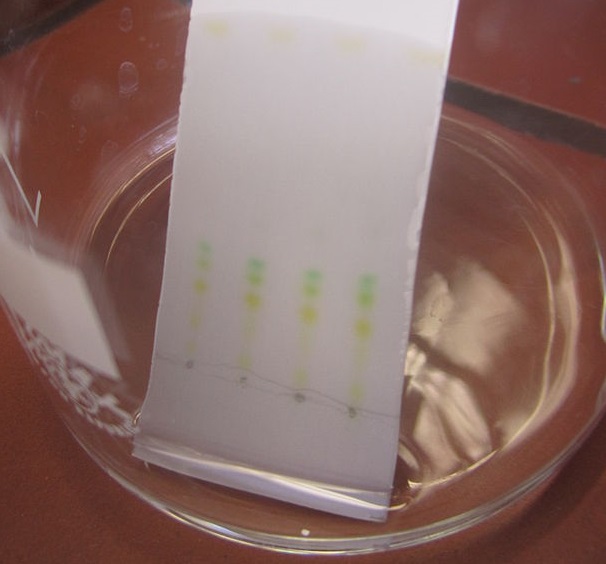

- Sort these pigments into the pigment at the reaction centre and the accessory pigments: carotene, chlorophyll a, chlorophyll b, xanthophyll. (5.6) (2)
- Why should the solvent front be marked in pencil as soon as the plate comes out of the tank? (5.7) (1)
- Phaeophytin is chlorophyll that has lost one part of its molecule. Name that part, and give one reason why phaeophytin appears on a chromatogram. (5.7) (2)
- In core practical 10, a lamp is moved from 10 cm to 30 cm from the pondweed. By what factor does the light intensity change? (5.8) (1)
- Explain why a graph of the rate of photosynthesis against light intensity levels off. (5.8) (2)
Reveal the mark scheme for part 1
1. Sorting (2)
- Reaction centre: chlorophyll a (1)
- Accessory pigments: carotene, chlorophyll b, xanthophyll (1)
2. The solvent front (1)
- The solvent evaporates within seconds, so the front can no longer be seen (1)
3. Phaeophytin (2)
- The magnesium ion (1)
- The leaves were old, or the extract stood too long (1)
- ACCEPT Mg2+
4. The lamp (1)
- It falls to one ninth (1/32) (1)
- ACCEPT divided by 9
5. Levelling off (2)
- Another factor, such as carbon dioxide or temperature, becomes limiting (1)
- So more light no longer raises the rate (1)
- DO NOT ACCEPT photosynthesis has stopped
Part 2: exam-style questions (13 marks) 15 min
Allow about a minute per mark. Use the command word: describe says what happens or what you would do, explain gives reasons, suggest applies what you know to a new situation.
| Pigment | Wavelength absorbed most / nm | Light absorbed at that wavelength / % |
|---|---|---|
| Chlorophyll a | 430 | 84 |
| Chlorophyll b | 455 | 63 |

- 1. The table shows the wavelength that two pigments from a rainforest plant absorb most, and the percentage of light absorbed there.
(a) Calculate how many times more light chlorophyll a absorbs than chlorophyll b, at their maximum absorptions. (5.6) (1) - (b) The rate of photosynthesis of this plant was measured in light of each wavelength from 400 to 700 nm. Describe the shape of the action spectrum you would expect. (5.6) (2)
- 2. Describe the measurements you would take from a chromatogram of leaf pigments, and how you would use them to calculate the Rf value of one pigment. (5.7) (3)
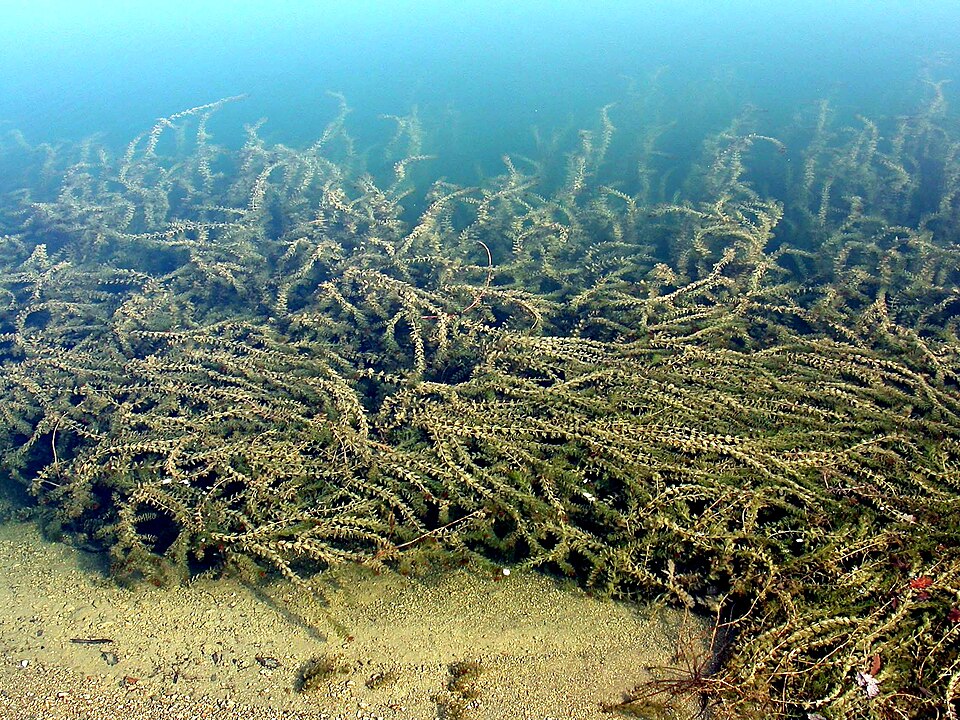
- 3. Cabomba is a water plant. Describe how you could use a photosynthometer to investigate the effect of temperature on the rate of photosynthesis of Cabomba. (5.8) (5)
- 4. Before the main experiment, the student did some preliminary work. Suggest two things this preliminary work should find out. (5.8) (2)
Reveal the mark scheme for part 2
Question 1(a) (1)
- 84 ÷ 63 = 1.33 (1)
- ACCEPT 1.3 or 1.33
- DO NOT ACCEPT 63 ÷ 84
Question 1(b) (2)
- High in blue (about 430 to 460 nm) and in red (about 640 to 680 nm) (1)
- Low, but not zero, in green and yellow (about 500 to 600 nm) (1)
Question 2 (3)
- Distance from the origin to the solvent front (1)
- Distance from the origin to the centre of the spot (1)
- Rf = spot distance ÷ solvent front distance (1)
- ACCEPT measurements in mm or cm
Question 3 (5): max 5
- At least five temperatures, for example 10 to 40 °C, in a water bath (1)
- Leave the plant a few minutes to adjust at each temperature (1)
- Collect gas for a set time; measure its volume with the syringe and scale (1)
- Keep the light intensity (lamp distance) the same (1)
- Keep the carbon dioxide supply (sodium hydrogencarbonate) the same (1)
- Repeat at each temperature and calculate a mean rate (volume ÷ time) (1)
- Max 5
Question 4 (2)
- A lamp distance that gives a volume of gas big enough to measure (1)
- How long the plant needs to adjust, or how long to collect the gas (1)
Part 3: looking back (7 marks) 7 min
Spaced practice from earlier in the unit: chloroplasts (5.5), the light-dependent reactions (5.2, 5.3) and the Calvin cycle (5.4).
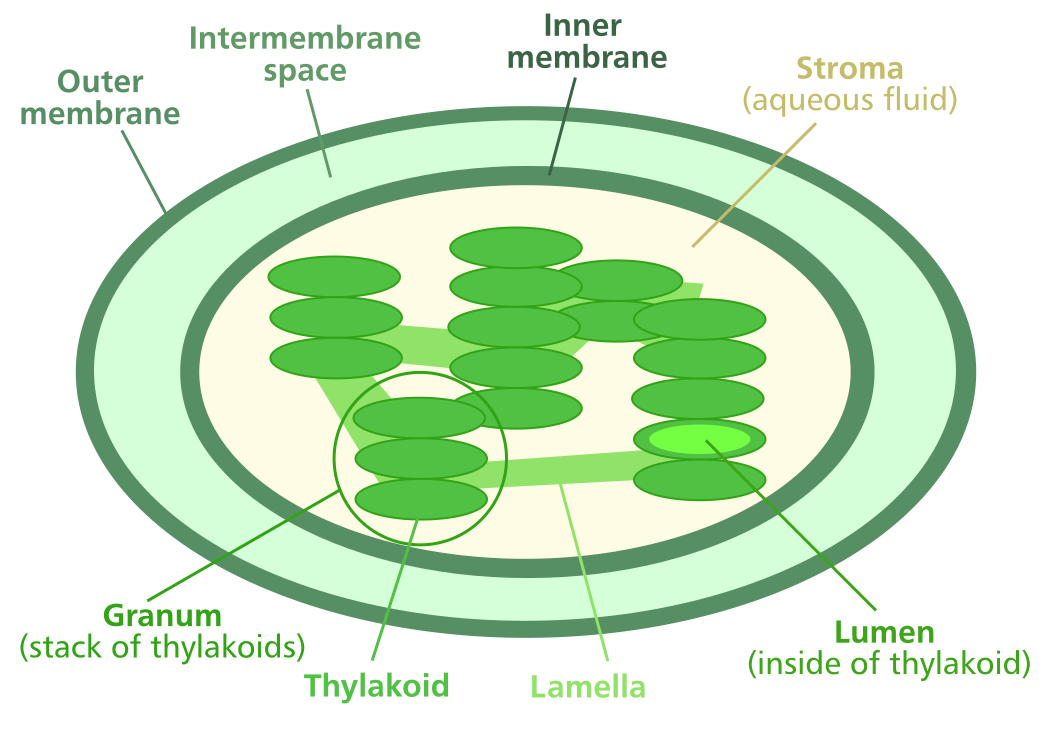

- Look at the diagram of a chloroplast. Give two ways in which the grana are suited to the light-dependent reactions. (5.5) (2)
- Light makes photosystem II lose electrons. Explain why these electrons must be replaced, and say where the replacements come from. (5.3) (2)
- A chloroplast makes 12 molecules of GALP in the Calvin cycle. How many of them are used to regenerate RuBP? (5.4) (1)
- Write a word equation for the hydrolysis of ATP, and say whether energy is released or used. (5.2) (2)
Reveal the mark scheme for part 3
1. The grana (2)
- Stacked thylakoids give a large membrane area for the photosystems and pigments (1)
- The membranes hold the electron carriers and ATP synthase (1)
- ACCEPT the thylakoid space lets hydrogen ions build up into a gradient
2. Replacing electrons (2)
- Otherwise photosystem II could not lose more electrons, so the reactions would stop (1)
- From the photolysis of water (1)
3. Regenerating RuBP (1)
- 10 (five in every six) (1)
4. Hydrolysis of ATP (2)
- ATP + water → ADP + phosphate (Pi) (1)
- Energy is released (1)
- ACCEPT Pi / inorganic phosphate