The Chromozone / IAL Psychology / Topic A Social psychology
Milgram (1963): research into obedience
Share this page with your students: it is all they will see. Students who have joined your class can also open it on their own once the class has moved past this lesson.
Key words
- Volunteer sample
- Participants who choose to take part, for example by answering an advert. It is also called a self-selected sample.
- Confederate
- An actor who works for the researcher and pretends to be a real participant.
- Deception
- Lying to participants or misleading them about the true aim of a study.
- Standardised procedure
- The procedure, instructions, apparatus and conditions are the same for every participant.
- Reliability
- Consistency: research is reliable if repeating it gives the same results.
- Internal validity
- Whether a study measures what it intends to measure, so that the results are caused by the independent variable and not by something else.
- Mundane realism
- How far a research task is like everyday, real-life situations.
- Right to withdraw
- Participants can stop at any time and take their data back.
- Debriefing
- Telling participants the true aim and what happened after the study, and checking they are well.
Starter (5 marks) 5 min
Answer these four recap questions in your notebook:
- Explain how socialisation leads to obedience, according to agency theory. (1.1.1) (2)
- Raven (1965) added a sixth base of power to French and Raven's five. Name it. (1.1.1) (1)
- Give one weakness of explaining behaviour at one level only. (5.4.3) (1)
- Informed consent and the right to withdraw both come under one of the BPS principles. Which one? (1.2.9) (1)
Reveal the starter answers
1. Socialisation (2)
- We learn to obey as we grow up, from parents and then teachers (1)
- We are rewarded for obeying and punished for dissent, so obedience becomes a norm (1)
2. The sixth base of power (1)
- Informational power (1)
3. Reductionism (1)
- It oversimplifies, because behaviour involves several levels at once (1)
4. BPS principle (1)
- Respect (1)
1. Aim and sample
- Aim: to find out whether ordinary people would obey an order to give an innocent person a harmful electric shock.
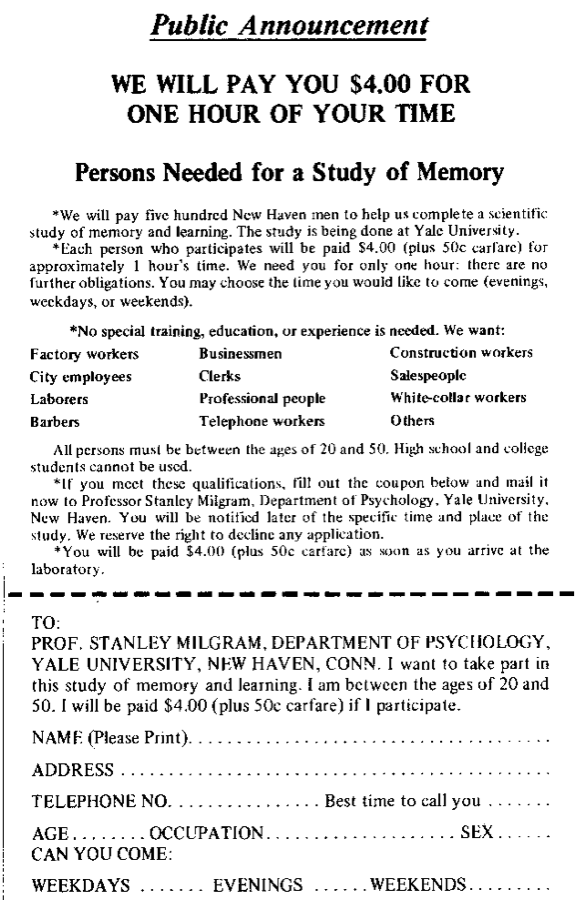
- Sample: 40 men aged 20 to 50 from New Haven, USA, paid $4.50 each. They answered an advert for a study of memory: a volunteer sample.

2. Roles and apparatus
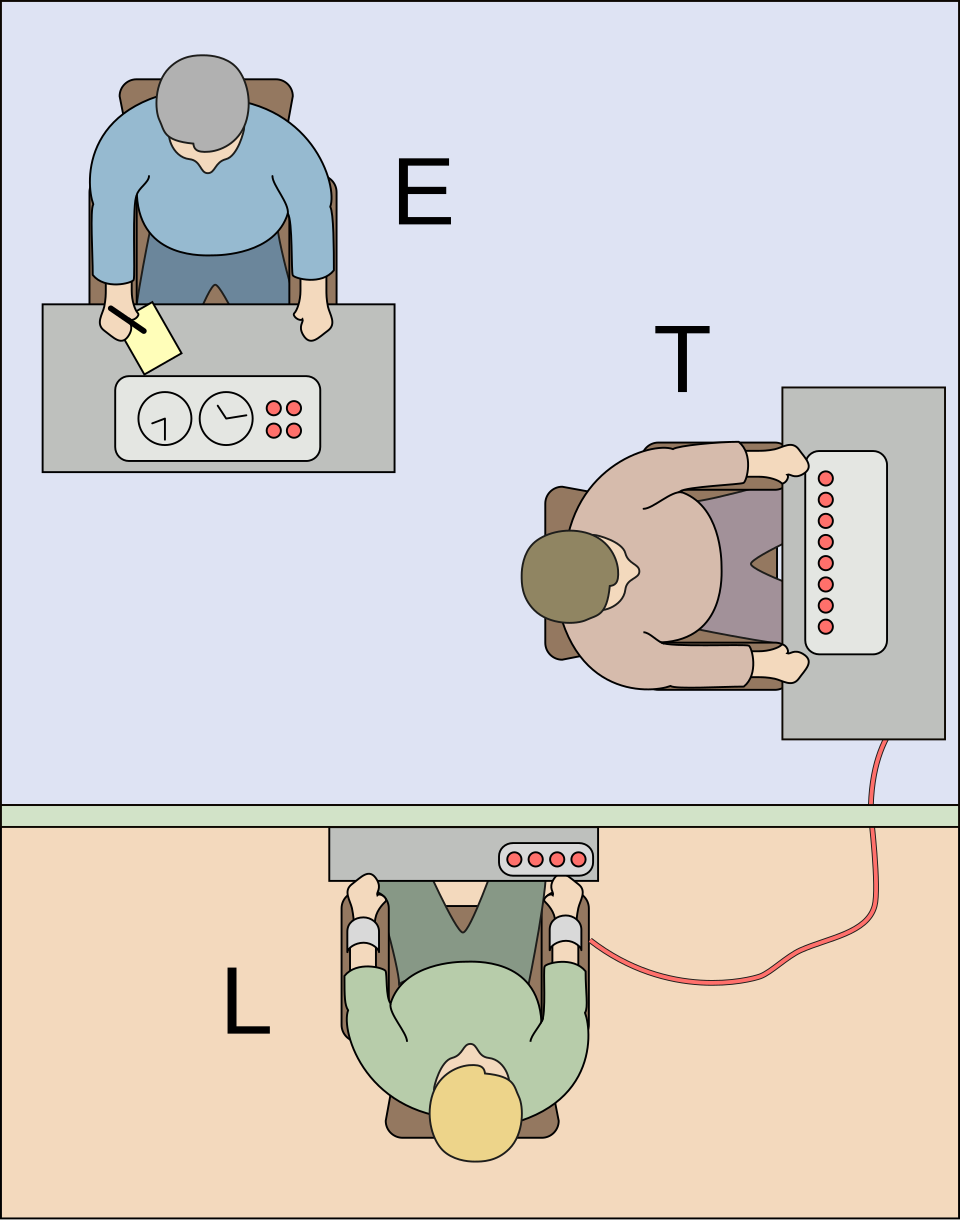
- Roles: a rigged draw made the real participant the teacher. The learner was a confederate.
- Apparatus: a shock generator with 30 switches, from 15 to 450 volts, labelled "Slight Shock" to "XXX". The shocks were fake, but the teacher felt one real 45-volt sample shock.

Spot the lies 2 min
The teachers were told the study was about memory. List four things they were told, or led to believe, that were not true.
Reveal the answers
- The study was about memory and learning: it was about obedience.
- The draw for roles was fair: it was rigged, so the real participant was always the teacher.
- The learner was another volunteer: he was a confederate.
- The learner was being shocked: the shocks were fake, apart from the 45-volt sample.
- These lies are the deception. Milgram said the study needed them to get real behaviour.
3. Procedure: the shocks and the prods
- The teacher read out word pairs and tested the learner. For each wrong answer, or no answer, the teacher gave a shock 15 volts higher.
- At 300 volts the learner pounded on the wall and stopped answering. If the teacher hesitated, the experimenter gave up to four prods, in order.
Class practical: where would you stop? 4 min
Before you start: no talking. Nobody will see your answer, and no names go on it.
- Part A: imagine you are the teacher in the procedure above. On a slip of paper write the band you think you would stop in: A = at or before 150 V, B = 165 to 300 V, C = 315 to 435 V, D = all the way to 450 V.
- Part B: fold the slip. Your teacher collects the slips and writes the four totals on the board.
- Part C: answer in your notebook:
- Which band did most of the class choose?
- Milgram asked colleagues the same question about other people. Most thought hardly anyone would reach the end. Why might people's answers about what they would do be wrong?
- Why did Milgram run an experiment instead of just asking people?
Reveal what most people find
- Part C(a): usually A or B. Very few students expect to go all the way.
- Part C(b): people think they are more independent than they are, and they cannot picture the pressure of the room. They may also want to look good.
- Part C(c): what people say they would do is a poor guide to what they do. Milgram needed to see real behaviour, so he made an experiment.
- Compare the totals with the real result later: 26 of 40 (65%) went all the way to 450 V.
How many went all the way? 3 min
In fact, 65% of Milgram's 40 teachers went all the way to 450 volts.
- Calculate how many teachers went to 450 volts, and how many stopped before. Show your working.
- What percentage of your class chose band D in the practical? Compare it with 65%, in one sentence.
Reveal the answers
- (a) 65% of 40 = 0.65 × 40 = 26 went to 450 V. 40 − 26 = 14 stopped before 450 V.
- (b) Usually far fewer than 65% of a class choose band D. People expect themselves, and others, to stop much earlier than Milgram's teachers did. That surprise is why the study became famous.
4. Findings
- All 40 teachers gave shocks up to 300 volts. 26 (65%) went all the way to 450.
- Many showed extreme tension: sweating, trembling and nervous laughter. Three had seizures.
- Conclusion: ordinary people obey an authority figure, even when ordered to harm an innocent person.
5. Strength: a standardised procedure
- What they did: every teacher had the same generator, the same briefing and the same four prods in the same order. Each wrong answer, or no answer, meant a shock 15 volts higher.
- What they found: all 40 teachers went through this one procedure. All went to 300 volts and 26 (65%) went to 450. Burger (2009) later repeated part of it and found similar obedience.
- Why it is a strength: if the procedure is the same for everyone, a difference in how far teachers went must come from the person, not from a changing procedure. Others can also repeat it. This makes the study reliable.
- Exam point: the study was highly standardised (point). Every teacher had the same generator, briefing and four prods (evidence). So differences in obedience came from the people and the study can be repeated (explain), which makes it reliable (link).
A strength, in the wrong order 3 min
These four sentences make one strong answer. Label each one Point, Evidence, Explain or Link, then put them in order.
- So any difference in how far people went can be put down to the person, not to a changing procedure, which makes the findings reliable.
- This means the study can be repeated and checked, as Burger (2009) did with part of it.
- One strength of Milgram's study is that it was highly standardised.
- Every teacher had the same generator, the same briefing and the same four prods in the same order.
Reveal the answers
- C is the Point: it names the strength.
- D is the Evidence: it gives the details from this study.
- A is the Explain: it says why that makes the study reliable.
- B is the Link: it ties the strength to what it lets us do.
6. Weakness: the experimenter went off script
- What they did: Perry (2013) listened to the recordings Milgram made of his sessions and compared what the experimenter said with the four official prods.
- What they found: the experimenter sometimes added extra lines and pressure beyond the four prods, so some teachers were pushed harder than others.
- Why it weakens the study: a standardised procedure means every teacher gets the same treatment. If some were pushed harder, how far a teacher went may reflect the extra pressure and not the teacher. So the procedure was less standardised than claimed.
- The other side: Burger (2009) repeated part of the study and found similar obedience, which suggests the main finding survives.
- Exam point: the experimenter went off script (point). Perry (2013) found extra lines beyond the four prods in the recordings (evidence). So teachers were not all treated the same (explain), which weakens the study's standardisation and reliability (link).
If you have time (20 marks)
Exam-style questions for when you finish early: about 22 minutes.
1. Milgram ran many variation studies. State two conclusions he made from them. (2)
2. Explain one strength of Milgram's laboratory research into obedience. (2)
3. Milgram recruited his participants with a newspaper advert. Explain one weakness of using a volunteer sample. (2)
4. Describe how Milgram debriefed his participants. (2)
5. Stretch (A/A*). Evaluate Milgram's research into obedience. Describe what he did, then weigh up the strengths, the weaknesses and the ethics. End with a judgement. (12)
Reveal the mark scheme
Question 1 (2)
AO1 (2 marks)
Credit one mark for each accurate conclusion, up to two.
- Obedience falls when the authority figure is not close by (proximity) (1)
- Obedience falls when the authority figure has less prestige or status, or the place has less prestige (1)
Look for other reasonable marking points.
Question 2 (2)
AO1 (1 mark), AO3 (1 mark)
Credit one mark for identifying a strength and one mark for justifying it.
- It used a controlled laboratory, so Milgram could measure a cause and effect, for example the effect of the experimenter's presence on the shock given (1)
- Or: a standardised procedure with the same prods and machine for all 40, which increases reliability (1)
Accept genuine stress as evidence that participants believed the shocks, so internal validity.
Generic answers score 0 marks.
Question 3 (2)
AO1 (1 mark), AO3 (1 mark)
Credit one mark for identifying a weakness and one mark for justifying it.
- Volunteers may be more willing to obey, or more respectful of authority, than people who would not answer an advert (1)
- So the 65% may not apply to the general population: low generalisability (1)
Accept: all the participants were men, so the findings may not apply to women.
Generic answers score 0 marks.
Question 4 (2)
AO1 (2 marks)
Credit one mark for each accurate point.
- Each participant had a friendly meeting with the learner (1)
- Each was told the true aim, and later sent a written report; those who obeyed were told their behaviour was normal (1)
Look for other reasonable marking points.
| AO1 | 40 male volunteers, a rigged draw, a confederate learner, shocks of 15 to 450 V with four prods |
|---|---|
| 100% went to 300 V and 65% to 450 V; many were distressed; three had seizures | |
| Deception about the aim, the draw, the learner and the shocks | |
| The conclusion: ordinary people obey an authority figure, even to harm someone | |
| AO3 | Standardised procedure, so reliable (Burger repeated part of it) |
| Androcentric volunteer sample, so limited generalisability | |
| A lab task lacks mundane realism, but Hofling found obedience in a hospital | |
| The hoax claim and Perry's tapes challenge validity and reliability | |
| Ethics: deception and distress, against the value of the findings; 84% glad | |
| A supported judgement about how far the findings can be trusted |
Perry (2013) also argued that the 65% figure came from one condition: across all the variations, more than half disobeyed.
Equal emphasis needed: knowledge and understanding (AO1) and evaluation and conclusion (AO3).
Look for other reasonable marking points.
| Level | Mark | Descriptor |
|---|---|---|
| 0 | 0 | No rewardable material. |
| 1 | 1-3 | Isolated facts; a generic or limited judgement. |
| 2 | 4-6 | Mostly accurate facts; some evaluation, imbalanced. |
| 3 | 7-9 | Accurate facts; developed evaluation; a judgement that may be imbalanced. |
| 4 | 10-12 | Thorough facts; logical chains of reasoning; competing arguments; a balanced conclusion. |
7. Validity: did they believe the shocks were real?
- The point: critics called the study a "hoax". The shocks were fake, so teachers who guessed this may only have played along.
- Milgram's reply: the teachers' distress was obvious, with sweating, trembling, nervous laughter and three seizures, and most said later that they believed the shocks were real.
- What Perry found: many teachers had doubts about whether the shocks were real.
- Why it weakens the study: a study has internal validity if it measures what it intends to measure, here real obedience. A teacher who doubted the shocks was not obeying an order to hurt someone, so going on shows little. If many doubted, the 65% may overstate real obedience.
- Exam point: participants may not have believed the shocks were real (point). Perry found many had doubts (evidence). Those teachers were not really obeying an order to harm (explain), so the study may lack internal validity (link).
Believer or doubter? 2 min
Mark each remark B (believer) or D (doubter). Which kind of evidence did Milgram rely on?
- "I was shaking. I thought I might be killing him."
- "I kept looking for a hidden camera. It felt staged."
- "I laughed nervously and begged them to stop the test."
- "I knew nobody would let a stranger be hurt at Yale."
Reveal the answers
- Believers: 1 and 3. Their distress looks real.
- Doubters: 2 and 4. They suspected a set-up, so they may not have been obeying "for real".
- Milgram relied on the first kind of evidence. If many were doubters, the study may not have measured real obedience.
8. Generalisability: volunteers and only men
- What they did: Milgram recruited 40 men, aged 20 to 50, from New Haven in the USA. They answered a newspaper advert offering $4.50 for a memory study, so they were a volunteer sample.
- What it means: the sample is androcentric, because it contains no women. Volunteers may also obey more readily than other people.
- Why it weakens the study: the findings come from one kind of person, so we cannot be sure women, or people who would never answer an advert, would obey as much. That limits generalisability.
- Exam point: the sample was biased (point). All 40 were American men who answered an advert (evidence). So women and non-volunteers are missing (explain), and the findings may not apply to everyone (link).
Who answers an advert? 2 min
The advert offered $4.50 for an hour of a memory study at Yale. List three kinds of people who would not have answered it.
Reveal the answers
- Women: Milgram recruited only men.
- People in full-time work or without a spare hour during the day, and people living far from New Haven.
- People who distrust universities or would never answer an advert.
- So the volunteers may not represent everyone: this is sample bias, and it limits generalisability.
9. Mundane realism: shocks in a laboratory
- The point: teachers read word pairs and shocked a stranger in a Yale laboratory. People are not normally ordered to shock a stranger, so the task lacked mundane realism.
- Why it weakens the study: if the task is unlike everyday life, teachers may behave differently from real life, so the findings may not show how people really obey.
- The other side: Hofling et al. (1966) found that 21 of 22 nurses set off to give a drug dose too high on an unknown doctor's phone order in a real hospital.
- Exam point: the task lacked mundane realism (point). Ordering people to shock a stranger is not an everyday event (evidence). So behaviour in the laboratory may differ from real life (explain), which limits what the findings show about real obedience (link).


Lab or hospital? 2 min
For Milgram and for Hofling, write the setting, who gave the order and who could have been harmed. Which is closer to real life?
Reveal the answers
- Milgram: a Yale laboratory; a scientist gave the orders; a stranger (the learner) seemed to be hurt.
- Hofling: a real hospital; an unknown doctor gave the order by phone; a patient could have been given too much of a drug.
- Hofling is closer to real life: ordinary people take orders at work, but nobody is ordered to shock a stranger.
10. Ethics: deception and harm
- What they did: participants were told the study was about memory and learning. They were deceived about the aim, the draw for roles, the learner and the shocks.
- What they found: many teachers showed extreme tension, with sweating, trembling and nervous laughter, and three had seizures.
- The argument: Baumrind (1964) said the stress was deliberate and severe. Milgram said he had not expected it, that the deception was needed to get real behaviour (it prevented demand characteristics), and that 84% later said they were glad they took part.
- Why it matters: deception means participants could not give informed consent, and distress breaks the rule of protection from harm.
- Exam point: the study used deception and caused distress (point). Teachers were told it was about memory and three had seizures (evidence). They could not consent fully and were harmed (explain), but Milgram argued the deception was needed and 84% were glad they took part (link).
Costs against benefits 3 min
Make two lists: what Milgram's participants went through, and what psychology learned. Then write one sentence judging which side is heavier, and why.
Reveal the answers
- Costs: stress, trembling, three seizures, lies told to participants.
- Benefits: we learned how far ordinary people obey, which helps explain real atrocities.
- Milgram: 84% were glad they took part. Baumrind: the stress was deliberate and severe. A good judgement says which side outweighs the other and why.
11. Ethics: the right to withdraw and the debrief
- What they did: participants were told at the start that they could stop. But when a teacher hesitated, the experimenter gave up to four prods, and prod 4 said "You have no other choice, you must go on."
- Why it is an ethical problem: the right to withdraw only counts if people can use it. The prods made stopping hard, although 35% still stopped before 450 volts. Milgram said the prods were needed to test obedience.
- The debrief: each participant met the learner in a friendly way, and a written report followed. Those who had obeyed were told their behaviour was normal.
- Exam point: the right to withdraw was given but undermined (point). The prods challenged any teacher who tried to stop (evidence). So withdrawing was very hard in practice (explain), although the debrief reduced the harm afterwards (link).
Rewrite prod 4 2 min
Prod 4 was "You have no other choice, you must go on." Rewrite it so the experiment still pushes the teacher on but respects the right to withdraw. What happens to obedience?
Reveal the answers
- Example: "You may stop at any time. I would like you to carry on, but it is your choice."
- The aim stays the same, because the teacher is still pushed to continue. But the prod no longer overrides the right to withdraw.
- Strong answers say that this would probably lower the obedience rate, which is the trade-off.
Common misconceptions and exam errors
- Vague results. "It fell to 20%" is not enough. Say what the 65% baseline was and that 450 volts is the measure.
- Generic strengths. "It was a laboratory experiment" could be said of any study. Use Milgram's own details: the same prods, the same machine.
- Naming an ethical issue and stopping. Justify it with what happened in Milgram's study.
Exam-style question: ethical issues (6 marks) 7 min
Explain three ethical issues with Milgram's (1963) research into obedience. (6)
Reveal the mark scheme
Mark scheme (6)
AO1 (3 marks), AO3 (3 marks)
Credit one mark for each accurate description of an ethical issue in Milgram's (1963) study and one mark for each justification; credit up to three issues.
- Right to withdraw: it was given at the start (1)
- but the verbal prods made it very hard to stop in practice (1)
- Deception: participants were told the study was about memory and learning, not obedience (1)
- it was needed to prevent demand characteristics and get valid data on obedience (1)
- Psychological harm: many were severely distressed, with sweating, trembling and seizures (1)
- after the debrief most were glad they took part (84%), so Milgram argued the harm was justified (1)
Accept informed consent, protection from harm or lack of a full debrief if justified. Max 6.
Generic answers score 0 marks.
Look for other reasonable marking points.
Checklist: by the end of this lesson I can
- Describe the sample, roles, apparatus, prods and findings of Milgram's study.
- Say why the study was reliable, and how Perry challenged that.
- Explain the hoax claim and why it matters for validity.
- Give two limits of the sample and of mundane realism.
- Explain three ethical issues, with how Milgram justified each.
Plenary: RAG self-assessment 2 min
Rate each goal red, amber or green in your notebook.
- I can describe the aim, procedure and findings of Milgram's (1963) study.
- I can evaluate its reliability, validity and sample.
- I can explain the ethical issues and how Milgram justified them.
- Red: I cannot do this yet without my notes.
- Amber: I can do most of it, but I mix up some details or percentages.
- Green: I can do it in an exam answer.
Past paper practice
Each link opens the paper on Pearson's own website, where past papers are free to download. Try the question, then check your answer with the mark scheme.
- January 2022, question 5 Discuss, using Milgram's (1963) research, why a student obeys in some places and not others, with reference to the context (8 marks). Question paperMark scheme
- June 2021, question 10 Evaluate Milgram's research into obedience (12 marks). Question paperMark scheme
- January 2019, question 2 Explain three strengths of Milgram's laboratory research at Yale (6 marks). Question paperMark scheme
- October 2016, question 2(a) Explain three ethical issues with Milgram's original obedience study (6 marks). Question paperMark scheme
Papers and mark schemes © Pearson Education Ltd, hosted by Pearson. We only point to them.