The Chromozone / Courses / IGCSE Co-ordinated Sciences / Biology / B3 Movement into and out of cells
Cambridge IGCSE Co-ordinated Sciences (0654) · Biology · B3 Movement into and out of cells · Revision summary
Revision summary: movement into and out of cells (B3.1 to B3.3)
One screen per syllabus point for B3: the key words, the key ideas as a table and a picture, and a 2-minute "spot the mistakes" check that you mark yourself. Then a list of common exam errors and a self-check of 18 marks (Core 14). Boxes and questions marked "Extended only" are for Extended students; Core students skip them. Type your self-check answers in the boxes and hand them in at the bottom of the page; the mark scheme opens after you hand in. It takes about 40 minutes and you need a calculator. Use it after the active transport lesson, before the B3 end-of-unit test. Teachers: this is the page to set as homework before the test.
Teach these first
This revision summary covers these lessons. Teach them before students start here:
- B3.1 Diffusion into and out of cells
- B3.1 Diffusion and temperature: the beetroot practical
- B3.1 Diffusion: concentration gradient, distance and surface area
- B3.2 Osmosis
- B3.2 Osmosis in plant and animal cells
- B3.2 Investigating osmosis: the practical (lesson 1 of 2)
- B3.2 Investigating osmosis: results and conclusions (lesson 2 of 2)
- B3.3 Active transport
B3.1 key words
- Diffusion
- The net movement of particles from a region of their higher concentration to a region of their lower concentration (down a concentration gradient), as a result of their random movement.
- Concentration gradient
- A difference in concentration between two regions. Particles diffuse down it, from higher to lower.
- Random movement
- Movement in any direction, which changes each time a particle hits another particle.
- Net movement
- The overall movement in one direction, once all the movements of the particles are added together.
- Partially permeable
- Lets some substances pass through but not others, like the cell membrane.
- Solute
- A substance that is dissolved in a liquid, such as glucose dissolved in water.
B3.1 Diffusion into and out of cells
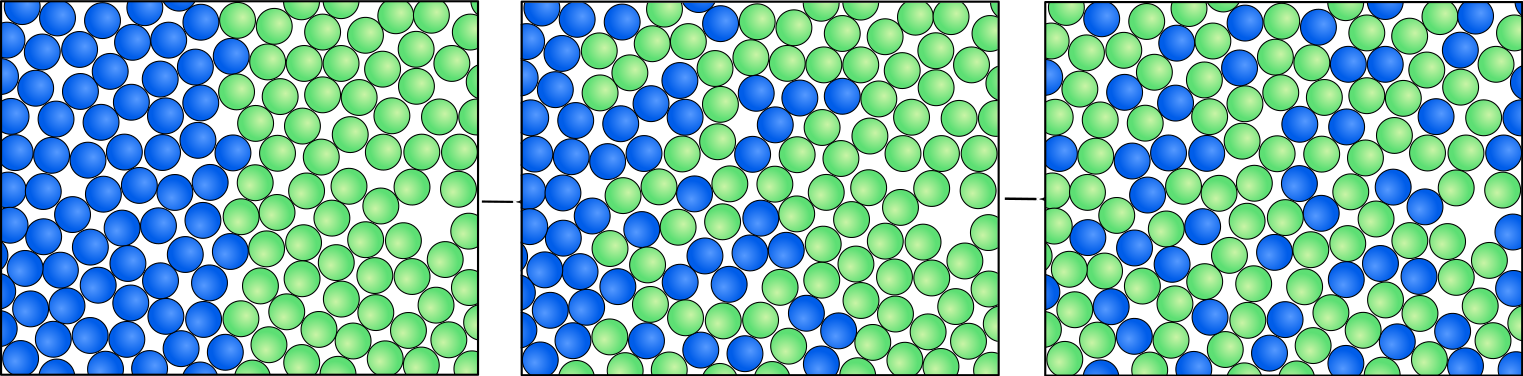

- Diffusion needs no energy from the cell. The particles move by themselves.
- Small particles (oxygen, carbon dioxide, water, glucose) cross the cell membrane. Large particles (proteins, starch) cannot.
| Where | What diffuses | From → to |
|---|---|---|
| lungs (air sacs) | oxygen | air → blood |
| lungs (air sacs) | carbon dioxide | blood → air |
| body cells | oxygen and glucose, for respiration | blood → cells |
| body cells | carbon dioxide from respiration | cells → blood |
| liver | urea (a waste) | liver cells → blood |
Check B3.1: spot the mistakes (2 marks) 2 min
A student wrote this. Find each mistake and correct it. (2)
"Oxygen moves from the blood into a brain cell because the cell pulls it in. Proteins also diffuse out of cells through the cell membrane."
Reveal the corrections
- There is a net movement of oxygen down its concentration gradient (higher in the blood, lower in the respiring cell), caused by random movement: nothing pulls it (1)
- Proteins are too large to pass through the cell membrane (1)
B3.1 Investigating diffusion
In the beetroot practical, red pigment diffused out of beetroot cubes into water at two temperatures. In the agar practical, acid diffused into agar cubes of different sizes.
- Independent variable: the one you change (temperature; cube size).
- Dependent variable: the one you measure (colour of the water; time to turn red).
- Controlled variables: the ones you keep the same, such as cube size, volume of liquid and time, for a fair test.
- Accurate results are close to the true value. Repeatable results are similar when you do the test again.
B3.1 key words: the speed of diffusion Extended only
- Rate of diffusion
- How quickly diffusion happens: how many particles have a net movement in a given time.
- Kinetic energy
- The energy a particle has because it is moving.
- Diffusion distance
- How far the particles have to travel.
- Surface area to volume ratio
- The surface area divided by the volume. A small object has a larger ratio than a large object of the same shape.
B3.1 Four factors that change the rate of diffusion Extended only
| Factor | Faster when | Why |
|---|---|---|
| temperature | higher | particles have more kinetic energy and move faster |
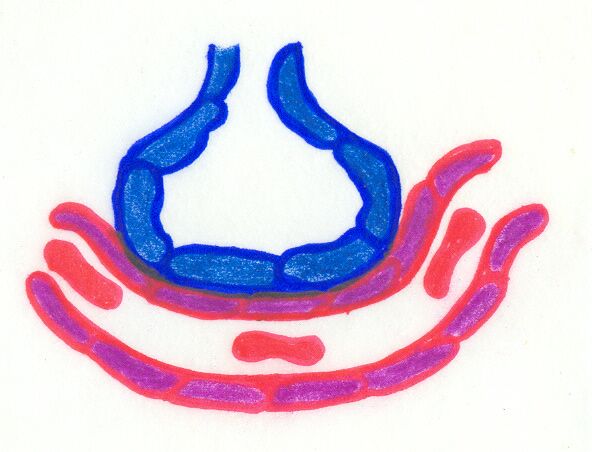
| concentration gradient | steeper (a bigger difference) | more particles move down it in the same time |
| distance | shorter | particles have less far to travel, e.g. walls one cell thick |
| surface area | larger (a larger surface area to volume ratio) | more particles cross at the same time |

Check B3.1: spot the mistakes (2 marks) Extended only 2 min
A student wrote this. Find each mistake and correct it. (2)
"Diffusion is faster when it is cold, because the particles are closer together. A small cell has a smaller surface area to volume ratio than a large cell, so it takes longer to fill with oxygen."
Reveal the corrections
- Diffusion is faster at a higher temperature: the particles have more kinetic energy and move faster (1)
- A small cell has a larger surface area to volume ratio, so diffusion reaches all of it faster (1)
B3.2 key words
- Solute
- A substance that dissolves in a liquid, for example sugar or salt.
- Solvent
- The liquid that a solute dissolves in. In living things, the solvent is water.
- Solution
- A solute dissolved in a solvent.
- Concentrated solution
- A solution with a lot of solute in it, and so less water.
- Dilute solution
- A solution with only a little solute in it, and so more water.
- Partially permeable membrane
- A membrane that lets small molecules, such as water, through, but not larger molecules, such as sugar.
- Osmosis
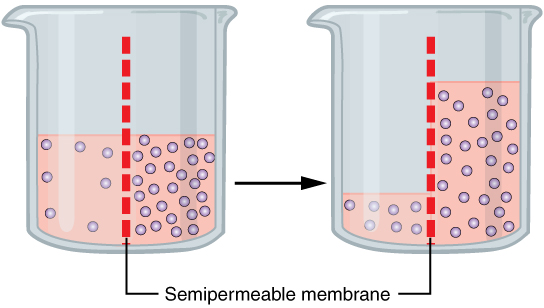
- The net movement of water molecules from a dilute solution to a more concentrated solution, through a partially permeable membrane.
B3.2 Osmosis
- Osmosis is the diffusion of water. The solute particles are too big to cross the membrane.
- The net movement of water is from the dilute solution (more water) to the concentrated solution (less water).
- Water moves into and out of cells by osmosis through the cell membrane.

B3.2 key words: water potential Extended only
- Water potential
- A measure of how freely water can move out of a solution. A dilute solution has a high water potential; a concentrated solution has a low one. Pure water has the highest.
- Osmosis (Extended definition)
- The net movement of water molecules from a region of higher water potential (dilute solution) to a region of lower water potential (concentrated solution), through a partially permeable membrane.
Check B3.2: spot the mistakes (2 marks) 2 min
A student wrote this. Find each mistake and correct it. (2)
"A partially permeable membrane lets every kind of molecule through, only more slowly. In a plant cell, the cell wall is the partially permeable membrane."
Reveal the corrections
- It lets small molecules, such as water, through, but not larger ones, such as sugar (1)
- The cell membrane is partially permeable; the cell wall is fully permeable (water and dissolved substances pass straight through) (1)
B3.2 Osmosis in animal and plant cells
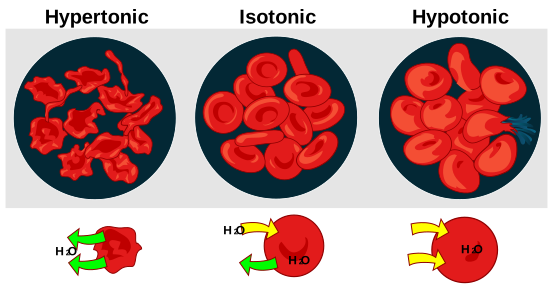
| Solution outside the cell | Red blood cell (no cell wall) | Plant cell (cell wall) |
|---|---|---|
| more dilute, e.g. pure water | water moves in: it swells and bursts | water moves in: it swells and becomes firm, but the cell wall stops it bursting |
| same concentration as the cytoplasm | no net movement: no change | no net movement: no change |
| more concentrated, e.g. strong salt solution | water moves out: it shrinks and crinkles | water moves out: it becomes soft; the cell membrane may pull away from the wall |

B3.2 Investigating osmosis in plant tissue
Put cubes of potato in a range of salt or sugar solutions. Blot and weigh each cube before and after. Work out:
- A gain in mass: the solution was more dilute than the cells, so water moved in. A loss (keep the minus sign): it was more concentrated, so water moved out.
- Plot percentage change against concentration. Where the line crosses zero, the solution has the same concentration as the cells.
Check B3.2: spot the mistakes (2 marks) 2 min
A student wrote this. Find each mistake and correct it. (2)
"A potato cube went from 2.50 g to 2.30 g. So the percentage change in mass is 0.20 ÷ 2.30 × 100 = +8.7%."
Reveal the corrections
- Divide by the starting mass: 0.20 ÷ 2.50 × 100 = 8.0% (1)
- The cube lost mass, so the answer is −8.0% (1)
B3.2 key words: plant cells Extended only
- Turgid
- Describes a plant cell that is swollen and firm because it has taken in water by osmosis.
- Turgor pressure
- The pressure of the cell contents pushing outwards on the cell wall.
- Flaccid
- Describes a plant cell that has lost water and become soft, with little or no turgor pressure.
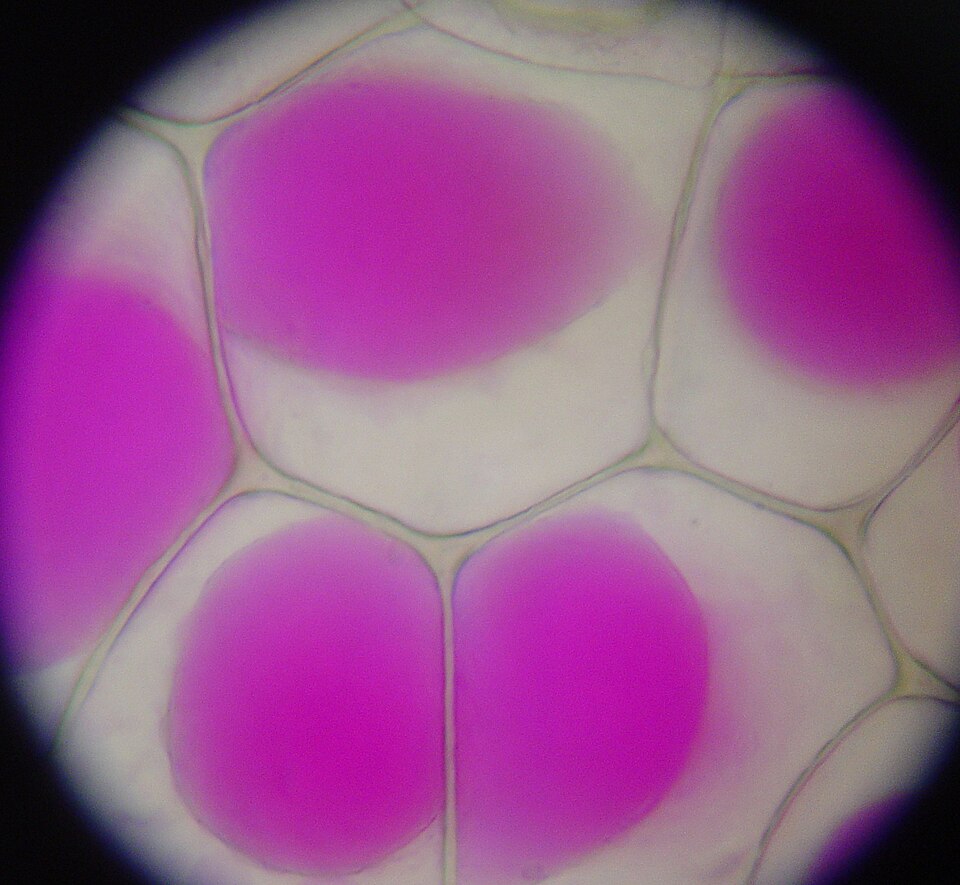
- Plasmolysis
- When a plant cell loses so much water that the cell membrane and cytoplasm pull away from the cell wall.
B3.2 Turgor, plasmolysis and why water potential matters Extended only
- In a solution with a higher water potential, water enters the vacuole by osmosis. The contents push on the wall (turgor pressure) and the cell becomes turgid. Turgid cells support stems and hold leaves out flat.
- In a solution with a lower water potential, water leaves. The cell becomes flaccid and the plant wilts. If it loses even more, plasmolysis happens.
- Roots take in water because soil water has a higher water potential than root hair cells. Seawater or too much fertiliser stops this.
- Blood plasma has about the same water potential as body cells, so cells neither swell nor shrink.

Check B3.2: spot the mistakes (2 marks) Extended only 2 min
A student wrote this. Find each mistake and correct it. (2)
"A plasmolysed cell has burst because too much water went in. Turgid cells make a plant wilt."
Reveal the corrections
- A plasmolysed cell has lost water: its membrane and cytoplasm have pulled away from the wall (1)
- Turgid cells support the plant; flaccid cells make it wilt (1)
B3.3 key words
- Active transport
- The movement of particles through a cell membrane from a region of lower concentration to a region of higher concentration (against a concentration gradient), using energy from respiration.
- Against a concentration gradient
- From a region of lower concentration to a region of higher concentration.
- Down a concentration gradient
- From a region of higher concentration to a region of lower concentration.
B3.3 Three ways in and out of cells
| Diffusion | Osmosis | Active transport | |
|---|---|---|---|
| what moves | particles of gases and solutes | water | particles such as mineral ions or glucose |
| direction | down a concentration gradient | dilute → concentrated solution | against a concentration gradient |
| energy from respiration? | no (passive) | no (passive) | yes |
| needs a membrane? | no, but it can cross one | yes: partially permeable | yes: the cell membrane |
B3.3 Why active transport matters Extended only
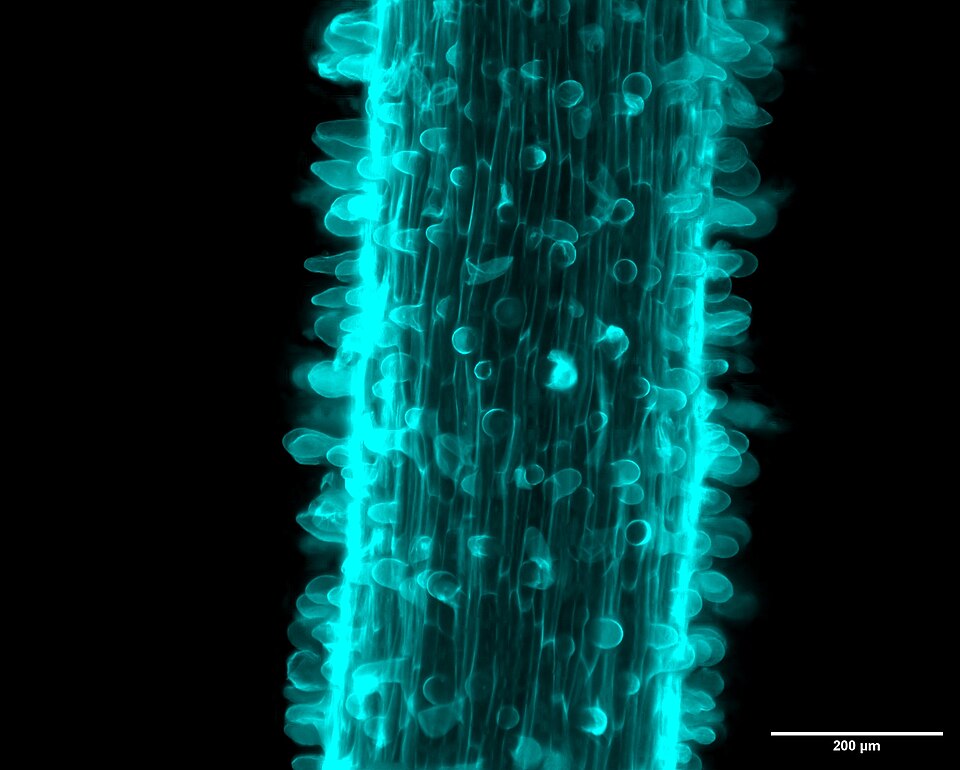
- Soil water has a lower concentration of mineral ions (such as nitrate) than root hair cells. By diffusion, the ions would leave the root. Root hair cells take them in by active transport.
- The energy comes from respiration, which needs oxygen. In waterlogged soil, roots respire less and take in fewer ions.
- When the small intestine holds less glucose than its lining cells, the cells still take it in by active transport.

Check B3.3: spot the mistakes (2 marks) 2 min
A student wrote this. Find each mistake and correct it. (2)
"Active transport works in dead cells too, as long as there is a concentration gradient. Root hair cells take in water by active transport."
Reveal the corrections
- Active transport needs energy from respiration, so only living, respiring cells can do it (1)
- Water enters root hair cells by osmosis; active transport moves particles such as mineral ions (1)
Common misconceptions and exam errors
- B3.1 "The particles want to spread out." Particles move at random; the net movement is down the concentration gradient.
- B3.1 "Diffusion stops when the particles are evenly spread." The particles keep moving: only the net movement stops.
- B3.1 Extended only Saying a small cell has a small surface area to volume ratio: it is large.
- B3.2 Saying that salt or sugar moves in osmosis. In osmosis only water moves, through a partially permeable membrane.
- B3.2 Saying plant cells burst in pure water. The cell wall stops them; only animal cells, such as red blood cells, burst.
- B3.2 Dropping the minus sign for a loss in mass, or dividing by the final mass instead of the starting mass.
- B3.3 Forgetting that active transport needs energy from respiration, and so oxygen.
Self-check: B3.1 to B3.3 (18 marks, Core 14) 18 min
Answer without your notes, then hand in. The syllabus section is in brackets after each question. You need a calculator.
S1. A frog sitting under water takes in oxygen through its thin, moist skin. The oxygen passes from the water into the blood in the skin.
S1(a). Name the process that moves the oxygen into the blood, and explain why the oxygen moves in this direction. (B3.1) (2)
S1(b). Extended only The Lake Titicaca frog lives in a cold, deep lake in South America. Its skin hangs in large, loose folds. Explain how these folds help the frog to take in enough oxygen. (B3.1) (2)
S2. A student puts some dried apricots in a beaker of water and weighs them every few minutes. The inside of a dried apricot is a very concentrated sugar solution.
S2(a). Describe how the mass of the apricots changes. Use data from the table. (B3.2) (2)
| Time / min | 0 | 10 | 20 | 40 | 60 |
|---|---|---|---|---|---|
| Mass / g | 6.0 | 6.6 | 7.1 | 7.7 | 7.9 |
S2(b). Calculate the percentage increase in the mass of the apricots after 60 minutes. Give your answer to the nearest whole number. (B3.2) (2)
S2(c). Explain why the mass of the apricots increases. (B3.2) (2)
S2(d). Extended only Use the idea of water potential to suggest why the mass increases more slowly after 40 minutes. (B3.2) (2)
S3. Some mangrove trees grow in salty water on the coast. Special cells in their leaves move salt out of the leaf onto the leaf surface, where the salt is already more concentrated. White salt crystals form on the leaves.
S3(a). Name the process that moves the salt out of the leaf cells, and state where the cells get the energy for it. (B3.3) (2)
S3(b). Describe how the salt moves, compared with the concentration gradient. Use the information above. (B3.3) (2)
S4. Give two differences between osmosis and active transport. (B3.2, B3.3) (2)
Mark scheme for the self-check
S1(a) (2)
- Diffusion (1)
- The concentration of oxygen is higher in the water than in the blood, so there is a net movement down the concentration gradient (1)
S1(b) (2)
- The folds give the skin a larger surface area (1)
- So more oxygen diffuses into the blood at the same time (a faster rate of diffusion) (1)
- Accept: thin skin gives a short diffusion distance, as a second point only if surface area is given.
S2(a) (2)
- The mass increases, quickly at first and then more slowly (levels off) (1)
- Data quoted with units, e.g. from 6.0 g to 7.1 g in the first 20 minutes, but only 0.2 g more from 40 to 60 minutes (1)
S2(b) (2)
- (7.9 − 6.0) ÷ 6.0 × 100 (1)
- = 32% (1)
- Correct answer with no working: 2 marks. 31.7% gets 2 marks.
S2(c) (2)
- Water moves into the apricot (cells) by osmosis (1)
- from the dilute solution (water) outside to the concentrated sugar solution inside, through partially permeable membranes (1)
- Max 2. Do not accept "sugar moves out" as the reason for the gain.
S2(d) (2)
- As water moves in, the water potential inside the apricot rises (the sugar solution becomes more dilute) (1)
- So the difference in water potential is smaller, and the net movement of water is slower (1)
- Accept: the cells become turgid, and the cell walls push back.
S3(a) (2)
- Active transport (1)
- The energy comes from respiration (in the leaf cells) (1)
- Do not accept "from the Sun" or "from photosynthesis".
S3(b) (2)
- From a region of lower salt concentration (inside the cells) to a region of higher concentration (the leaf surface) (1)
- So it moves against the concentration gradient (1)
S4 (2)
- Osmosis moves only water; active transport moves other particles, such as ions (1)
- Osmosis is passive / uses no energy; active transport uses energy from respiration (1)
- Osmosis goes from a dilute to a concentrated solution (down a gradient); active transport goes against a concentration gradient (1)
- Max 2. Each mark needs both sides of the difference.