The Chromozone / Courses / IGCSE Co-ordinated Sciences / Chemistry / C1 States of matter
Cambridge IGCSE Co-ordinated Sciences (0654) · Chemistry · C1 States of matter · Revision summary
Revision summary: C1 States of matter
One screen for each part of the C1 syllabus: the key words, the key ideas as a table or a picture, the Extended ideas in their own boxes, and a 2-minute "spot the mistakes" check that you mark yourself. Then a list of common exam errors and a self-check of 20 marks (Core 13): Core students skip the boxes and questions marked Extended only. Type your self-check answers in the boxes and hand them in at the bottom of the page; the mark scheme opens after you hand in. It takes about 40 minutes. Use it after the last C1 lesson (Diffusion), before the C1 end-of-unit test. Teachers: this is the page to set as homework before the test.
Teach these first
This revision summary covers these lessons. Teach them before students start here:
C1.1 key words: the three states
- Solid
- Has a fixed shape and a fixed volume.
- Liquid
- Has a fixed volume, but flows and takes the shape of its container.
- Gas
- Has no fixed shape and no fixed volume: it spreads out to fill its whole container.
- Kinetic particle theory
- All matter is made of tiny particles that are always moving.
C1.1 Solids, liquids and gases: properties and particles
| Solid | Liquid | Gas | |
|---|---|---|---|
| Shape | fixed | takes the shape of its container | fills the whole container |
| Volume | fixed | fixed | not fixed |
| Can it be compressed? | no | hardly at all | yes, easily |
| Separation | touching | touching (close together) | far apart |
| Arrangement | regular pattern | random | random |
| Motion | vibrate about fixed positions | slide past each other | move quickly in all directions |
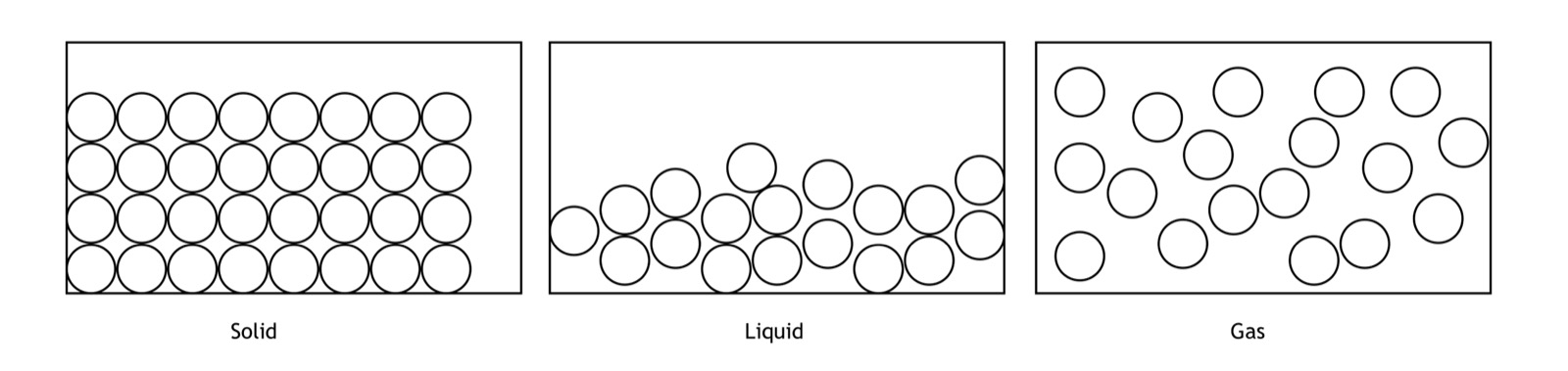

Why the particles explain the properties Extended only
- A solid keeps its shape because its particles are held in fixed positions by strong forces of attraction.
- A liquid flows because its particles can slide past each other; it keeps its volume because they stay touching.
- A gas can be compressed because there are big spaces between its particles, which can be made smaller.
Check C1.1: spot the mistakes (2 marks) 2 min
A student wrote this in her revision notes. Find the two mistakes and correct them. (2)
"In a solid the particles do not move at all. In a gas the particles are close together, but they move quickly."
Reveal the corrections
- The particles in a solid vibrate about fixed positions (1)
- The particles in a gas are far apart (1)
C1.1 key words: changes of state
- Melting
- A solid changing into a liquid.
- Freezing
- A liquid changing into a solid.
- Boiling
- A liquid changing into a gas all through the liquid, with bubbles, at its boiling point.
- Evaporating
- A liquid changing into a gas at its surface only, below its boiling point.
- Condensing
- A gas changing into a liquid.
- Melting point and boiling point
- The temperatures at which a substance melts and boils. Pure water: 0 °C and 100 °C (at standard atmospheric pressure).
C1.1 Changes of state, and checking purity
- Heating makes particles move faster. Melting and boiling need energy; freezing and condensing give energy out.
- While a pure substance melts or boils, its temperature stays the same until the change is finished.
- To find the state at a temperature: below the melting point it is a solid; between the melting and boiling points a liquid; above the boiling point a gas.
- Purity: a pure substance melts and boils at one exact temperature. An impurity lowers the melting point, raises the boiling point, and makes the substance melt over a range of temperatures.
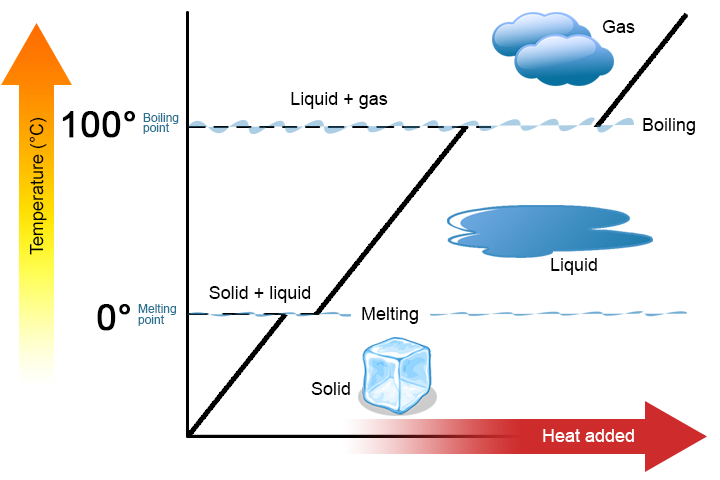

Explaining heating and cooling curves Extended only
- Sloping sections: the energy makes the particles move faster, so the temperature rises.
- Flat sections (melting, boiling): the energy is used to overcome the forces of attraction between the particles, not to make them move faster, so the temperature stays the same.
- Boiling takes longer than melting because the particles must be separated completely, which needs more energy.
- On a cooling curve the flat sections are condensing and freezing: energy is given out as the forces of attraction form, so the temperature stays the same.
Check C1.1: spot the mistakes (2 marks) 2 min
A student wrote this in her revision notes. Find the two mistakes and correct them. (2)
"Water only evaporates when it reaches 100 °C. While water boils, its temperature keeps going up."
Reveal the corrections
- Evaporating happens at the surface at any temperature below the boiling point (1)
- While water boils, its temperature stays at 100 °C (the boiling point) (1)
C1.1 key words: the volume of a gas
- Pressure
- The force acting on each unit of area of a surface. A gas pushes on every surface it touches.
- Gas pressure
- Caused by gas particles colliding with the walls of their container.
C1.1 Temperature, pressure and the volume of a gas
| Change | Kept the same | Volume of the gas |
|---|---|---|
| temperature goes up | pressure | increases (the gas expands) |
| temperature goes down | pressure | decreases (the gas contracts) |
| pressure goes up | temperature | decreases |
| pressure goes down | temperature | increases |
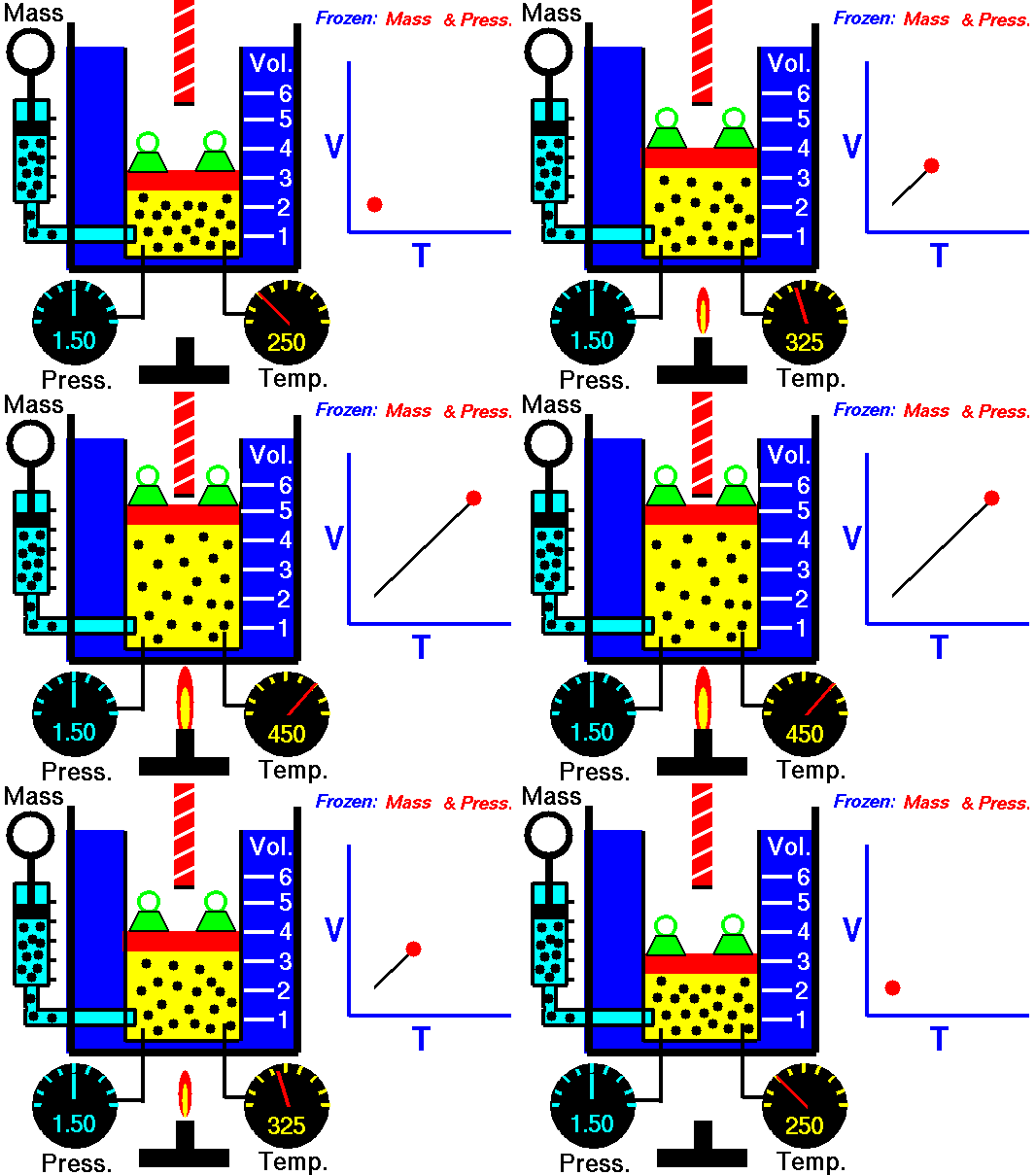

The explanation, using particles Extended only
- Hotter: the particles gain kinetic energy and move faster. They hit the walls harder and more often, so the gas pushes outwards and expands until the pressure is the same as outside.
- Higher pressure: the gas is pushed into a smaller space, so the particles are closer together and hit the walls more often. The volume gets smaller until the gas pushes back with the same pressure.
- The particles themselves never get bigger or smaller: only the spaces between them change.
Check C1.1: spot the mistakes (2 marks) 2 min
A student wrote this in her revision notes. Find the two mistakes and correct them. (2)
"When a gas is heated at constant pressure, its particles expand, so the gas takes up more space. Squeezing a gas harder makes its volume bigger."
Reveal the corrections
- The particles stay the same size: they move faster and the spaces between them get bigger (1)
- A higher pressure makes the volume of the gas smaller (1)
C1.2 key words: diffusion
- Diffusion
- The net movement of particles from a region of their higher concentration to a region of their lower concentration, as a result of their random movement.
- Concentration gradient
- A difference in concentration between two regions. Particles diffuse down a concentration gradient.
C1.2 Diffusion
- Particles move at random and keep colliding. More of them move out of a crowded region than into it, so they spread out.
- When they are evenly spread, the particles still move, but there is no net movement any more.
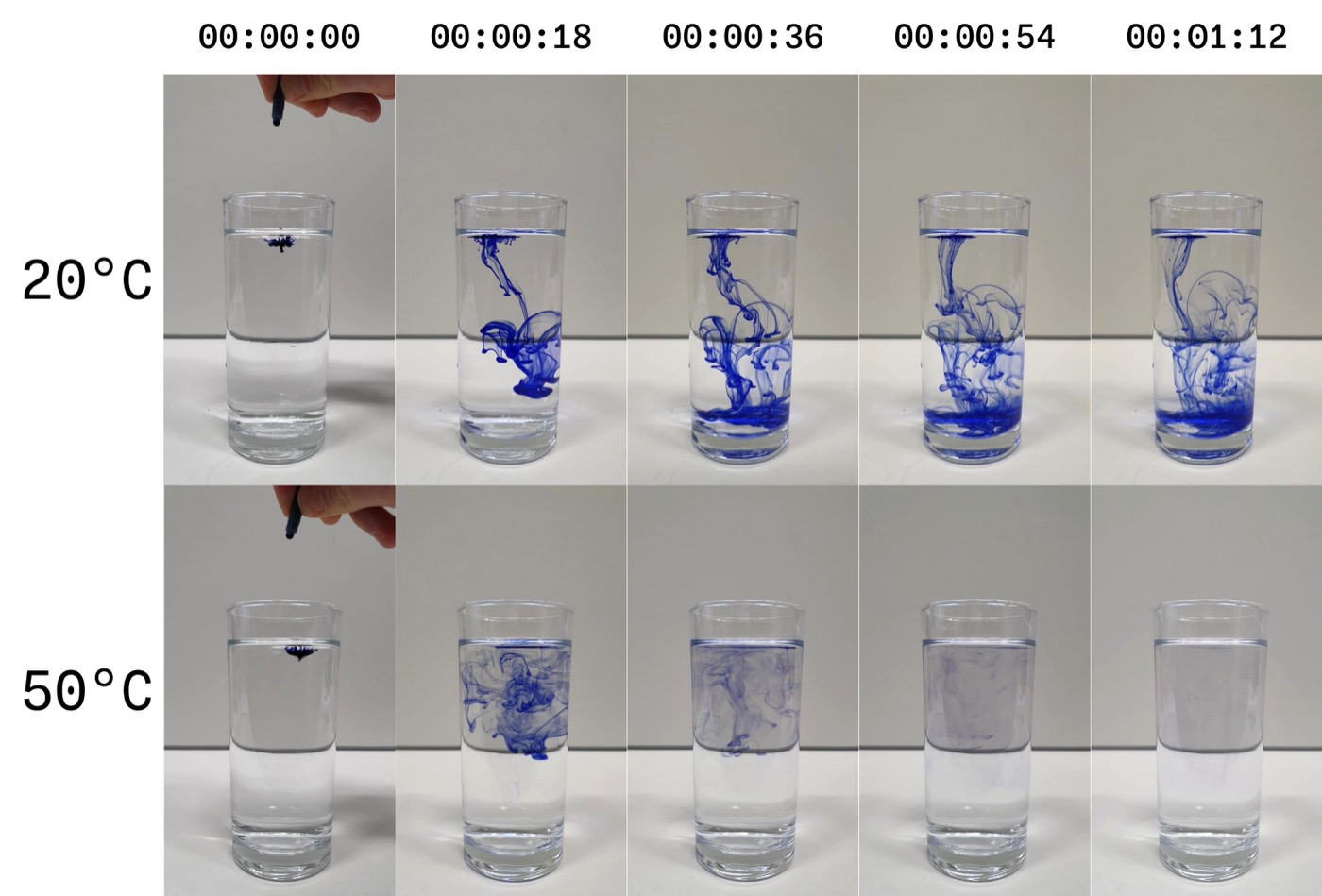
- Gases diffuse much faster than liquids: gas particles are far apart and move quickly; liquid particles are close together and keep colliding.
- Diffusion is faster at a higher temperature, because the particles move faster.

C1.2 key word Extended only
- Relative molecular mass (Mr)
- A number that compares the mass of one molecule with the mass of other molecules. A bigger Mr means a heavier molecule.
Lighter gases diffuse faster Extended only
- At the same temperature, molecules with a lower Mr move faster on average, so the gas diffuses faster.
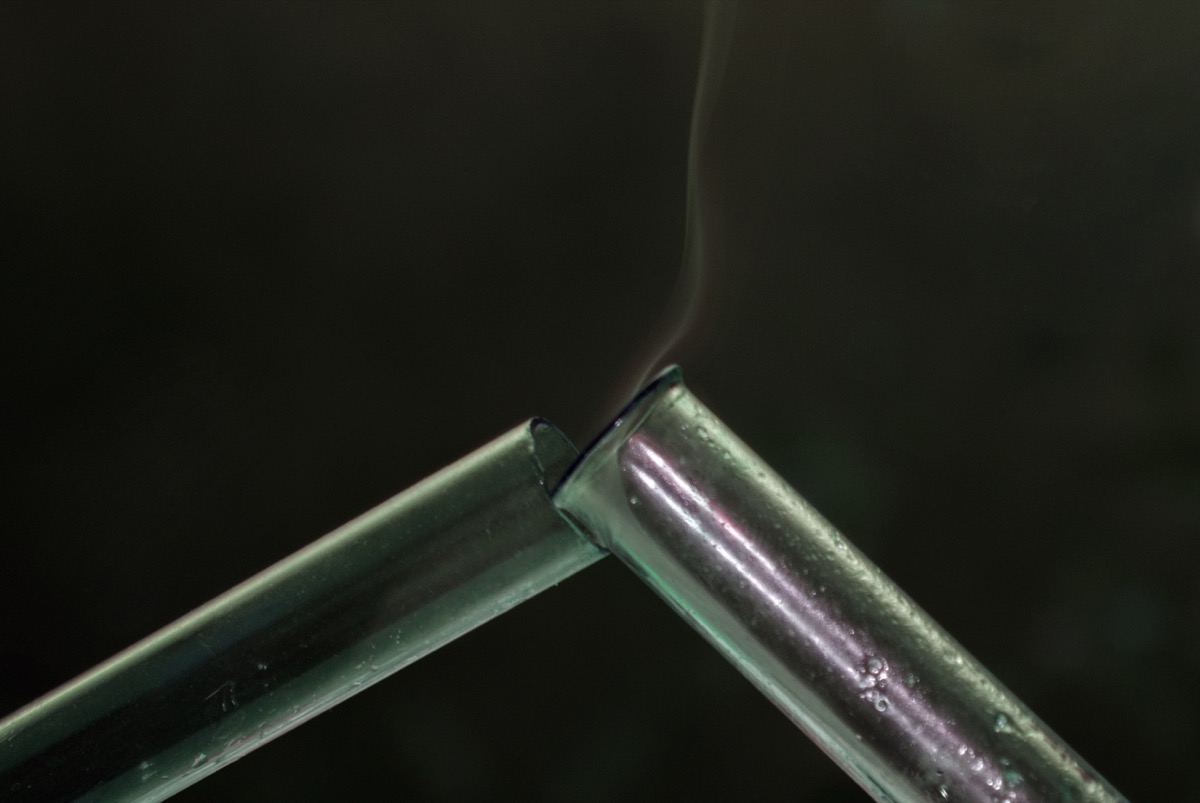
- Ammonia (Mr 17) diffuses faster than hydrogen chloride (Mr 36.5): where they meet in a tube, the white ring forms nearer the hydrogen chloride end.

Check C1.2: spot the mistakes (2 marks) 2 min
A student wrote this in her revision notes. Find the two mistakes and correct them. (2)
"In diffusion, particles move from a low concentration to a high concentration, because they want to spread out."
Reveal the corrections
- Particles diffuse from a higher to a lower concentration (1)
- They spread because of their random movement (particles do not "want" anything) (1)
Common misconceptions and exam errors
- "The particles get bigger." When a substance is heated, melts, boils or expands, its particles stay the same size: the spaces between them change.
- "Steam is the white cloud." Steam (water as a gas) is invisible. The white cloud is tiny droplets of liquid water that have condensed.
- "The temperature rises while it boils." For a pure substance it stays at the boiling point until all the liquid has boiled.
- "Water evaporates at 100 °C." Evaporating happens at the surface at any temperature; boiling happens at the boiling point.
- "Diffusion stops when the particles are evenly spread." The particles keep moving; there is just no net movement.
- Extended only "Heavier gases diffuse faster." It is the other way round: a lower Mr means faster diffusion.
Self-check: C1 States of matter (20 marks, Core 13) 20 min
Answer without your notes, then hand in. The syllabus section is in brackets after each question. Core students skip the questions marked Extended only.
S1. A student says: "In ice the water particles are not moving at all, and in steam each water particle is bigger than in liquid water." Correct both parts of what she says. (C1.1) (2)
S2. Name the change of state in each case: (a) a frozen lake turns back into water in spring; (b) mist forms on a cold bathroom mirror after a hot shower. (C1.1) (2)
S3. Cyclohexane is a liquid used to make nylon. Use the table to give its physical state (a) in a freezer at −18 °C, (b) on a lab bench at 25 °C, (c) in a water bath at 95 °C. (C1.1) (3)
| Temperature / °C | |
|---|---|
| melting point | 7 |
| boiling point | 81 |
S4. The water in a car's cooling system has antifreeze dissolved in it. This liquid does not freeze until −30 °C, and it boils at 106 °C. Explain how these two values show that the liquid is not pure water. (C1.1) (2)
S5. Extended only A solid is heated from room temperature until it has all melted. Explain, using kinetic particle theory, what happens to the particles (i) while the solid warms up and (ii) while it melts, and why the temperature stays the same during melting. (C1.1) (3)
S6. A diver ties a sealed plastic bottle of air to her belt. As she swims deeper, the pressure of the water on the bottle increases. The temperature stays the same. Describe what happens to the volume of the air in the bottle as she goes down, and as she comes back up. (C1.1) (2)
S7. Extended only The burner of a hot-air balloon heats the air inside the balloon. The pressure stays the same. Explain, using kinetic particle theory, why the volume of the hot air increases. (C1.1) (2)
S8. The smell of coffee spreads through a room much faster from a hot cup than from a cold cup of the same coffee. Explain why. (C1.2) (2)
S9. Extended only A faulty heater gives off two harmful gases: carbon monoxide (Mr = 28) and sulfur dioxide (Mr = 64). Explain which gas would reach the other side of the room first. (C1.2) (2)
Mark scheme for the self-check
S1 (2)
- In ice the particles vibrate about fixed positions (1)
- The particles are the same size in steam; they are just much further apart (1)
S2 (2)
- (a) melting (1)
- (b) condensing (1)
- Accept condensation. Do not accept "evaporating" for (b).
S3 (3)
- (a) solid (1)
- (b) liquid (1)
- (c) gas (1)
S4 (2)
- Pure water freezes at 0 °C and boils at 100 °C (at standard atmospheric pressure) (1)
- The dissolved antifreeze is an impurity: it lowers the freezing point and raises the boiling point (1)
S5 (3)
- (i) The particles gain kinetic energy and vibrate faster, so the temperature rises (1)
- (ii) The energy is used to overcome the forces of attraction, so the particles leave their fixed positions and slide past each other (1)
- The energy does not make the particles move faster, so the temperature stays the same (until all of it has melted) (1)
- Do not accept "the particles melt" or "the particles get bigger".
S6 (2)
- Going down: the volume decreases (the bottle is squashed) (1)
- Coming up: the volume increases again (1)
S7 (2)
- The air particles gain kinetic energy and move faster (1)
- They hit the inside of the balloon harder and more often, so the air pushes outwards and takes up a larger volume (1)
S8 (2)
- The particles in the hot coffee (and the air above it) have more kinetic energy and move faster (1)
- So they diffuse (spread) through the air faster (1)
- Accept "more particles evaporate from the hot coffee" as an extra point, max 2.
S9 (2)
- Carbon monoxide (1)
- It has a lower Mr, so its molecules move faster at the same temperature and it diffuses faster (1)
- No mark for "carbon monoxide" without a reason.