The Chromozone / Courses / IGCSE Co-ordinated Sciences / Physics / P1.3 Mass and weight and P1.4 Density
Cambridge IGCSE Co-ordinated Sciences (0654) · Physics · P1.3 Mass and weight and P1.4 Density · Revision summary
P1.3 Mass and weight and P1.4 Density: revision summary
Use this page before the end-of-section test. Each section is one part of the syllabus: answer the "from memory" question first, then read the key words and key facts. Boxes and questions tagged Extended only are for Extended students only. The self-check at the end takes about 20 minutes and is worth 17 marks (Core 15); type your answers and hand them in, then mark yourself with the mark scheme. The whole page takes about 35 minutes. You need a calculator.
The lessons in these sections
This summary covers these lessons. Use it before the end-of-section test.
From memory (1 mark) 1 min
Which instrument measures mass, and which measures weight? (1)
Check your answer
- Mass: a balance; weight: a force meter (newton meter) (1)
P1.3 Mass and weight: key words
- Mass
- A measure of the quantity of matter in an object. Unit: kg.
- Weight
- The gravitational force on an object that has mass. Unit: N.
P1.3 Mass and weight: key facts
| Mass | Weight | |
|---|---|---|
| What it is | quantity of matter | gravitational force on the object |
| Unit | kg | N |
| Measured with | balance | force meter |
| Moved to the Moon | stays the same | gets smaller |
| Scalar or vector? Extended only | scalar | vector (downwards) |
From memory (1 mark) 1 min
State the value of g near the Earth's surface, with its unit. (1)
Check your answer
- 9.8 N/kg (1)
P1.3 Gravitational field strength: key words
- Gravitational field strength, g
- The gravitational force per unit mass (on each kg). Unit: N/kg. About 9.8 N/kg near the Earth.
P1.3 Gravitational field strength: key facts
In symbols: g = W ÷ m, so W = m × g and m = W ÷ g
- Mass in kg (1 kg = 1000 g; 1 tonne = 1000 kg); weight in N; g in N/kg.
- g is different on other planets and moons, so the weight changes but the mass does not. A question always gives you the value of g for another world (the Moon is about 1.6 N/kg).
- Bigger planets do not always have a bigger g (Saturn is far bigger than the Earth, with a smaller g).
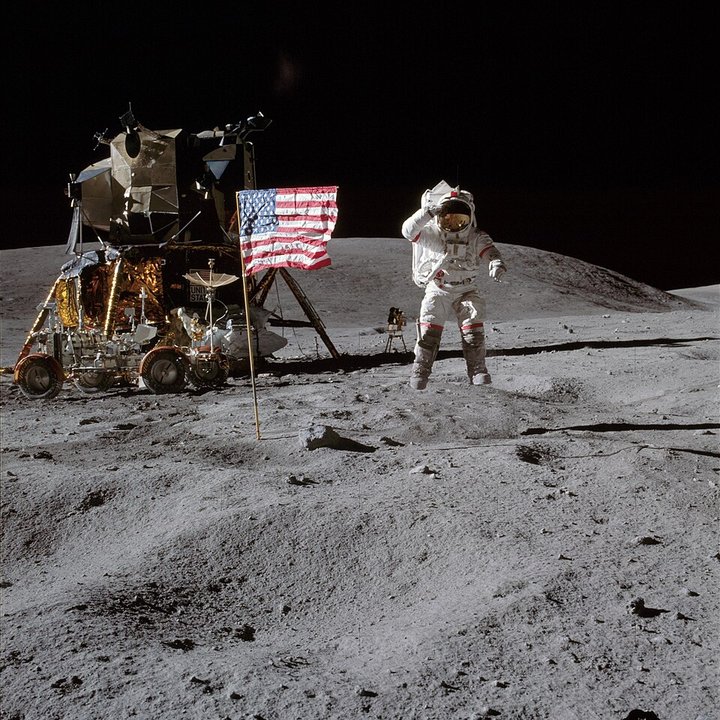

P1.3 Fields and free fall Extended only
- A planet is surrounded by a gravitational field: a region where any mass feels a force towards the planet. Weight is the effect of the field on a mass.
- g is equivalent to the acceleration of free fall: 9.8 N/kg near the Earth means a falling object (no air resistance) accelerates at 9.8 m/s². On a world where g = 1.6 N/kg, it accelerates at 1.6 m/s².
- With no air resistance, heavy and light objects fall with the same acceleration.
Common misconceptions and exam errors
- "My weight is 55 kg." That is a mass. Weight is in newtons: 55 × 9.8 = 539 N.
- "Mass is smaller on the Moon." Mass never changes; only weight does.
- "W = m × g with m in grams." Change grams into kilograms first.
- "There is no gravity on the Moon." There is: g on the Moon is about 1.6 N/kg.
From memory (1 mark) 1 min
Write 7.9 g/cm³ in kg/m³. (1)
Check your answer
- 7900 kg/m³ (1)
P1.4 Density: key words
- Density
- The mass per unit volume of a material. Units: g/cm³ or kg/m³.
P1.4 Density: key facts
In symbols: ρ = m ÷ V, so m = ρ × V and V = m ÷ ρ
| Change | How |
|---|---|
| g into kg | ÷ 1000 |
| cm³ into m³ | ÷ 1 000 000 |
| g/cm³ into kg/m³ | × 1000 |
| kg/m³ into g/cm³ | ÷ 1000 |
Keep units in pairs: g with cm³, kg with m³. Density belongs to the material: a big and a small piece of the same material have the same density.
From memory (1 mark) 1 min
Name the method used to find the volume of an irregular solid that sinks. (1)
Check your answer
- Displacement (the rise in water level in a measuring cylinder) (1)
P1.4 Measuring density: key facts
| Sample | Mass | Volume |
|---|---|---|
| regular solid | balance | ruler: V = length × width × height |
| irregular solid that sinks | balance | displacement: second reading − first reading in a measuring cylinder (object completely under, lowered on a thread) |
| liquid | balance: (cylinder + liquid) − empty cylinder | read the measuring cylinder at eye level, at the bottom of the meniscus |
Then density = mass ÷ volume, with its unit.
From memory (1 mark) 1 min
An object has a density of 0.6 g/cm³. Does it float or sink in water (1.0 g/cm³)? (1)
Check your answer
- Floats (it is less dense than water) (1)
P1.4 Float or sink: key words
- Floats
- Stays at the surface: the object is less dense than the liquid.
- Sinks
- Goes to the bottom: the object is denser than the liquid.
P1.4 Float or sink: key facts
- Less dense than the liquid: floats. Denser: sinks. Equal: stays where it is.
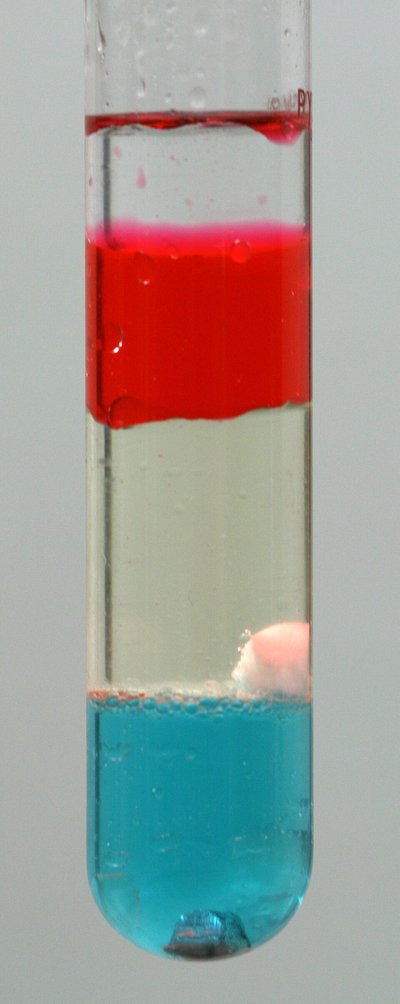
- Liquids that do not mix form layers, the densest at the bottom.
- For a hollow object (a boat, a closed box) use the average density: total mass ÷ total volume.

Common misconceptions and exam errors
- "density = volume ÷ mass." Mass goes on top: ρ = m ÷ V.
- "1 m³ = 100 cm³." 1 m³ = 1 000 000 cm³.
- "The balance reading is the mass of the liquid." Subtract the mass of the empty cylinder.
- "Heavy things sink." Compare densities, not masses.
Self-check: hand it in (17 marks; Core 15) 20 min
Answer from memory, then hand in. The mark scheme opens after you hand in. Use g = 9.8 N/kg on Earth.
S1. Define mass and define weight. (P1.3) (2)
S2. A climber has a mass of 65 kg. Calculate her weight on Earth and on Mars, where g = 3.7 N/kg. (P1.3) (2)
S3. A lunar module weighs 24 000 N on the Moon, where g = 1.6 N/kg. Calculate its mass. (P1.3) (1)
S4. Extended only Describe what is meant by a gravitational field. (P1.3) (1)
S5. Extended only On a planet, g = 8.9 N/kg. State the acceleration of a rock falling freely there, with its unit. (P1.3) (1)
S6. A wooden block is 8.0 cm × 5.0 cm × 2.5 cm and has a mass of 70 g. Calculate its density in g/cm³, then in kg/m³. (P1.4) (3)
S7. Describe how to find the density of honey, using a measuring cylinder and a balance. (P1.4) (4)
S8. Does the wooden block in S6 float or sink in cooking oil of density 0.92 g/cm³? Give a reason. (P1.4) (1)
S9. Aluminium has a density of 2.7 g/cm³. Calculate the volume of 270 g of aluminium, in cm³ and in m³. (P1.4) (2)
Check your self-check answers
S1 (2)
- Mass: the quantity of matter in an object (1)
- Weight: the gravitational force on an object (that has mass) (1)
S2 (2)
- Earth: 65 × 9.8 = 637 N (1)
- Mars: 65 × 3.7 = 240.5 N (accept 240 N or 241 N) (1)
S3 (1)
- m = 24 000 ÷ 1.6 = 15 000 kg (1)
S4 (1)
- A region (around a mass) where another mass feels a gravitational force (1)
S5 (1)
- 8.9 m/s² (1)
S6 (3)
- V = 8.0 × 5.0 × 2.5 = 100 cm³ (1)
- ρ = 70 ÷ 100 = 0.70 g/cm³ (1)
- 700 kg/m³ (1)
S7 (4)
- Weigh the empty measuring cylinder on the balance (1)
- Pour in honey and read its volume (at eye level, bottom of the meniscus) (1)
- Weigh the cylinder and honey; mass of honey = difference (1)
- Density = mass ÷ volume (1)
S8 (1)
- Floats: 0.70 g/cm³ is less than 0.92 g/cm³ (1)
S9 (2)
- V = 270 ÷ 2.7 = 100 cm³ (1)
- 100 ÷ 1 000 000 = 0.0001 m³ (1)