The Chromozone / IGCSE Psychology / Topic 1: Memory and forgetting
Murdock's study and your own investigation (lesson 1 of 3)
For full screen in Safari: press Control + Command + F (Esc to leave).
For the teacher
The first of three lessons on Murdock (1962). The whole class takes a 15-word recall test and builds a hands-up tally on the board; then the class studies Murdock's aim, procedure, results and conclusion, the link to the multistore model, and the depth of processing argument against it. You need paper and pens, and a 15-row table on the board. Timed tasks come to 31 minutes. Boxes headed Teacher only never appear in projector view, and "Show all answers" leaves them shut.
Starter (4 marks) 5 min
Answer these three recap questions in your notebook:
- In the multistore model, decay causes forgetting in two stores. Name the two stores. (1.3.3) (1)
- Two students revise the same topic. One reads the textbook chapter three times; the other writes "why" questions about it and answers them. Using the levels of processing model, explain which student is likely to remember more. (1.2.6) (1)
- Confidentiality and privacy are two separate ethical guidelines. Explain how they differ. (7.7.1) (2)
Reveal the starter answers
1. Decay (1)
- The sensory register and short-term memory (both needed) (1)
2. Two ways to revise (1)
- The student who answers "why" questions: thinking about meaning is deep (semantic) processing, which gives a stronger memory than rereading (1)
3. Confidentiality and privacy (2)
- Confidentiality: keeping participants' data anonymous, for example numbers instead of names (1)
- Privacy: not making participants reveal unnecessary personal details (1)
Learning objectives
By the end of the lesson I can:
- Describe the aim, procedure, results and conclusion of Murdock's (1962) study. (1.3.4)
- Explain how Murdock's results support the multistore model. (1.3.2, 1.3.4)
- Explain why the multistore model cannot explain depth of processing. (1.3.5)
Class test: fifteen words and a hands-up tally 6 min
Everyone takes part. Your teacher reads the words, and the class builds one picture of what it remembered.
- Predict. Write down the three positions in a 15-word list that you think the class will recall best.
- Listen. Your teacher reads 15 words, one every two seconds. Just listen: do not write anything yet.
- Recall. When your teacher says "Write", write down every word you remember, in any order. You have 60 seconds .
- Count. Your teacher reads the list again in order. Put your hand up for each word you wrote down; the number of hands goes into the tally on the board.
| Position | 1 | 2 | 3 | 4 | 5 | 6 | 7 | 8 | 9 | 10 | 11 | 12 | 13 | 14 | 15 |
|---|---|---|---|---|---|---|---|---|---|---|---|---|---|---|---|
| Hands up |
Then discuss:
- Which positions did the class remember best? Was your prediction right?
- Our class picture comes from one list. Give one reason why it might still not show the true pattern.
Reveal the answers
- (a) Usually the first two or three words and the last three or four, with the fewest hands for the middle words: a U shape. Any honest description of the tally is right.
- (b) With only one list, one easy or striking word can stand out wherever it is; and one class is a small group of similar people.
- Murdock tested 103 people on many lists, so chance effects like these cancel out.
Teacher only: the full brief for this demonstration
Aim: the class builds its own picture of the serial position effect from a hands-up tally, and sees why Murdock needed many people and many lists.
Materials: this list (keep it off the screen), paper and a pen for everyone, a stopwatch. Before the lesson, draw a 15-row table on the board: position, word, number of hands.
Words, one every two seconds in an even voice: 1. rope, 2. shell, 3. cloud, 4. spoon, 5. tiger, 6. brick, 7. lemon, 8. chair, 9. nail, 10. flute, 11. glove, 12. fence, 13. wagon, 14. towel, 15. clock.
Script: "I will read 15 words, one every two seconds. Just listen. When I say 'Write', write down as many as you can, in any order, for 60 seconds."
Tally: read the list again in order; for each word, write it in its row and count the hands (about 8 seconds a word). A student can count hands while you write.
Timing: predictions 1 minute, words 30 seconds, recall 60 seconds, tally 2 minutes, discussion 1 to 2 minutes.
Ethics: nobody's own score is shared: a raised hand only shows that one word was remembered. Say first that most people recall 5 to 8 of 15 words. Anyone may sit out and count hands instead.
Debrief: explain the aim. If the U shape is weak, use it: that is exactly why Murdock tested 103 people on many lists.
Murdock (1962): aim and procedure
Aim: to investigate the serial position effect in memory: does the position of a word in a list affect how likely it is to be recalled?
Participants: 103 psychology students, male and female.
Procedure:
- Each list had 10 to 40 common words, read aloud one at a time.
- Every word was presented for the same amount of time: one or two seconds, depending on the list.
- Straight after the list, participants had 90 seconds to write down as many words as they could, in any order. This is free recall.
- The test was repeated over several days, with a new list each time.
Task: our demonstration and Murdock's study 3 min
Copy and complete the table. Then answer the question below it.
| Feature | Our demonstration | Murdock (1962) |
|---|---|---|
| Participants | ||
| Words in a list | ||
| Number of lists | ||
| Time for each word | ||
| Time to recall |
Choose two differences that make Murdock's results more trustworthy than ours, and explain each one.
Reveal the answers
- Participants: our class; Murdock had 103 psychology students.
- Words in a list: 15; Murdock 10 to 40.
- Number of lists: one; Murdock many lists, a new one each day over several days.
- Time for each word: two seconds; Murdock one or two seconds.
- Time to recall: 60 seconds; Murdock 90 seconds.
- 103 participants: a few people with unusual memories make little difference to the overall pattern.
- Many lists: a pattern found in every list cannot be caused by a few easy words.
Key words: the serial position effect
- Serial position effect
- How well an item is recalled depends on its position in a list.
- Primacy effect
- Information presented at the beginning is better remembered than information presented at a later stage.
- Recency effect
- Information presented at a recent stage is better remembered than information presented at an earlier stage.
Murdock's results
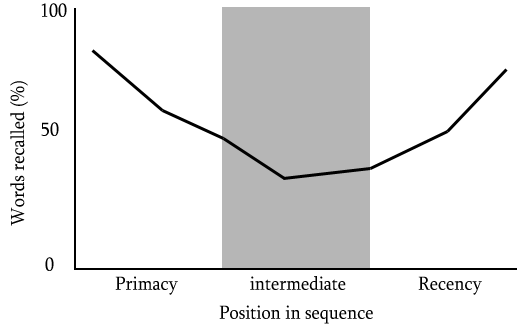

Recall depended on position, so a graph of the results is U-shaped: the serial position effect.
- Primacy effect: the first three or four words were recalled more often than the middle words.
- Recency effect: the last eight or so words were also recalled more often.
- Words in the middle of the list were recalled least.
- The same U shape appeared for every list length. A longer list just had a longer low middle.
Quick check: read the curve 2 min
Look at the curve in the box above.
- Which part of the curve shows the primacy effect, and which part shows the recency effect?
- Murdock's lists had 10 to 40 words. Why is it more useful to show the percentage of words recalled than the number?
- Give one way the curve is like our class tally, and one way it is different.
Reveal the answers
- (a) Primacy: the high left end (the first few positions). Recency: the high right end (the last positions).
- (b) Percentages let you compare lists and groups of different sizes: 5 out of 10 and 20 out of 40 are both 50%.
- (c) Alike: recall is often higher at one or both ends. Different: our tally comes from one class and one list, so it is bumpy; the curve is smooth because it combines many people and many lists.
Murdock's conclusion: evidence for the multistore model
Murdock concluded that the two ends of the curve come from two different stores.
- The first words had time to be rehearsed, so they were transferred from short-term memory (STM) to long-term memory (LTM). They are recalled from LTM.
- The last words were still in STM when recall began, so they could be written down at once.
So STM and LTM are separate stores. This is the argument for the multistore model (MSM) on the syllabus (1.3.4).
Forgetting in the MSM: why words are lost
Murdock's middle words were heard but not recalled. The MSM explains forgetting in a different way for each store (1.3.3).
- Decay (sensory register and STM): information fades if it is not processed in time. In STM, a word that is not rehearsed is lost within about 18 to 30 seconds.
- Displacement (STM): STM holds only 5 to 9 items, so each new word pushes an earlier one out. In a 15-word list, the middle words are pushed out before they can be rehearsed.
Quick check: decay or displacement? 1 min
Match each sentence to decay or displacement.
- "By the time I had to write, the first words had faded because I had stopped repeating them."
- "Each new word seemed to push the one before it out of my head."
Reveal the answers
- A: decay: a word that is not rehearsed fades from STM.
- B: displacement: STM is full, so new words push old ones out.
Forgetting in the MSM: words stored but not found
A word can also be lost from long-term memory.
- Access problems (LTM): the word is still stored in LTM, but it cannot be retrieved without the right cue.
- It may come back when you see the list again: the list is the cue.
Task: which kind of forgetting? 4 min
For each situation, name the kind of forgetting (decay, displacement or an access problem) and explain it using the MSM.
- Suppose word 8 in our class test was heard by everyone but remembered by very few.
- A researcher repeats Murdock's procedure, but participants count backwards in threes from 100 for 30 seconds before they start writing. Which end of the curve changes, and why?
- A participant cannot recall the first word of the list, but recognises it at once when she sees the list again.
Reveal the answers
- (a) Displacement: later words pushed word 8 out of STM before it could be rehearsed into LTM.
- (b) The recency effect shrinks or disappears; the primacy effect stays. The last words were only in STM: without rehearsal they decay, and the numbers displace them. The first words were already in LTM.
- (c) An access problem: the word was stored in LTM, but she could not retrieve it without a cue. Seeing the list is the cue.
When researchers tried (b), the recency effect did disappear while the primacy effect stayed.
The argument against: depth of processing
- In the MSM, information reaches LTM through rehearsal: the more a word is repeated, the better it should be remembered.
- The levels of processing model (1.2) says memory depends on how deeply a word is processed. Thinking about its meaning (deep, semantic processing) gives a stronger memory than noticing how it looks or sounds (shallow processing).
- Craik and Tulving (1975) found exactly this, with the same time spent on every word.
- The MSM has no way to explain this, because it only counts rehearsal. This is the argument against the model on the syllabus (1.3.5).
Predict, then explain: repeat it or picture it? 4 min
Two groups hear the same 20-word list at the same pace, as in Murdock's study.
- Group R is told: "Repeat each word in your head until the next one arrives."
- Group P is told: "Picture each word and link it to the word before, as a little story."
- Which group does the multistore model predict will recall more middle words? Why?
- Which group does the levels of processing model predict will recall more? Why?
- Suppose group P recalls more middle words. Explain why this is a problem for the multistore model.
Reveal the answers
- (a) Group R, or no difference: the MSM says rehearsal moves words into LTM, and group R rehearses more.
- (b) Group P: picturing and linking each word is deep (semantic) processing, which gives a stronger memory.
- (c) Group P rehearsed less but remembered more, so rehearsal is not the only way into LTM. The MSM cannot explain depth of processing.
Common misconceptions and exam errors
- Naming the effect but not the store. "Murdock found primacy and recency" is only a start. Say which store explains each end and why: primacy from LTM after rehearsal, recency from STM.
- Saying the same point twice. "STM and LTM are separate" and "they are two different stores" earn one mark, not two.
- "Repeating something always makes it stick." Repetition is shallow processing, so it may not help. That is the depth of processing point against the MSM.
Teacher note: 0266 has no examiner reports yet (first exams 2027). Sources: specimen Paper 1 mark scheme, question 2 (separate marks for the effect, the store and the reason) and question 1(b) (repetition may not help, as it is only shallow processing); generic marking principle f (no credit for repetition of a point).
Exam-style question (4 marks) 5 min
Dev's teacher says, "Murdock's study of the serial position effect is the best evidence for the multistore model of memory."
Explain why Murdock's (1962) study supports the argument for the multistore model of memory (MSM). (1.3.4) (4)
Reveal the mark scheme
Question (4)
1 mark for each relevant point (× 4)
- The primacy effect: the words at the start of the list were recalled well (1)
- They were recalled from LTM, because they had time to be rehearsed (consolidated) before the middle words arrived (1)
- The recency effect: the words at the end of the list were recalled well (1)
- They were recalled from STM, because they were still there when recall began: no later words had displaced them (1)
- The two effects have different causes, so STM and LTM are separate stores (the MSM) (1)
- The words in the middle were recalled least: they were neither rehearsed into LTM nor still in STM (1)
Max 4. Do not credit a point that only repeats an earlier one (for example, "STM and LTM are different" said twice).
Teacher note: Mirrors the 2027 specimen paper 1, question 2: "Explain why the study about serial position effect (Murdock) supports the argument for the multistore model", 4 marks, one mark for each relevant point, AO1 and AO2. The mark scheme asks for both ends of the curve and the link to a store. Ask for the effect, the store and the reason each time.
Stretch: long lists and short lists (3 marks)
Murdock used lists from 10 to 40 words long. In every list, the last eight or so words were recalled well. Use the multistore model to explain why the low middle part of the curve was much longer for a 40-word list than for a 10-word list. (1.3.2, 1.3.4) (3)
Reveal the mark scheme
1 mark for each relevant point (× 3)
- STM has a limited capacity (about 5 to 9 items), so only about the last eight words can still be there at recall, whatever the length of the list (1)
- Only the first few words get enough rehearsal to reach LTM, before STM fills up (1)
- In a 40-word list about 28 words fall between these two parts, but in a 10-word list there are almost none, so the dip is much longer (1)
Plenary: learning objectives check 1 min
Rate yourself red, amber or green for each objective.
- Describe the aim, procedure, results and conclusion of Murdock's (1962) study. (1.3.4)
- Explain how Murdock's results support the multistore model. (1.3.2, 1.3.4)
- Explain why the multistore model cannot explain depth of processing. (1.3.5)
- Red: I cannot do this yet.
- Amber: I can do some of it.
- Green: I can do all of it.
If you have time
For classes that finish early or have a longer period.
1. Murdock: aim and procedure
- State the aim of Murdock's (1962) study.
- Outline the procedure of Murdock's study.
2. Murdock in research methods words
Murdock's study in research methods words.
- Identify the independent variable and the dependent variable in Murdock's study.
- Every participant heard words in every position. Name this experimental design.
- Explain why Murdock used a new list of words each day.
3. Murdock and your revision
The night before a test, Maya reads her list of 30 key terms once, from top to bottom, then closes her book.
- Which terms is she most likely to forget? Use Murdock's results.
- Suggest two changes to the way she revises. Use Murdock's results for one and the levels of processing model for the other.
4. The argument against, in four sentences
Write four sentences that explain why the multistore model cannot explain depth of processing. Use Craik and Tulving's (1975) finding in one of them.
Reveal the answers
1. Murdock: aim and procedure
- Aim: to investigate the serial position effect: whether a word's position in a list affects how likely it is to be recalled.
- Procedure, any three: 103 psychology students; lists of 10 to 40 common words read aloud one at a time; the same time for every word (one or two seconds); 90 seconds of free recall straight afterwards; repeated over several days with a new list each time.
- Not: words shown on a screen, or recalled in order.
2. Murdock in research methods words
- IV: the serial position of a word in the list. DV: whether the word at each position was recalled, in 90 seconds of free recall.
- Repeated measures: every participant takes part in every level of the IV.
- With the same list, participants would remember words from earlier days, so recall would no longer depend only on position.
3. Murdock and your revision
- The terms in the middle of the list: they get little rehearsal and are pushed out of STM by the terms after them.
- Murdock: change the order each time she revises, so that different terms come first and last, or test herself on the middle terms first.
- Levels of processing: write an example or a "why" question for each term, so she thinks about its meaning (deep processing) instead of just reading it.
4. The argument against, in four sentences
- A model: "The multistore model says that information is transferred from STM to LTM by rehearsal. So the more something is repeated, the better it should be remembered. But Craik and Tulving found that words processed for their meaning were remembered better than words processed for their sound or look, with the same time on each word. The model cannot explain this, because it says nothing about how deeply information is processed."
Homework: extend
About 18 minutes on the serial position effect in real life: a talent show vote, an advert break and a list of instructions, explained with the multistore model.
Want every lesson like this?
- Ready-to-teach lessons
- Self-study pages for homework
- Exam-style tests