The Chromozone / Courses / Cambridge Primary Science / Stage 6 / Materials
Year 6 Science · Homework
Homework: Checkpoint coach
An exam-skills homework: learn the command words, then try Checkpoint-style questions on the end of the Materials unit. It takes about 15 minutes and is worth 10 marks. Type your answers in the boxes on screen, or print the sheet and write on it.
Teach this first
This homework follows Lesson 11 of the Materials unit, Chemical reactions: are new substances made?.
Checkpoint coach: read the command word
- Describe: say what happens, or what the pattern is.
- Explain: say why. Use the word “because”.
- Suggest: use your science to give a good idea. There can be more than one right answer.
Worked example. Explain why the balloon blows up. (2)
“A gas is made in the bottle (1), because the vinegar and bicarbonate of soda react (1).” Two marks need two points: look at the number in brackets.
Part A: command words (2 marks) 3 min
A1. Write what each question asks you to do: (1) Describe what happens to the ice. (2) Explain why the ice melts. (2)
Check your answers to part A
A1 (2)
- (1) Say what happens (for example: it turns into liquid water) (1)
- (2) Say why it happens (for example: because it is warmer than 0 °C) (1)
Part B: Checkpoint-style questions (8 marks) 12 min
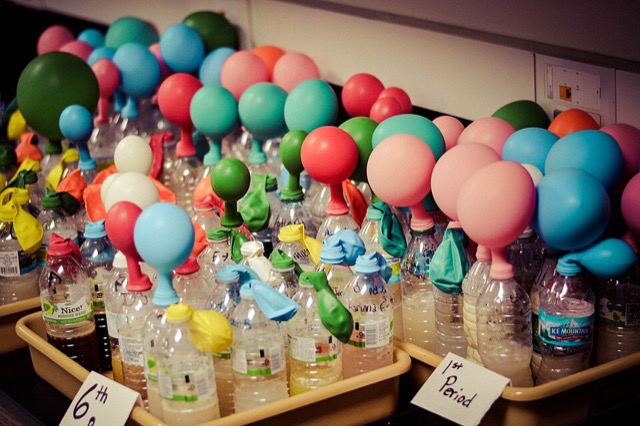
Leo put 20 ml of vinegar in a bottle. He stretched a balloon with bicarbonate of soda in it over the neck, tipped the powder in and measured the distance round the balloon. He did it again with more spoons of powder.

| Spoons of bicarbonate of soda | 1 | 2 | 3 | 4 |
|---|---|---|---|---|
| Distance round the balloon (cm) | 20 | 28 | 35 | 35 |
B1. Describe the pattern in Leo’s results. (1)
B2. Suggest why 4 spoons made the same size of balloon as 3 spoons. (1)
B3. Explain how Leo knows that a new substance is made. (2)
B4. A hairdryer dries wet hair. Is this boiling or evaporation? Explain. (2)
B5. Which two of these changes are irreversible? burning wood, melting butter, cooking an egg, dissolving salt (2)
Check your answers to part B
B1 (1)
- More bicarbonate of soda makes a bigger balloon, up to 3 spoons (then it stays the same) (1)
B2 (1)
- The vinegar was all used up (so the extra powder had nothing to react with) (1)
- Accept "not enough vinegar".
B3 (2)
- A gas is made (it fizzes, the balloon blows up) (1)
- Because the gas was not there before: it is a new substance, and you cannot change it back into vinegar and powder (1)
B4 (2)
- Evaporation (1)
- Because the water turns into a gas from the surface, below 100 °C (there are no bubbles) (1)
B5 (2)
- Burning wood (1)
- Cooking an egg (1)
- One mark each. A third choice loses a mark.