The Chromozone / IAL Biology / Unit 1 / Topic 1
Directed study: review
Spaced repetition: the IGCSE science that Topic 1 builds on
Spaced repetition revision, set after the first lesson of the course. It asks nothing about water. Topic 1 builds on what you learnt at IGCSE, so all three parts go back there: food molecules, cells and enzymes, and some chemistry. It takes about 22 minutes and is worth 20 marks. Type your answers in the boxes, then hand them in at the bottom of the page. The mark schemes open after you hand in: then mark yourself point by point in green. Teachers: set this after the lesson 1.1 Water, the polar solvent of life.
Teach these first
Set this sheet after the lesson 1.1 Water, the polar solvent of life. It asks nothing about that lesson. Every question goes back to earlier learning, to bring it back just when it is most likely to be forgotten (spaced repetition). The questions come from:
- IGCSE Biology: biological molecules and food tests (Part A)
- IGCSE Biology: cells, diffusion and enzymes (Part B)
- IGCSE Chemistry: formulae, moles, concentration and rates of reaction (Part C)
Part A: IGCSE Biology, food molecules (6 marks) 6 min
Answer from memory first. The brackets after each question tell you where you learnt it.
A1. Starch, proteins and fats are large molecules made from smaller ones. Name the smaller molecules that make up (a) starch, (b) a protein and (c) a fat. (IGCSE Biology: biological molecules) (3)
A2. A student did four food tests on three foods. Use the results to state which nutrients each food contains. (IGCSE Biology: food tests) (3)
Results of four food tests on three foods
| Food | Benedict's test (heated) | Iodine test | Biuret test | Ethanol (emulsion) test |
|---|---|---|---|---|
| Cornflour | stays blue | blue-black | stays blue | stays clear |
| Milk | orange precipitate | orange-brown | purple | cloudy white |
| Gelatine | stays blue | orange-brown | purple | stays clear |
Check your answers to Part A
A1 (3)
- (a) Starch: glucose (1)
- (b) Protein: amino acids (1)
- (c) Fat: fatty acids and glycerol (both needed) (1)
- DO NOT ACCEPT “sugars” for (a) or “fats” for (c)
A2 (3)
- Cornflour: starch only (1)
- Milk: reducing sugar, protein and fat (all three needed) (1)
- Gelatine: protein only (1)
- ACCEPT “reducing sugar” or “glucose” for the Benedict’s result
- The sugar in milk is lactose, a reducing sugar. You will meet it again in lesson 1.2.
Part B: IGCSE Biology, cells, diffusion and enzymes (8 marks) 9 min
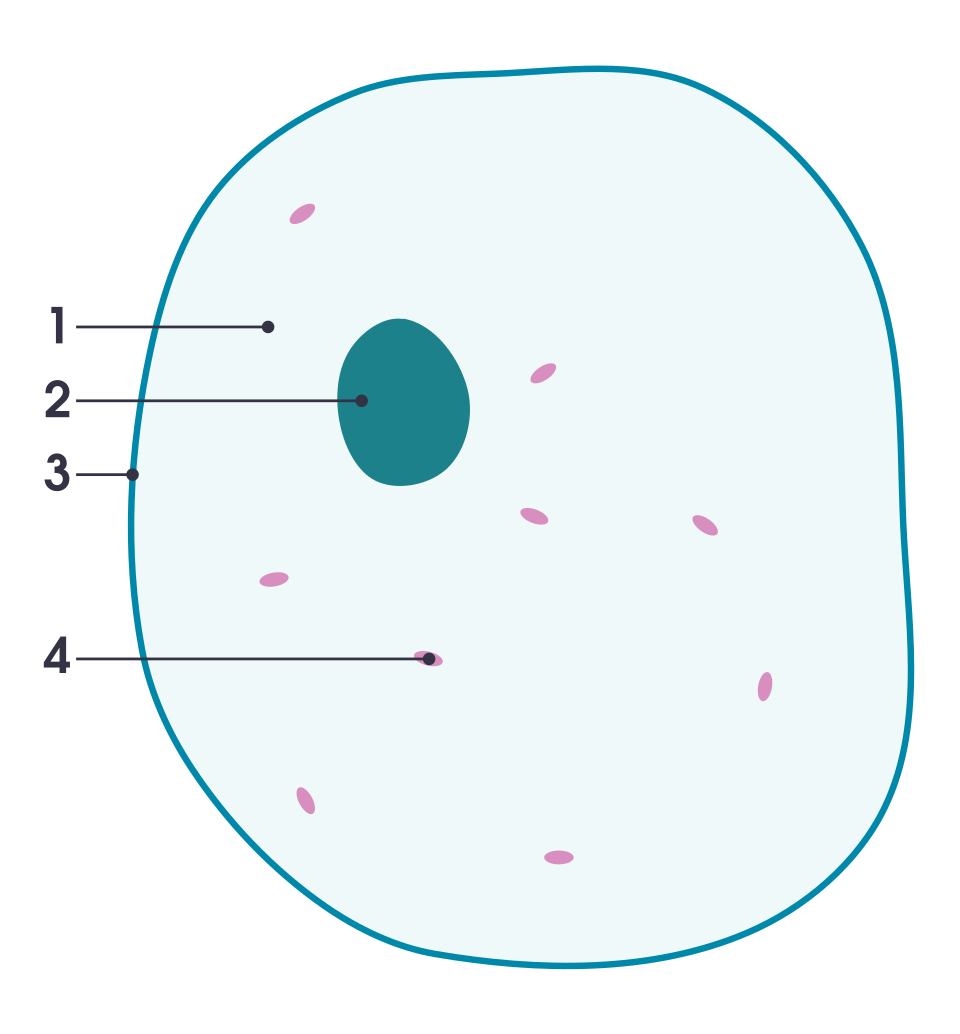
B1. The diagram shows an animal cell. Name the parts labelled 2 and 4, and give the function of part 4. (IGCSE Biology: cells) (3)

B2. A drop of blue dye is put into a beaker of still water. An hour later the water is evenly blue all the way through. Which statement is correct? (IGCSE Biology: diffusion) (1)
- A The dye particles have stopped moving.
- B The dye and water particles keep moving, but there is no longer a net movement of dye in one direction.
- C The dye particles now move from where they are less concentrated to where they are more concentrated.
- D Diffusion has stopped because the dye has dissolved.
Write the letter, then how sure you are: guess, fairly sure or certain.
B3(a). Exam-style question. A student mixed amylase with starch at five temperatures. Every minute she tested a drop of each mixture with iodine, until it no longer turned blue-black. Describe the effect of temperature on the activity of the amylase. Use the data. (IGCSE Biology: enzymes) (2)
Time taken for amylase to digest all the starch
| Temperature / °C | Time for the starch to disappear / min |
|---|---|
| 20 | 9.5 |
| 30 | 5.0 |
| 40 | 2.5 |
| 50 | 4.0 |
| 60 | starch still there after 20 min |
B3(b). Explain the result at 60 °C. (IGCSE Biology: enzymes) (2)
Check your answers to Part B
B1 (3)
- 2: nucleus (1)
- 4: mitochondrion / mitochondria (1)
- Function of 4: aerobic respiration, which releases energy (1)
- DO NOT ACCEPT “makes energy” (energy is released, not made)
- 3 is the cell membrane and 1 is the cytoplasm.
B2 (1)
- B (1)
- A: particles never stop moving; only the net movement stops.
- C: that would be the opposite of diffusion (it needs energy, as in active transport).
- D: dissolved particles still diffuse; dissolving and diffusion happen together.
B3(a) (2)
- From 20 to 40 °C the activity rises: the time falls from 9.5 to 2.5 min (1)
- Above 40 °C the activity falls, and at 60 °C no starch is digested (1)
- ACCEPT the optimum is about 40 °C
- NB quote figures for the first mark; a description with no data scores at most 1
B3(b) (2)
- The amylase is denatured: its active site changes shape (1)
- Starch no longer fits (is not complementary), so no enzyme-substrate complexes form (1)
- DO NOT ACCEPT “the enzyme is killed”: enzymes are not alive
Part C: IGCSE Chemistry, formulae, moles and rates (6 marks) 7 min
Use a calculator and show your working.
C1. Calculate the relative formula mass (Mr) of glucose, C6H12O6. Relative atomic masses: H = 1, C = 12, O = 16. (IGCSE Chemistry: formulae and moles) (2)
C2. A student dissolves 9.0 g of glucose in water and makes the solution up to 250 cm3. Calculate the concentration of the solution in mol dm−3. Use your answer to C1. (IGCSE Chemistry: concentration) (2)
C3. Explain, in terms of particles, why most chemical reactions go faster at a higher temperature. (IGCSE Chemistry: rates of reaction) (2)
Check your answers to Part C
C1 (2)
- (6 × 12) + (12 × 1) + (6 × 16) (1)
- Mr = 180 (no units) (1)
C2 (2)
- Moles of glucose = 9.0 ÷ 180 = 0.050 mol (1)
- Concentration = 0.050 ÷ 0.250 dm3 = 0.20 mol dm−3 (1)
- ALLOW ecf from a wrong value in C1
- DO NOT ACCEPT an answer with no unit for the final mark
C3 (2)
- The particles have more kinetic energy, so they move faster and collide more often (1)
- More of the collisions have at least the activation energy, so more collisions are successful (1)
- IGNORE “more collisions” on its own for the second point