The Chromozone / IAL Biology / Unit 1 / Topic 1
Directed study
Directed study: what smoking does to the heart and blood vessels
Directed study after the lesson on atherosclerosis. It links the last five lessons, from mass transport to atherosclerosis, through one real-world case: what tobacco smoke does to the circulation. Part A is active recall, Part B is the case study with exam-style questions, and Part C practises ideas that are easy to mix up. It takes about 35 minutes and is worth 26 marks. Type your answers in the boxes, then hand them in at the bottom of the page. The mark schemes open after you hand in: then mark yourself point by point in green. Teachers: set this after the lesson 1.10 How atherosclerosis develops.
Teach these first
This page builds on these lessons. Teach them before students start here:
Part A: active recall, from the lungs to the heart muscle (6 marks) 6 min
Without your notes, follow one oxygen molecule on its way to a heart muscle cell. This links all five lessons since 1.6.
A1. Give the word or words that go in each of the boxes A to F. (1.6 to 1.10, Topic 1) (6)
The path of one oxygen molecule from the lungs to a heart muscle cell
| What happens | Lesson |
|---|---|
| 1. In the lungs, the oxygen binds to the iron ion of a haem group in the protein A, inside a red blood cell. | 1.9 |
| 2. The oxygenated blood goes back to the heart in the B. | 1.8 |
| 3. The C contracts and pumps the blood into the aorta. | 1.8 |
| 4. The blood reaches the heart muscle through the D, which branch from the aorta. | 1.10 |
| 5. In the working heart muscle, carbon dioxide lowers the affinity of haemoglobin for oxygen, so more oxygen is unloaded. This is the E. | 1.9 |
| 6. The oxygen diffuses through the capillary wall, which is only one cell thick, into a muscle cell, where it is used in F. | 1.6, 1.7 |
Check your answers to Part A
A1 (6): one mark each
- A: haemoglobin (1)
- B: pulmonary vein (1)
- C: left ventricle (1)
- D: coronary arteries (1)
- E: Bohr effect (1)
- F: aerobic respiration (to release energy, making ATP) (1)
- DO NOT ACCEPT pulmonary artery for B or right ventricle for C
- ACCEPT respiration for F
Part B: case study, what smoking does to the heart and blood vessels (15 marks) 21 min
Tobacco smoke contains carbon monoxide, nicotine and thousands of other chemicals. Smoking is one of the biggest causes of cardiovascular disease in the world. In this case study you use what you learnt in lessons 1.6 to 1.10 to work out why.
Carbon monoxide. Carbon monoxide (CO) binds to the iron ion of a haem group, in the same place as oxygen. It binds about 200 times more strongly than oxygen and does not let go easily.
Nicotine. Nicotine makes the heart beat faster and raises the blood pressure for a while after each cigarette.
Other chemicals. Many other chemicals in the smoke damage the endothelium of the arteries.
B1(a). The haemoglobin in 100 cm3 of fully saturated blood carries 20.0 cm3 of oxygen when none of it carries carbon monoxide. Use the table to calculate the largest volume of oxygen that 100 cm3 of the heavy smoker's blood can carry. (1.9) (2)
Percentage of haemoglobin carrying carbon monoxide (example values)
| Person | Haemoglobin carrying carbon monoxide / % |
|---|---|
| Non-smoker | 1 |
| Light smoker (about 10 cigarettes a day) | 4 |
| Heavy smoker (20 or more a day) | 9 |
B1(b). Explain why carbon monoxide in the blood means that less oxygen reaches respiring cells. (1.9) (2)
B2. One person's resting heart rate rose from 64 to 80 beats per minute after a cigarette. Calculate the length of one cardiac cycle, in seconds, at 80 beats per minute. (1.8) (2)
B3. Explain how chemicals in tobacco smoke that damage the endothelium can raise a person's blood pressure over many years. (1.7 and 1.10) (3)
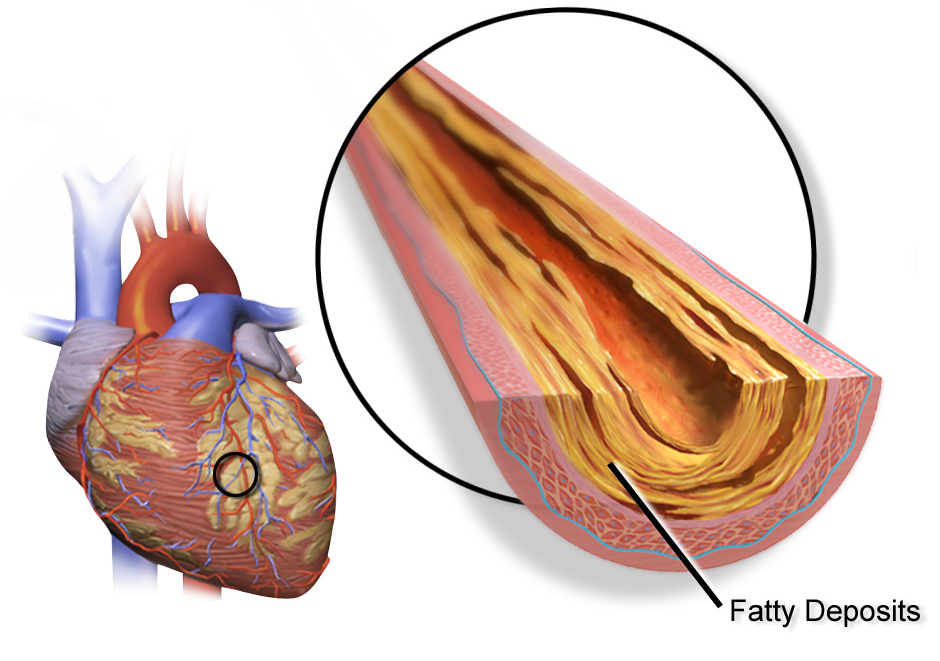

B4*. A doctor tells a 55-year-old man who has smoked 20 cigarettes a day for 35 years that he has a high risk of a heart attack. Use the information in this case study and your knowledge of haemoglobin, the heart and atherosclerosis to explain why. (1.7 to 1.10) (6)
* Your answer is marked on how well you link your points together: write in full sentences, in a logical order.
Check your answers to Part B
B1(a) (2)
- 100 − 9 = 91% of the haemoglobin can carry oxygen: 20.0 × 0.91 (1)
- = 18.2 cm3 (1)
- NB correct answer with no working scores both marks
- ACCEPT 18 cm3 / 18.20 cm3
B1(b) (2)
- Carbon monoxide takes up haem groups (the Fe2+), so fewer can bind oxygen: less oxyhaemoglobin forms in the lungs (1)
- So less oxygen is carried to, and unloaded in, the respiring tissues (1)
- DO NOT ACCEPT "iron" on its own: it is the iron ion, Fe2+
- ACCEPT carboxyhaemoglobin forms / CO binds irreversibly
B2 (2)
- 60 ÷ 80 (1)
- = 0.75 s (1)
- NB correct answer with no working scores both marks
- ACCEPT 0.75 (the unit is given in the question)
B3 (3): max 3, in a logical order
- The damaged endothelium starts an inflammatory response: white blood cells move into the artery wall (1)
- Cholesterol, white blood cells, calcium salts and fibres build up under the endothelium: an atheroma (1)
- The atheroma narrows the lumen and makes the wall stiffer (less elastic) (1)
- The heart pumps against more resistance, so the blood pressure rises (1)
- Max 3
- DO NOT ACCEPT "fat sticks to the inside of the artery" or "a clot forms": the atheroma forms inside the wall
- IGNORE "the wall of the vessel": it must say endothelium
B4* (6): levels-based. Credit points like these, then check the level
Indicative content (levels-based: no mark per point)
AO1 (knowledge)
- Carbon monoxide binds to haemoglobin, so the blood carries less oxygen
- Heart (cardiac) muscle needs a constant supply of oxygen for aerobic respiration, to make ATP and keep contracting
- Chemicals in smoke damage the endothelium, starting an inflammatory response and an atheroma
- An atheroma in a coronary artery narrows the lumen, so less blood and oxygen reach the heart muscle
- An atheroma can crack and a clot forms on it, blocking the coronary artery
- Heart muscle beyond the blockage is starved of oxygen, cannot respire aerobically and dies: a myocardial infarction (heart attack)
AO2 (from the case study)
- Up to 9% less oxygen carried in a heavy smoker
- Nicotine raises the heart rate, so the heart muscle contracts more often and needs even more oxygen
- Raised blood pressure damages more endothelium: each makes the other worse (a vicious circle)
Levels
- Level 1 (1 to 2 marks): one or two points, not linked.
- Level 2 (3 to 4 marks): points from at least two lessons, partly linked (for example damage, then atheroma, then a narrow coronary artery).
- Level 3 (5 to 6 marks): a linked chain from both carbon monoxide and endothelial damage to heart muscle starved of oxygen, using the case study data.
- NB no marks for the case study data alone: the answer must link it to haemoglobin, the heart or atherosclerosis
Part C: spot the mistakes (5 marks) 6 min
Some ideas from these lessons are easy to mix up. A student wrote the paragraph below.
C1. The paragraph contains five mistakes. Write each mistake, then correct it. (1.7 to 1.10) (5)
"Atherosclerosis starts when fat from the blood sticks to the inside of an artery. It happens mostly in veins, because the blood moves slowly there. As the plaque grows, it narrows the lumen, so the blood pressure falls. This is serious in the heart, because the heart muscle gets its oxygen from the blood inside the left ventricle. In working heart muscle, carbon dioxide makes haemoglobin hold on to oxygen more tightly, so less oxygen is released."
Check your answers to Part C
C1 (5): one mark for each mistake found and corrected
- It starts with damage to the endothelium; the atheroma forms inside the artery wall, under the endothelium, not on its surface (1)
- It happens in arteries, where the blood pressure is high and surges with each heartbeat, not in veins (1)
- The blood pressure rises, not falls: the heart pumps against more resistance (1)
- The heart muscle gets its oxygen from the coronary arteries, not from the blood in its chambers (1)
- Carbon dioxide lowers the affinity of haemoglobin for oxygen (the Bohr effect), so more oxygen is released, not less (1)
- NB each mistake must be corrected to score: spotting it alone does not
- ACCEPT the mistakes in any order