The Chromozone / IAL Biology / Unit 1 / Topic 1
Directed study: atherosclerosis, blood clots and risk
Directed study after the lessons on atherosclerosis (1.10) and on blood clotting, risk factors and antioxidants (1.11 to 1.13). Part A checks what you remember from the two lessons, Part B is exam-style questions, and Part C goes back to earlier lessons in Topic 1. It takes about 35 minutes and is worth 29 marks. Type your answers in the boxes, then hand them in at the bottom of the page. The answers open after you hand in: then mark your work point by point and correct it in green. The spec point in brackets tells you where to revise. Teachers: set this after the lesson 1.11 to 1.13 Blood clotting, CVD risk factors and antioxidants.
Teach these first
This page builds on these lessons. Teach them before students start here:
Part A: what do you remember? (6 marks) 6 min
Answer from memory first. Then look back at your notes for anything you could not remember.
Card sort. Give the letters of the five cards in the order in which atherosclerosis develops. (1.10) (2)
- P White blood cells and lipids, such as cholesterol, build up in the artery wall.
- Q The endothelium is damaged, for example by high blood pressure.
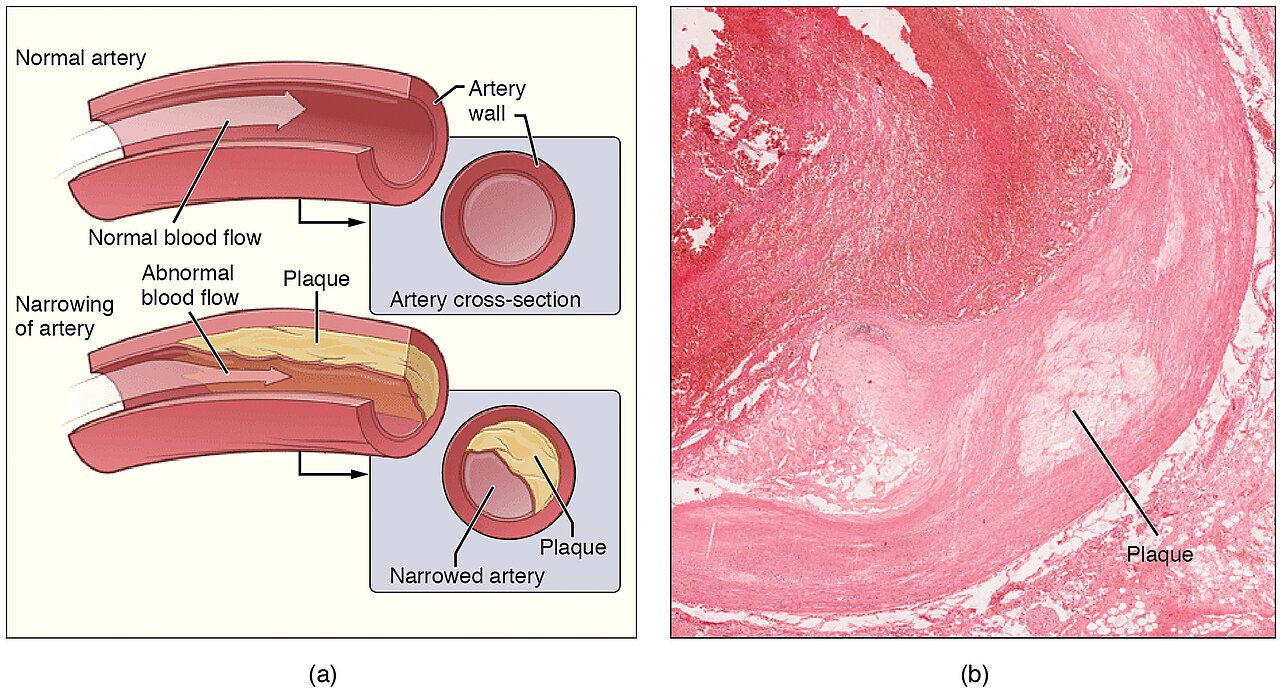
- R The plaque narrows the lumen, so the blood pressure rises even more.
- S An inflammatory response begins in the artery wall.
- T An atheroma (plaque) forms, and calcium salts make it hard.
An atheroma narrows the lumen of a coronary artery from 4.0 mm to 1.0 mm across (diameter). Calculate the percentage decrease in the cross-sectional area of the lumen. Area of a circle = πr2. (1.10) (2)
Explain how a diet high in salt increases the risk of CVD. (1.10, 1.12) (2)

Reveal the answers to Part A
Retrieval 1 (2)
- Q then S: damage first, then inflammation (1)
- Then P, T, R: build-up, plaque, narrowing (1)
- NB the full order is Q, S, P, T, R
- NB one mark for each half
Retrieval 2 (2)
- Areas: π × 2.02 = 12.6 mm2 and π × 0.52 = 0.79 mm2 (1)
- Decrease = (12.6 − 0.79) ÷ 12.6 × 100 = 94% (1)
- ACCEPT 93.75% / 93.8%
- ACCEPT the diameter used as the radius: it gives the same percentage
Retrieval 3 (2)
- Salt raises blood pressure (1)
- High pressure damages the endothelium, so atheromas form more easily (1)
- IGNORE walls of the blood vessels (it must say endothelium / lining)
Part B, question 1: the clotting cascade (1.11) (6 marks) 6 min

Complete the table by giving what goes in each of the boxes A to F. (6)
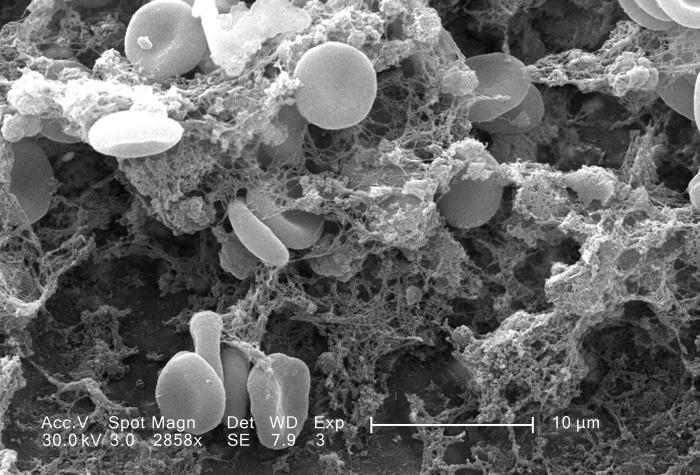
Some substances in blood clotting Name What it does Soluble or insoluble in plasma? Thromboplastin A soluble B An inactive plasma protein, made in the liver, that is converted into thrombin C Thrombin D soluble Fibrinogen A plasma protein that is converted into fibrin E F Forms a mesh of fibres that traps platelets and red blood cells insoluble ABCDEF
Reveal the mark scheme for question 1
1 (6)
- A: speeds up (catalyses) prothrombin → thrombin (1)
- B: prothrombin (1)
- C: soluble (1)
- D: an enzyme that converts fibrinogen into fibrin (1)
- E: soluble (1)
- F: fibrin (1)
- ACCEPT for A: released by platelets and damaged tissue, if the conversion is also given
- DO NOT ACCEPT fibrinogen for F
Part B, question 2: a leech bite (1.11) (4 marks) 5 min
Leeches are worms that feed on blood. Their saliva contains hirudin, a protein that stops thrombin from working. After a leech has fed, the bite can keep bleeding for hours. Explain why. (4)
Reveal the mark scheme for question 2
2 (4)
- Thrombin is an enzyme (1)
- With hirudin there is little or no working thrombin (1)
- So little soluble fibrinogen is converted to insoluble fibrin (1)
- No fibrin mesh traps platelets and red blood cells: no clot (1)
- DO NOT ACCEPT hirudin stops the blood clotting, with no reference to thrombin
Part B, question 3: stiffer arteries (1.10, 1.12) (3 marks) 4 min
As people get older, some of the elastic fibres in their artery walls are replaced by stiffer collagen fibres. The arteries then stretch less with each heartbeat. Explain how this change can lead to CVD. (3)
Reveal the mark scheme for question 3
3 (3): max 3
- Pressure surges in the arteries are higher: blood pressure rises (1)
- High pressure damages the endothelium (1)
- An atheroma builds up and narrows the lumen (1)
- Less blood and oxygen reach the heart muscle, or a clot forms (1)
- Max 3
Part B, question 4: green tea or iced tea? (1.12, 1.13) (4 marks) 5 min
Explain whether drinking green tea is likely to reduce the risk of CVD more than drinking the sweetened iced tea drink. Use the information in the table. (4)
Two drinks, per 250 cm3 cup Drink Antioxidants / mg Sugar / g Energy / kJ Green tea, no sugar 120 0 5 Sweetened iced tea drink 20 24 400
Reveal the mark scheme for question 4
4 (4)
- Green tea has six times more antioxidants (120 mg, not 20 mg) (1)
- Antioxidants remove free radicals: less damage to the endothelium (1)
- The iced tea gives far more sugar and energy (24 g, 400 kJ) (1)
- Extra energy can lead to obesity, which raises the risk of CVD (1)
- ACCEPT these figures alone cannot show that green tea lowers the risk; a study is needed
Part C: spaced practice from earlier in Topic 1 (6 marks) 7 min
These questions go back to earlier lessons. Try them without your notes first.
In some older people, the semilunar valve at the base of the aorta no longer closes fully. Suggest how this affects the left ventricle. (1.8) (2)
In core practical 1 you heated the tubes in a water bath at 80 to 90 °C. Give one hazard of this step and one way to reduce the risk. (1.3) (2)
During shallow breathing, the pO2 in the lungs can fall from 13 kPa to 11 kPa, but the blood leaving the lungs is still about 95% saturated with oxygen. Use the shape of the oxygen dissociation curve to explain why. (1.9) (2)
Reveal the answers to Part C
Spaced 1 (2)
- In diastole, blood flows back from the aorta into the ventricle (1)
- So the ventricle must pump extra blood each beat: it works harder (1)
- ACCEPT less blood reaches the body with each beat for the second point
Spaced 2 (2)
- Hazard: hot water or tubes can scald (1)
- Use a test-tube holder or tongs; keep the bath on a steady bench (1)
- ACCEPT eye protection against hot splashes
- NB the risk reduction must match the hazard given
Spaced 3 (2)
- At high pO2 the curve is flat (it levels off) (1)
- So a small fall in pO2 hardly changes the saturation (1)
- ACCEPT plateau for flat