The Chromozone / IAL Biology / Unit 1 / Topic 1
Directed study: review
Spaced repetition: water, and IGCSE circulation and chemistry
Spaced repetition revision, set after the second lesson on carbohydrates. It asks nothing about sugars. Part A goes back to the first lesson of the course (water), and Parts B and C go back further, to IGCSE Biology and Chemistry. It takes about 22 minutes and is worth 20 marks. Type your answers in the boxes, then hand them in at the bottom of the page. The mark schemes open after you hand in: then mark yourself point by point in green. Teachers: set this after the lesson 1.2 and 1.4 Naming glycosidic bonds, starch and glycogen.
Teach these first
Set this sheet after the lesson 1.2 and 1.4 Naming glycosidic bonds, starch and glycogen (lesson 2 of 2). It asks nothing about that lesson. Every question goes back to earlier learning, to bring it back just when it is most likely to be forgotten (spaced repetition). The questions come from:
- 1.1 Water, the polar solvent of life (Part A)
- IGCSE Biology: circulatory systems, respiration and blood (Part B)
- IGCSE Chemistry: concentration, acids and alkalis, structure and bonding (Part C)
Part A: back to the first lesson, water (7 marks) 8 min
Lesson 1.1 is the furthest back you can go in IAL Biology so far. Answer from memory first; the brackets tell you where to revise.
A1. Nitrogen is more electronegative than hydrogen. Ammonia, NH3, is very soluble in water. Use what you know about water to explain why. (1.1, Topic 1) (2)
A2. Sugar is stirred into a glass of water and seems to disappear. Which statement is correct? (1.1, Topic 1) (1)
- A The sugar has melted.
- B The sugar molecules have spread out between the water molecules, which attract them.
- C The sugar has reacted with the water to make a new substance.
- D The sugar has been destroyed, so the solution has the same mass as the water alone.
Write the letter, then how sure you are: guess, fairly sure or certain.
A3(a). Exam-style question. Plants take up calcium ions (Ca2+) and nitrate ions (NO3−) from the soil and carry them up the stem in the xylem. Describe how water molecules are arranged around a calcium ion and around a nitrate ion. (1.1, Topic 1) (2)
A3(b). Explain why this arrangement allows the ions to be carried in the xylem. (1.1, Topic 1) (2)
Check your answers to Part A
A1 (2)
- Nitrogen pulls the shared electrons towards itself: N is δ−, each H is δ+, so ammonia is polar (1)
- So it is attracted to water molecules (hydrogen bonds form between them), and it dissolves (1)
- ACCEPT “dipole” for polar
- DO NOT ACCEPT “ammonia is ionic”
A2 (1)
- B (1)
- A: melting needs heat and turns a solid into a liquid; dissolving does not.
- C: no new substance forms; boil off the water and the sugar is still there.
- D: nothing is destroyed; the solution weighs the same as the water plus the sugar.
A3(a) (2)
- Around Ca2+: the δ− oxygen atoms of water molecules face the ion (1)
- Around NO3−: the δ+ hydrogen atoms of water molecules face the ion (1)
- DO NOT ACCEPT “the oxygen faces the nitrate ion”: opposite charges attract
A3(b) (2)
- Each ion is surrounded by water molecules, so the ions separate and dissolve (1)
- They are carried in solution as the water moves up the xylem (1)
- IGNORE “water is a good solvent” on its own
Part B: IGCSE Biology, circulation and blood (7 marks) 8 min
B1(a). Look at the fish (a) and the mammal (d). In one complete circuit of the body, how many times does the blood pass through the heart in a fish, and in a mammal? (IGCSE Biology: circulatory systems) (1)
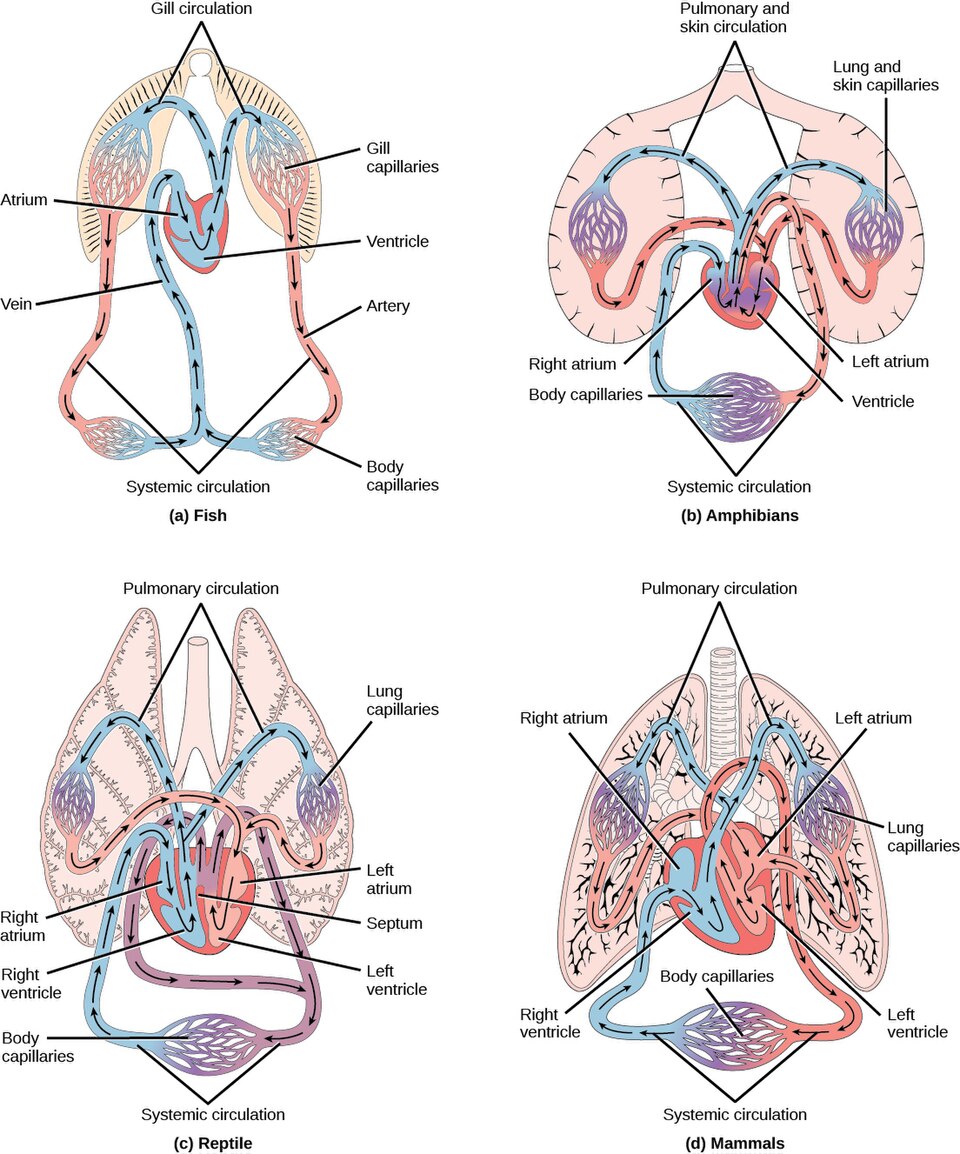

B1(b). A mammal has a double circulation. Explain one advantage of this. (IGCSE Biology: circulatory systems) (2)
B2. Write the word equation for aerobic respiration. (IGCSE Biology: respiration) (2)
B3. Name the protein in red blood cells that carries oxygen, and the metal element it contains. (IGCSE Biology: blood) (2)
Check your answers to Part B
B1(a) (1)
- Fish: once; mammal: twice (both needed) (1)
B1(b) (2)
- Blood comes back to the heart after the lungs and is pumped again (1)
- So it reaches the body at a high pressure and flows quickly, delivering oxygen faster (1)
- Or: oxygenated and deoxygenated blood are kept apart, so blood to the body carries more oxygen (1)
- Max 2
B2 (2)
- glucose + oxygen → (1)
- carbon dioxide + water (1)
- IGNORE energy in the products: it is released, but it is not a substance
- DO NOT ACCEPT an equation with the reactants and products the wrong way round
B3 (2)
- Haemoglobin (1)
- Iron (1)
- ACCEPT Fe
- You will meet haemoglobin again in lesson 1.9.
Part C: IGCSE Chemistry (6 marks) 6 min
Show your working in the calculation.
C1. A student needs 50 cm3 of a glucose solution with a concentration of 4.0 g dm−3. Calculate the mass of glucose she must dissolve. (IGCSE Chemistry: concentration) (2)
C2. Stomach juice has a pH of 2. Pancreatic juice has a pH of 8. (a) Which juice is acidic? (b) Name the ion that all acids release when they dissolve in water. (IGCSE Chemistry: acids and alkalis) (2)
C3. Methane, CH4, is a gas at room temperature, but sodium chloride melts only at 801 °C. Explain why, in terms of their structure and bonding. (IGCSE Chemistry: structure and bonding) (2)
Check your answers to Part C
C1 (2)
- 50 cm3 = 0.050 dm3 (1)
- 4.0 × 0.050 = 0.20 g (1)
- ALLOW 0.2 g
- DO NOT ACCEPT an answer with no unit for the final mark
C2 (2)
- (a) Stomach juice (pH below 7) (1)
- (b) The hydrogen ion, H+ (1)
- DO NOT ACCEPT hydroxide for (b)
C3 (2)
- Methane is made of small molecules with weak forces between the molecules: little energy separates them (1)
- Sodium chloride is a giant lattice of ions held by strong attractions between opposite charges: much energy is needed (1)
- DO NOT ACCEPT “the covalent bonds in methane are weak”: the bonds inside the molecule do not break when it boils