The Chromozone / IAL Biology / Unit 1 / Topic 1
Directed study: water and sugars
Work through this on your own after the lesson on carbohydrates, sugars and glycosidic bonds. Part 1 checks that lesson, part 2 is exam-style questions, and part 3 looks back at water, the first lesson of the unit. The spec point in brackets tells you where to revise. It takes about 30 to 35 minutes (26 marks). Type your answer in the box under each question, then press Hand in at the bottom of the page. The mark schemes open after you hand in: then mark yourself point by point. Teachers: this is the page to set as homework.
Teach these first
This page builds on these lessons. Teach them before students start here:
Part 1: retrieval (9 marks) 9 min
Answer from memory first. Then check your notes for anything you could not remember.
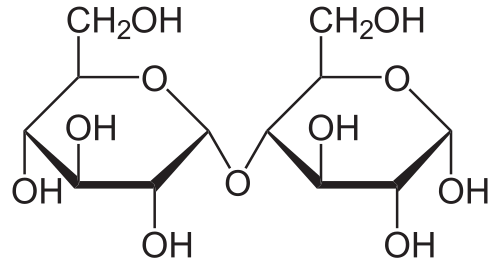

- Sort these carbohydrates into monosaccharides, disaccharides and polysaccharides: galactose, glycogen, lactose, fructose, maltose, amylopectin. (1.2) (3)
- Name the two monosaccharides in each disaccharide: (i) maltose, (ii) sucrose, (iii) lactose. (1.4) (3)
- What is a reducing sugar? (1.2) (1)
- Look at the figure of maltose. Name the bond that joins the two rings, and the carbon atoms it joins. (1.4) (2)
Reveal the mark scheme for part 1
1. Sorting (3)
- Monosaccharides: galactose, fructose (1)
- Disaccharides: lactose, maltose (1)
- Polysaccharides: glycogen, amylopectin (1)
- NB both sugars in a group are needed for its mark
2. Disaccharides (3)
- Maltose: glucose + glucose (1)
- Sucrose: glucose + fructose (1)
- Lactose: glucose + galactose (1)
- NB both monosaccharides are needed for each mark
3. Reducing sugar (1)
- A sugar that can donate electrons to / reduce another chemical (1)
- ACCEPT “a sugar that gives a positive Benedict’s test”
4. Maltose (2)
- A glycosidic bond (1)
- Carbon 1 of one glucose to carbon 4 of the other: α-1,4 (1)
- DO NOT ACCEPT a hydrogen bond or a peptide bond
- ACCEPT “1,4” without α
Part 2: exam-style questions (11 marks) 12 min
Allow about a minute per mark. Use the command word: describe says what happens, explain gives reasons, compare and contrast needs a similarity and a difference.
- 1. Which formula could be a monosaccharide? Write the letter. A C3H6O3 · B C6H10O5 · C C12H22O11 · D C2H6O (1.2) (1)
- 2. Trehalose is a disaccharide found in the blood of insects. It is made of two α-glucose molecules.
(a) Name the type of reaction that joins the two glucose molecules. (1.4) (1) - (b) Glucose has a relative molecular mass (Mr) of 180, and water 18. Calculate the Mr of trehalose. Show your working. (1.4) (2)
- (c) Insects break trehalose down to glucose when they fly. Describe how the bond in trehalose is broken. (1.4) (2)
- 3. Write the formula equation for making one molecule of sucrose from glucose and fructose. (Both have the formula C6H12O6.) (1.4) (2)
- 4. Compare and contrast the structure of glucose with the structure of maltose. (1.2) (3)
Reveal the mark scheme for part 2
Question 1 (1)
- A (1)
- DO NOT ACCEPT C (a disaccharide)
A is a triose, C3(H2O)3. B is a glucose unit inside a polysaccharide; C is a disaccharide; D is not a carbohydrate.
Question 2(a) (1)
- Condensation (1)
- DO NOT ACCEPT hydrolysis
Question 2(b) (2)
- 2 × 180 = 360, minus one water (18) (1)
- 342 (1)
- ALLOW one mark for 324 (two waters subtracted)
- ALLOW ecf from a wrong working mark
Question 2(c) (2)
- Hydrolysis: a molecule of water is added (1)
- The glycosidic bond breaks, releasing two glucose (enzyme-catalysed) (1)
- DO NOT ACCEPT condensation
Question 3 (2)
- C6H12O6 + C6H12O6 → C12H22O11 (1)
- + H2O (1)
- ACCEPT the formulae in any order
- DO NOT ACCEPT an equation that does not balance
Question 4 (3): at least one similarity and one difference
- Similarity: both contain α-glucose (C, H and O only) (1)
- Difference: glucose is one sugar unit; maltose is two (1)
- Difference: maltose has a glycosidic bond; glucose has none (1)
- Difference: C6H12O6 against C12H22O11 (1)
- Max 3
- DO NOT PIECE TOGETHER a comparison from separate statements about each molecule
Part 3: looking back at water (6 marks) 6 min
Spaced practice from the first lesson of the unit, water (1.1).
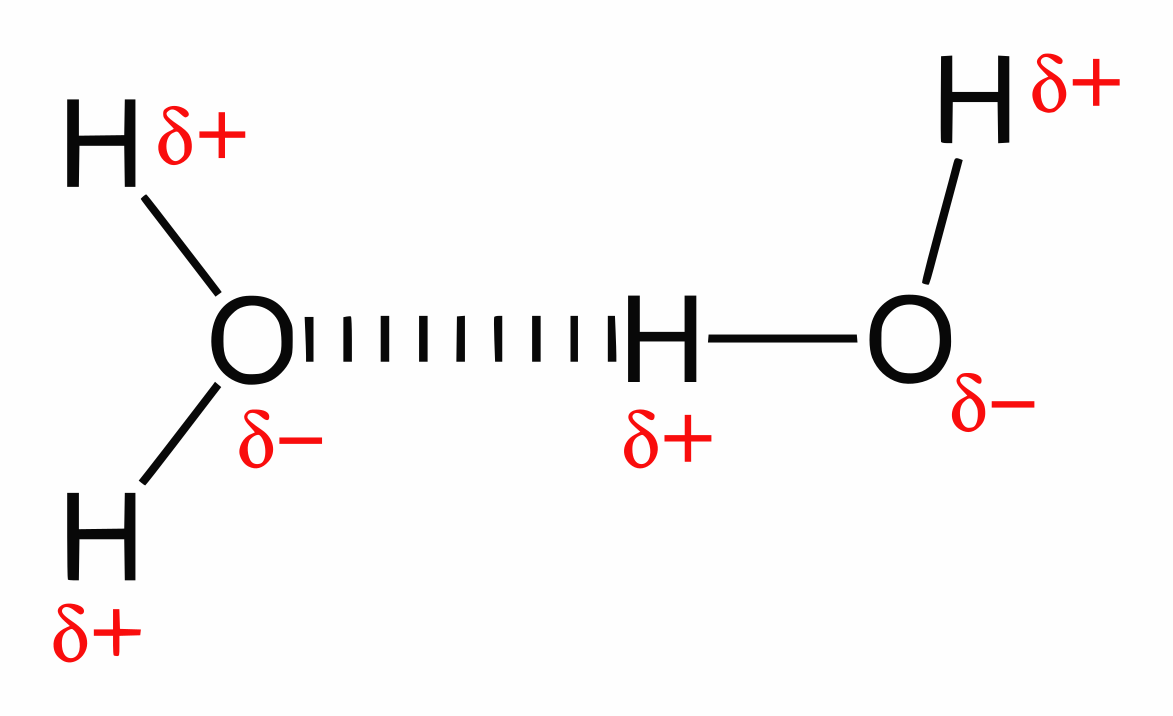

- Look at the figure of two water molecules. Name the bond shown by the dashed line, and the bond shown by each solid line. (1.1) (2)
- Give two reasons why being a good solvent makes water important to living organisms. (1.1) (2)
- Each hydrogen bond is weak. Explain how hydrogen bonds still give water its special properties. (1.1) (2)
Reveal the mark scheme for part 3
1. The bonds (2)
- Dashed line: hydrogen bond (1)
- Solid lines: covalent bonds (1)
- DO NOT ACCEPT ionic bonds
2. A good solvent (2)
- Substances are carried in solution: plasma, xylem, phloem (1)
- Reactions in cells take place in solution, in the cytoplasm (1)
- IGNORE “water dissolves things” with no link to transport or reactions
3. Weak bonds, strong effect (2)
- There are very many hydrogen bonds (1)
- Together they hold water molecules together: cohesion (1)
- ACCEPT “strong in total” for the first point