The Chromozone / IAL Biology / Unit 1 / Topic 1
Directed study: mass transport and blood vessels
Directed study after the lessons on mass transport (1.6) and blood vessels (1.7). Part A checks what you remember from the two lessons, and Part B is exam-style questions. It takes about 27 minutes and is worth 25 marks. Type your answers in the boxes, then hand them in at the bottom of the page. The answers open after you hand in: then mark your work point by point and correct it in green. The spec point in brackets tells you where to revise. Teachers: set this after the lesson 1.7 Blood vessels.
Teach these first
This page builds on these lessons. Teach them before students start here:
Part A: what do you remember? (6 marks) 6 min
Answer from memory first. Then look back at your notes for anything you could not remember.
A flatworm can be 20 mm long but less than 1 mm thick. It has no heart and no blood vessels. Explain how it can survive without a mass transport system. (1.6) (2)
A mouse and a lizard have about the same mass. The cells of the mouse need oxygen delivered much faster than the cells of the lizard. Explain why. (1.6) (2)
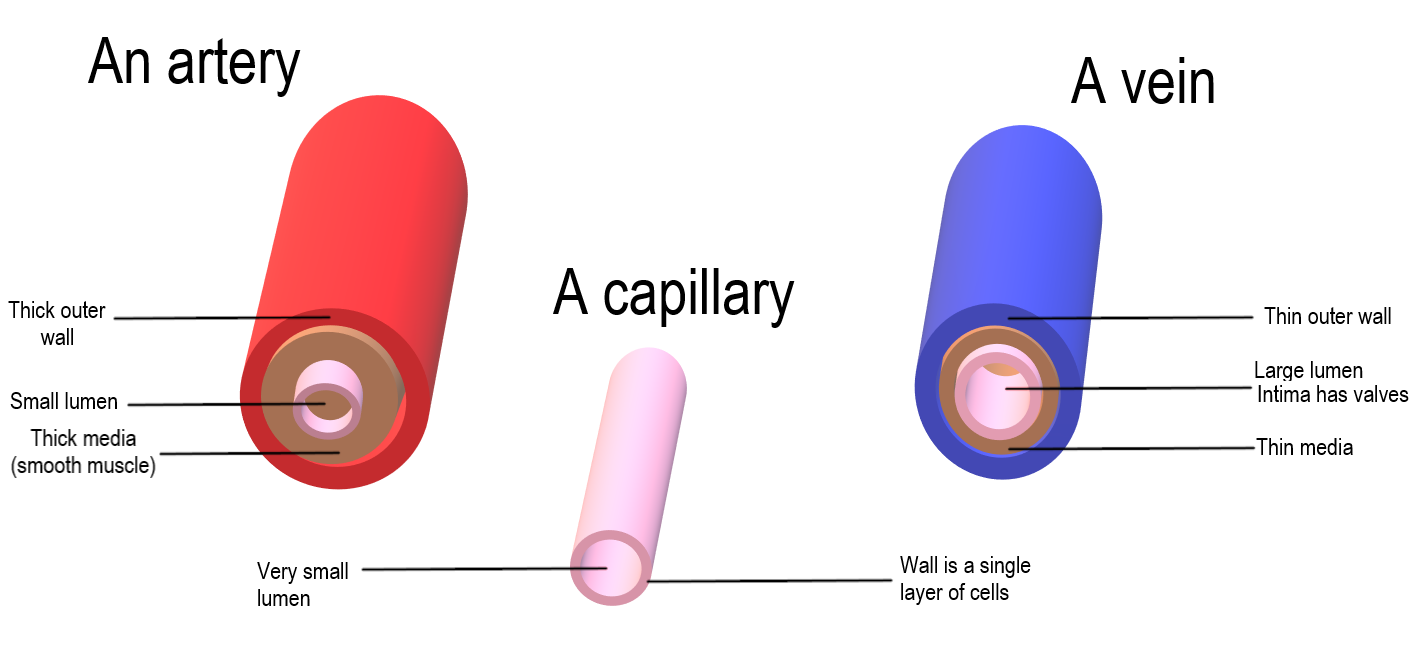
Spot the mistakes. A student wrote: "Capillaries have thick, muscular walls so that they can withstand the high pressure of the blood." Explain what is wrong with this statement. (1.7) (2)

Reveal the answers to Part A
Retrieval 1 (2)
- Its body is thin and flat, so every cell is close to the surface (1)
- So the diffusion distance is short and diffusion alone is fast enough (1)
- ACCEPT a large surface area for its volume; a low metabolic rate
- Max 2
Retrieval 2 (2)
- The mouse keeps its body warm; the lizard does not (1)
- So the mouse has a higher metabolic rate: its cells respire faster (1)
- ACCEPT the mouse is more active, so it uses oxygen faster
Retrieval 3 (2)
- Capillary walls are one cell thick (endothelium only), with no muscle (1)
- Thin walls give a short diffusion distance; arteries withstand the high pressure (1)
- DO NOT ACCEPT "capillaries are thin" with no reference to one cell
Part B, question 1: pressure in the blood vessels (1.7) (6 marks) 7 min
The table shows the highest and the lowest blood pressure in each type of vessel during one heartbeat. In the capillaries and veins the pressure hardly changes during a heartbeat.
| Blood vessel | Highest pressure (ventricular systole) / kPa | Lowest pressure (diastole) / kPa |
|---|---|---|
| Aorta | 15.2 | 10.0 |
| Large arteries | 15.0 | 10.2 |
| Small arteries | 13.6 | 9.8 |
| Arterioles | 8.4 | 6.6 |
| Capillaries | 3.5 | 3.5 |
| Veins | 1.2 | 1.2 |
| Vena cava | 0.4 | 0.4 |
The pulse pressure is the highest pressure minus the lowest pressure. Doctors are concerned if the pulse pressure in the aorta is less than a quarter (25%) of its highest pressure. Use the table to decide whether this person's pulse pressure is a concern. Show your working. (2)
The mean arterial pressure (MAP) can be estimated with this formula: MAP = lowest pressure + (highest pressure − lowest pressure) ÷ 3. Calculate the MAP in the large arteries. Give your answer to one decimal place. (2)
Use the data to explain why the walls of veins can be much thinner than the walls of arteries. (2)
Reveal the mark scheme for question 1
1(a) (2)
- Pulse pressure: 15.2 − 10.0 = 5.2 kPa (1)
- 25% of 15.2 = 3.8 kPa; 5.2 is above it (34%), so no concern (1)
- ALLOW ecf for the conclusion from the pulse pressure calculated
1(b) (2)
- 10.2 + (15.0 − 10.2) ÷ 3 = 10.2 + 1.6 (1)
- 11.8 kPa (1)
- NB a correct answer with no working gains both marks
1(c) (2)
- Pressure in veins is low (1.2 kPa); in arteries 10 to 15 kPa (1)
- No high-pressure surges, so less muscle and elastic tissue needed (1)
- NB the first point needs figures from the table for both vessels
Part B, question 2: arteries, capillaries and veins (1.7) (7 marks) 7 min
For each structure in the first table, give where it is found: artery only, capillary only, vein only, artery and vein, or all three. (4)
Some structures found in blood vessels Row Structure 1 A thick layer of elastic fibres and smooth muscle 2 A wall made of a single layer of flattened cells 3 Pocket-shaped valves along its length 4 Smooth muscle and collagen fibres in the wall Row 1Row 2Row 3Row 4Describe how the speed of the blood changes as it flows from the aorta to the vena cava. Use the data in the second table. (3)
Mean speed of the blood in different vessels Blood vessel Mean speed of the blood / cm s−1 Aorta 30 Large arteries 20 Arterioles 1.5 Capillaries 0.05 Venules 0.8 Veins 5 Vena cava 12
Reveal the mark scheme for question 2
2(a) (4)
- Row 1: artery only (1)
- Row 2: capillary only (1)
- Row 3: vein only (1)
- Row 4: artery and vein (1)
2(b) (3)
- Speed falls from the aorta (30) through the arteries and arterioles (1)
- Slowest in the capillaries: 0.05 cm s−1, 600 times slower than the aorta (1)
- Rises again in venules and veins, to 12 in the vena cava (1)
- NB one quoted value with its vessel and unit is needed for full marks
- IGNORE "speed changes" with no direction
Part B, question 3: small red blood cells (1.6, 1.7) (2 marks) 2 min
A goat's red blood cells are about 4 µm across. A human's are about 7.5 µm across. Explain why smaller red blood cells can take up and release oxygen more quickly. (2)
Reveal the mark scheme for question 3
3 (2)
- Smaller cells have a larger surface area to volume ratio (1)
- So oxygen diffuses in and out faster; shorter distance to the centre (1)
- DO NOT ACCEPT "a larger surface area" with no mention of the ratio
Part B, question 4: a caterpillar's circulation (1.6) (4 marks) 5 min
Insects have an open circulation. A tube-shaped heart pumps the blood forwards at low pressure, and the blood then flows freely through the spaces around the organs instead of staying inside blood vessels.
A silkworm caterpillar is about 40 mm long and 6 mm across. Treat it as a cylinder: its surface area is about 810 mm2, and the volume of a cylinder = πr2 × length.
Calculate the surface area to volume ratio of the caterpillar. (2)
Suggest why a caterpillar can survive with an open, low-pressure circulation, but a mammal needs its blood pumped through blood vessels at high pressure. (2)
Reveal the mark scheme for question 4
4(a) (2)
- Volume = π × 32 × 40 = 1131 mm3 (1)
- SA:V = 810 ÷ 1131 = 0.72:1 (1)
- ACCEPT 0.7:1 or 0.72
- NB using the diameter (6 mm) as the radius loses the first mark only
- ALLOW ecf for the ratio from the volume
4(b) (2)
- The caterpillar is small: its cells are close to the blood (1)
- It does not keep its body warm: lower metabolic rate, lower demand (1)
- A mammal is larger and warm: blood must reach every cell fast (1)
- ACCEPT insects get their oxygen through air tubes (tracheae), not from the blood
- Max 2