The Chromozone / IAL Biology / Unit 1 / Topic 1
Directed study: the heart and haemoglobin
Directed study after the lessons on the heart and the cardiac cycle (1.8) and haemoglobin (1.9). Part A checks what you remember from the two lessons, and Part B is exam-style questions. It takes about 26 minutes and is worth 24 marks. Type your answers in the boxes, then hand them in at the bottom of the page. The answers open after you hand in: then mark your work point by point and correct it in green. The spec point in brackets tells you where to revise. Teachers: set this after the lesson 1.9 Haemoglobin.
Teach these first
This page builds on these lessons. Teach them before students start here:
Part A: what do you remember? (9 marks) 8 min
Answer from memory first. Then look back at your notes for anything you could not remember.
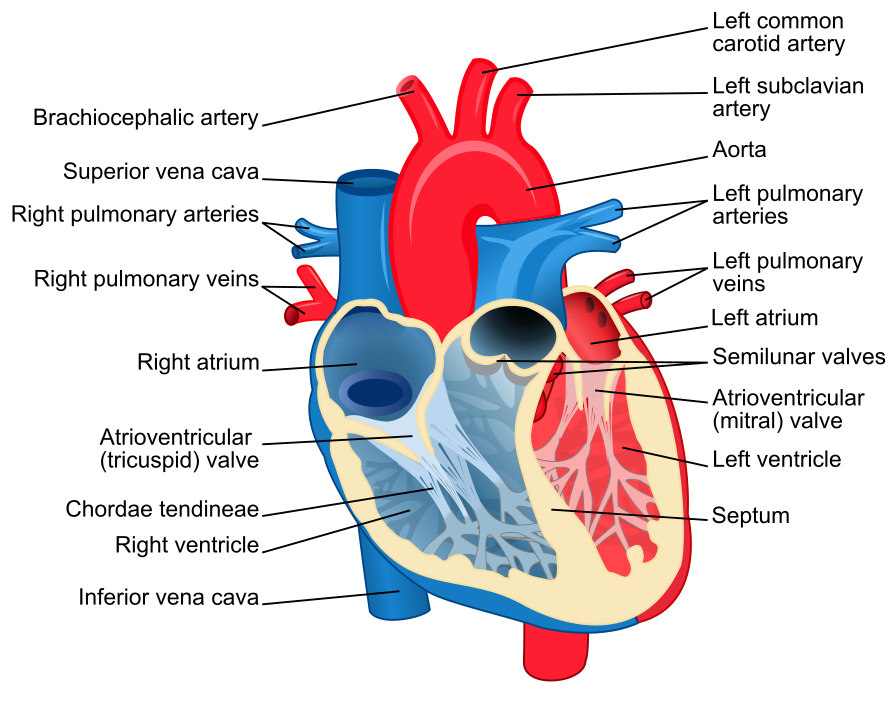
Blood enters the heart from the vena cava. Give the order in which the blood passes through these: aorta, left atrium, left ventricle, lungs, pulmonary artery, pulmonary vein, right atrium, right ventricle. (1.8) (2)
For each moment in the table, state whether the AV (bicuspid) valve and the semilunar valve in the aorta are open or closed. (1.8) (3)
Pressure on the left side of the heart at three moments Moment Left atrium / kPa Left ventricle / kPa Aorta / kPa A 0.8 0.6 10.9 B 0.6 14.2 13.8 C 0.5 7.0 12.0 Moment AMoment BMoment CState how many polypeptide chains and haem groups one haemoglobin molecule has, and the largest number of oxygen molecules it can carry. (1.9) (2)
After birth, a baby's fetal haemoglobin is slowly replaced by adult haemoglobin. Explain why adult haemoglobin suits the baby better once it breathes air. (1.9) (2)
Reveal the answers to Part A
Retrieval 1 (2)
- Right atrium, right ventricle, pulmonary artery, lungs (1)
- Pulmonary vein, left atrium, left ventricle, aorta (1)
- NB one mark for each half with every structure in the right order

Retrieval 2 (3)
- A: AV valve open, semilunar valve closed (1)
- B: AV valve closed, semilunar valve open (1)
- C: both valves closed (1)
- NB a valve opens when the pressure behind it is higher than the pressure in front: at C the ventricle is above the atrium but still below the aorta
Retrieval 3 (2)
- Four polypeptide chains, each with one haem group (1)
- Up to four oxygen molecules (O2), one per haem (1)
- DO NOT ACCEPT oxygen atoms
Retrieval 4 (2)
- Adult haemoglobin has a lower affinity for oxygen (1)
- So it unloads oxygen more easily to respiring tissues (1)
- ACCEPT pO2 in the lungs is high, so adult haemoglobin still loads fully (for the second point)
- DO NOT ACCEPT "higher affinity"
Part B, question 1: timing the cardiac cycle (1.8) (9 marks) 9 min
At rest, one cardiac cycle of a student's heart takes 0.75 s. The diagram shows when each stage happens.
Which row describes the atria and the ventricles during ventricular systole? Write the letter. (1)
Choose one row Row Atria Ventricles A contracted contracted B contracted relaxed C relaxed contracted D relaxed relaxed The ventricles start to contract only after the atria have finished contracting. Explain why this is important. (2)
Calculate the length of ventricular systole in milliseconds. Give your answer in standard form. (2)
State the fraction of the cardiac cycle that is cardiac diastole. (1)
During exercise, this person's cardiac cycle becomes 0.35 s shorter. Calculate the increase in heart rate, in beats per minute. Show your working. (3)
Reveal the mark scheme for question 1
1(a) (1)
- C (1)
- DO NOT ACCEPT a description with no letter
1(b) (2)
- The atria empty their blood into the ventricles first (1)
- So the ventricles are full when they contract: more blood pumped out (1)
- DO NOT ACCEPT "so the valves can close" on its own
1(c) (2)
- 0.40 − 0.10 = 0.30 s = 300 ms (1)
- 3.0 × 10² ms (1)
- ACCEPT 3 × 10² ms
- NB 300 ms gains the first mark only: the answer must be in standard form
1(d) (1)
- 0.35 ÷ 0.75 = 0.47 (1)
- ACCEPT 7/15 or 47%
1(e) (3)
- At rest: 60 ÷ 0.75 = 80 beats per minute (1)
- Exercise: 0.75 − 0.35 = 0.40 s, so 60 ÷ 0.40 = 150 beats per minute (1)
- Increase = 70 beats per minute (1)
- NB the correct answer, 70, gains all three marks
- ALLOW ecf for the increase from the two rates
Part B, question 2: a shrew and a horse (1.6, 1.9) (6 marks) 9 min
A shrew is one of the smallest mammals. The graph shows the oxygen dissociation curves of shrew and horse haemoglobin. The table shows how much oxygen their body tissues use.
| Animal | Body mass | Oxygen used / cm3 per gram of body per hour |
|---|---|---|
| Shrew | 8 g | 6.8 |
| Horse | 500 kg | 0.22 |
Explain the difference between the oxygen dissociation curves of the shrew and the horse. Use the information in the graph and the table to support your answer. (6)
Reveal the mark scheme for question 2
2 (6)
Indicative content (not marked line by line)
- AO1: the shrew curve is to the right, so its haemoglobin has a lower affinity for oxygen and unloads more oxygen at the same pO2
- AO1: both are almost fully saturated at lung pO2 (about 13 kPa)
- AO2: half saturated at 5.0 kPa for the shrew and 3.4 kPa for the horse; at 4 kPa the shrew unloads about 61% and the horse about 36%
- AO2: shrew tissues use about 30 times more oxygen per gram (6.8 against 0.22)
- AO2: a small shrew has a large SA:V, so it loses heat fast and respires fast to keep warm, so its cells need more oxygen
Levels
- Level 1 (marks 1 to 2): describes the difference in the curves or in oxygen use, with little or no explanation
- Level 2 (marks 3 to 4): links the lower affinity to more unloading, for a higher oxygen use
- Level 3 (marks 5 to 6): the full chain, with SA:V and heat loss, using the data from both the graph and the table