The Chromozone / IAL Biology / Unit 4 / Topic 5
Directed study: review
Spaced repetition: the Calvin cycle, mitosis and the heart
A spaced repetition sheet: short questions on things you learned weeks or months ago, brought back just when you are most likely to forget them. It takes about 22 minutes and is worth 19 marks. Answer from memory first; only then look back at the lesson. Type your answers in the boxes, then hand them in at the bottom of the page. The mark schemes open after you hand in: then mark yourself point by point and correct your work in a different colour. The spec point and topic in brackets after each question tell you where to revise. Teachers: this is the page to set as homework.
Where these questions come from
Set after the lesson 5.11 Introduction to ecology: the key terms. Nothing on this sheet comes from that lesson: every question brings back something you learned earlier, just when you are most likely to forget it. Teach these lessons before students start here:
- Part A, about a week back: 5.4 The light-independent reactions (Calvin cycle); 5.2, 5.4 Uses of glucose and ATP
- Part B, about a month back: 3.14 The cell cycle and mitosis; 3.15 Core practical 6: a root tip squash
- Part C, Unit 1: 1.8 The mammalian heart and the cardiac cycle; 2.1 Gas exchange surfaces and Fick's law
Part A: about a week back (7 marks) 8 min
From the first four lessons of Topic 5: chloroplasts, the light-dependent reactions, the Calvin cycle and the uses of glucose.
A1. Spot the mistakes. A student wrote this paragraph about the Calvin cycle. Find the four mistakes and correct each one. (5.4, Topic 5) (4)
"The light-independent reactions take place on the thylakoid membranes. Carbon dioxide combines with RuBP, a 6-carbon compound, to form GP. GP is oxidised to GALP, using ATP from the light-dependent reactions. Five out of every six GALP molecules leave the cycle to make glucose."
A2. Rice grains store protein as well as starch. Describe how a rice plant makes the protein in its grains, starting from the GALP made in its leaves. (5.4, Topic 5) (3)
Check your answers to part A
A1 (4)
- Not on the thylakoid membranes: in the stroma (1)
- RuBP is a 5-carbon compound, not 6-carbon (1)
- GP is reduced to GALP (not oxidised), using reduced NADP as well as ATP (1)
- Five out of every six GALP regenerate RuBP; only one in six leaves the cycle to make glucose (1)
A2 (3): max 3
- GALP is used to make amino acids (in the leaf or the grain) (1)
- This needs nitrogen, taken up from the soil as nitrate ions (1)
- Amino acids are carried to the grain (in the phloem) and joined by peptide bonds in condensation reactions (1)
- at the ribosomes, in the order set by the mRNA (translation) (1)
- DO NOT ACCEPT "protein carried in the phloem"
Part B: about a month back (4 marks) 5 min
In teaching order 15 to 25 lessons before this one, in Unit 2 (Topic 3).
B1. A body cell of an onion has 16 chromosomes. Give the number of chromosomes and the number of chromatids in (a) a cell at metaphase of mitosis; (b) each daughter cell just after cytokinesis. (3.14, Topic 3) (2)
B2. In core practical 6, a student cut 2 cm from the end of a garlic root to make her squash. She saw almost no cells in mitosis. Explain why, and state what she should have done instead. (3.15, Topic 3) (2)
Check your answers to part B
B1 (2)
- (a) 16 chromosomes, 32 chromatids (1)
- (b) 16 chromosomes, 16 chromatids (each chromosome is one chromatid) (1)
B2 (2)
- Cells divide only in the first few millimetres, the meristem just behind the root cap; most of a 2 cm piece is cells that are growing longer or specialising (1)
- Use only the tip, about the last 5 mm (or less) (1)
Part C: Unit 1 (8 marks) 8 min
Two months or more back: Topics 1 and 2.
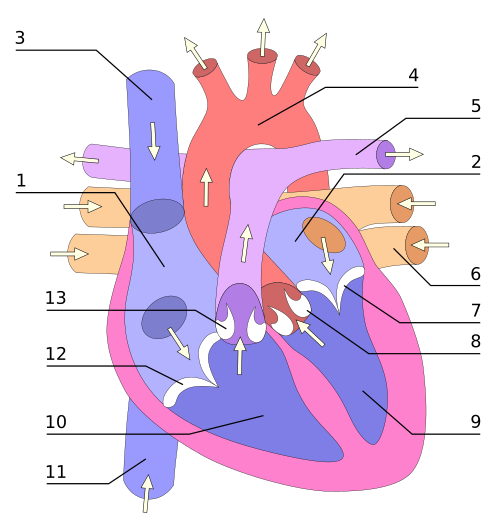
C1. Use the numbered drawing of the heart. Give the number of (a) the chamber that pumps blood to the lungs; (b) the vessel that brings oxygenated blood back from the lungs; (c) the valve that closes when the left ventricle starts to contract; (d) the valve that stops blood flowing back from the aorta into the heart. (1.8, Topic 1) (4)

C2. In pneumonia, the alveoli fill with fluid. Use Fick's law to explain why a person with pneumonia may be short of oxygen. (2.1, Topic 2) (3)
C3. Name the stage of the cardiac cycle in which blood flows from the atria into the relaxed ventricles, with all the chambers relaxed. (1.8, Topic 1) (1)
Check your answers to part C
C1 (4)
- (a) 10 (right ventricle) (1)
- (b) 6 (pulmonary vein) (1)
- (c) 7 (bicuspid or mitral valve) (1)
- (d) 8 (semilunar valve in the aorta) (1)
C2 (3)
- The fluid makes the diffusion distance between the air and the blood longer (a thicker barrier) (1)
- Fick's law: rate of diffusion is proportional to surface area × difference in concentration ÷ thickness (1)
- So oxygen diffuses into the blood more slowly (and fluid-filled alveoli give a smaller area for exchange) (1)
C3 (1)
- Cardiac diastole (1)
- DO NOT ACCEPT "ventricular diastole" on its own