The Chromozone / IAL Biology / Unit 4 / Topic 5
Directed study: chloroplasts and the light-dependent reactions
Work through this on your own after the lesson on the light-dependent reactions. Part 1 checks that lesson, part 2 is exam-style questions, and part 3 looks back at chloroplast structure, the first lesson of the unit. The spec point in brackets tells you where to revise. It takes about 30 to 35 minutes (27 marks). Type your answer in the box under each question, then press Hand in at the bottom of the page. The mark schemes open after you hand in: then mark yourself point by point. Teachers: this is the page to set as homework.
Teach these first
This page builds on these lessons. Teach them before students start here:
Part 1: retrieval (9 marks) 9 min
Answer from memory first. Then check your notes for anything you could not remember.

- Write the balanced symbol equation for photosynthesis. (5.1) (2)
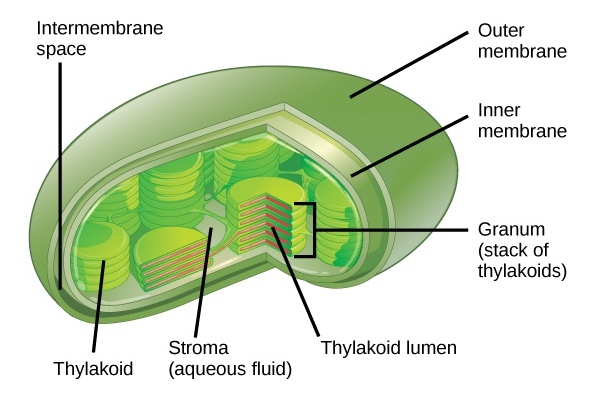
- Use the drawing of a chloroplast. Say precisely where each of these happens: (i) the photolysis of water; (ii) the reduction of NADP; (iii) the joining of ADP and Pi. (5.3) (3)
- Put these in the order an electron passes through them in non-cyclic photophosphorylation: NADP, photosystem I, water, electron carriers, photosystem II. (5.3) (2)
- A plant kept in the dark gives off no oxygen. Explain why. (5.3) (2)
Reveal the mark scheme for part 1
1. The equation (2)
- Correct formulae: CO2 and H2O → C6H12O6 and O2 (1)
- Balanced: 6CO2 + 6H2O → C6H12O6 + 6O2 (1)
- ALLOW multiples, e.g. 12CO2 + 12H2O → 2C6H12O6 + 12O2
2. Where it happens (3)
- (i) Inside the thylakoid (thylakoid space), at photosystem II (1)
- (ii) On the stroma side of the thylakoid membrane, at photosystem I (1)
- (iii) At ATP synthase in the thylakoid membrane; ATP is released into the stroma (1)
- DO NOT ACCEPT "in the chloroplast" alone
3. The path of an electron (2)
- Water, then photosystem II (1)
- Then electron carriers, photosystem I, NADP (1)
- NB all five in the right order: 2 marks; one pair swapped: 1 mark
4. No oxygen in the dark (2)
- No light energy, so water is not split (no photolysis) (1)
- The oxygen released in photosynthesis comes only from water (1)
- ACCEPT the plant still respires, which uses oxygen
- DO NOT ACCEPT oxygen comes from carbon dioxide
Part 2: exam-style questions (11 marks) 12 min
Allow about a minute per mark. Use the command word: describe says what happens, explain gives reasons, calculate needs working and units.
- 1. Which statement describes how ATP is made in the light-dependent reactions? Write the letter. (5.2)A ATP is hydrolysed and energy is releasedB ADP is phosphorylated and energy is neededC ADP is phosphorylated and energy is releasedD ATP is hydrolysed and energy is needed (1)
- 2. Breaking one mole of O–H bonds needs 459 kJ. In photolysis, one O–H bond is broken in each water molecule. Use the equation for photosynthesis to calculate the energy needed to break these bonds in the water used to make one mole of glucose. Show your working. (5.1, 5.3) (2)
- 3. Explain how the energy carried by the excited electrons is used to make ATP in the thylakoid membrane. (5.3) (4)
- 4. Give two differences between cyclic and non-cyclic photophosphorylation. (5.3) (2)
- 5. Explain the role of chlorophyll in the light-dependent reactions. (5.3) (2)
Reveal the mark scheme for part 2
Question 1 (1)
- B (1)
Question 2 (2)
- 6 moles of water are used, one bond each: 6 × 459 (1)
- 2754 kJ (1)
- ALLOW a correct answer with no working for both marks
Question 3 (4)
- Electrons pass along the electron transport chain (carriers) (1)
- They release energy as they go (1)
- The energy pumps H+ ions into the thylakoid space (1)
- H+ ions diffuse back to the stroma through ATP synthase (1)
- This joins ADP and Pi to make ATP (chemiosmosis) (1)
- Max 4
- DO NOT ACCEPT ATP synthase pumps the H+ ions
Question 4 (2)
- Cyclic uses only photosystem I; non-cyclic uses both (1)
- Cyclic does not split water (no photolysis) (1)
- Cyclic releases no oxygen (1)
- Cyclic makes no reduced NADP (1)
- Cyclic makes less ATP (1)
- Max 2
- ACCEPT the converse for non-cyclic
Question 5 (2)
- Chlorophyll absorbs light energy (1)
- This excites electrons, which leave the chlorophyll (photoionisation) (1)
- ACCEPT the electrons pass to the electron carriers, to make ATP and reduced NADP
Part 3: looking back at chloroplast structure (7 marks) 8 min
Spaced practice from the first lesson of the unit, chloroplast structure (5.5).

- A chloroplast is 6 µm long. In an electron micrograph, its image is 48 mm long. Calculate the magnification of the micrograph. Show your working. (5.5) (2)
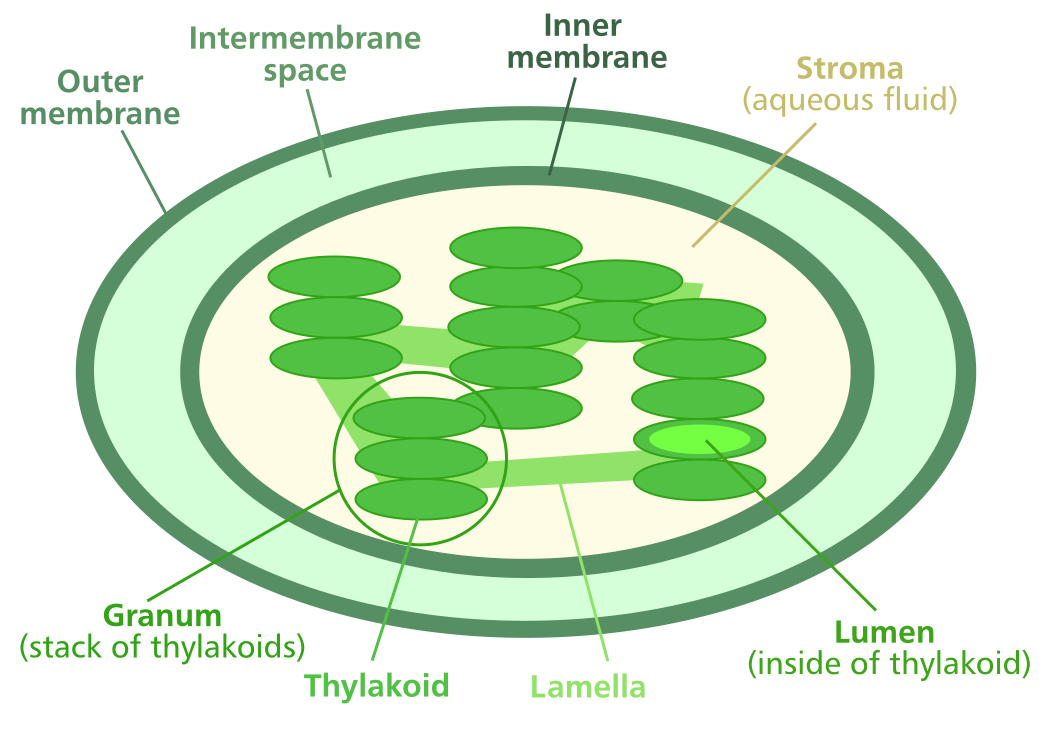
- A student wrote: "The light-independent reactions take place in the grana." Correct the statement, and explain why that place suits these reactions. (5.5) (2)
- Compare and contrast the structure of the chloroplast envelope with the structure of a thylakoid membrane. (5.5) (3)
Reveal the mark scheme for part 3
1. Magnification (2)
- 48 mm = 48 000 µm (1)
- 48 000 ÷ 6 = × 8000 (1)
- DO NOT ACCEPT a unit with the magnification
2. Correct the statement (2)
- They take place in the stroma (1)
- The stroma holds the enzymes (such as RUBISCO) and surrounds the thylakoids that make ATP and reduced NADP (1)
- DO NOT ACCEPT "stoma"
3. Envelope and thylakoid membrane (3)
- Similarity: both are phospholipid bilayers with proteins (1)
- The envelope is two membranes; a thylakoid has one (1)
- Thylakoid membranes hold photosystems (chlorophyll), electron carriers and ATP synthase (1)
- Thylakoids are stacked into grana; the envelope surrounds the whole chloroplast (1)
- Max 3, and at least one must be a similarity