The Chromozone / IAL Biology / Unit 4 / Topic 5
Directed study: the Calvin cycle and uses of glucose
Work through this on your own after the lesson on uses of glucose and ATP. Part 1 checks that lesson and the Calvin cycle, part 2 is exam-style questions, and part 3 looks back at earlier lessons in the unit: the light-dependent reactions and chloroplast structure. The spec point in brackets tells you where to revise. It takes about 35 minutes (30 marks). Type your answer in the box under each question, then press Hand in at the bottom of the page. The mark schemes open after you hand in: then mark yourself point by point. Teachers: this is the page to set as homework.
Teach these first
This page builds on these lessons. Teach them before students start here:
Part 1: retrieval (9 marks) 9 min
Answer from memory first. Then check your notes for anything you could not remember.

- True or false? Write T or F for each, and correct each false statement. (a) RUBISCO joins carbon dioxide to GALP. (b) GP is reduced to GALP using reduced NADP and ATP. (c) Regenerating RuBP uses ATP. (d) For every three molecules of carbon dioxide fixed, one GALP leaves the cycle. (5.4) (4)
- A plant makes these molecules from GALP. For each, name the element it must also take up from the soil, or write "none": (a) amino acids; (b) nucleotides (two elements); (c) triglycerides. (5.4) (3)
- Starch and cellulose are both made from glucose. Give two differences between them. (5.4) (2)
Reveal the mark scheme for part 1
1. True or false (4)
- (a) False: RUBISCO joins carbon dioxide to RuBP (1)
- (b) True (1)
- (c) True (1)
- (d) True (1)
- DO NOT ACCEPT RUBISCO joins carbon dioxide to GP
2. Elements from the soil (3)
- (a) Nitrogen (as nitrate ions) (1)
- (b) Phosphorus (phosphate ions) and nitrogen (1)
- (c) None: triglycerides contain only carbon, hydrogen and oxygen (1)
3. Starch and cellulose (2): any two
- Starch is made of α-glucose; cellulose of β-glucose (1)
- Starch is an energy store; cellulose makes cell walls (1)
- Starch is coiled or branched; cellulose forms straight chains in microfibrils (1)
- Max 2
- ACCEPT the converse for cellulose
Part 2: exam-style questions (15 marks) 16 min
Allow about a minute per mark. Use the command word: describe says what happens, explain gives reasons, describe and explain needs both, with data from the graph.
- 1. In which part of a chloroplast are the bonds in a new glucose molecule formed? Write the letter. (5.4)A the envelopeB the stromaC the thylakoid membraneD the thylakoid space (1)
- 2. To fix three molecules of carbon dioxide, the Calvin cycle uses 9 ATP and 6 reduced NADP.
(a) Give the ratio of ATP to reduced NADP used, in its simplest form. (5.4) (1) - (b) The three turns of the cycle make six GALP, but only one leaves the cycle. Explain why the plant cannot use all six to make glucose. (5.4) (2)
- 3. A glucose molecule made in photosynthesis contains carbon, hydrogen and oxygen atoms. Name the molecule that supplies (a) the carbon, (b) the hydrogen and (c) the oxygen in the glucose. (5.1, 5.4) (3)
- 4. Scientists kept algae in bright light, then switched the light off at 4 minutes. The graph at the top of part 2 shows the amounts of GP and RuBP in the algae. Describe and explain the changes after the light is switched off. (5.4) (4)
- 5. Sugar beet plants store sucrose in a swollen root. Describe how carbon fixed in the leaves ends up as sucrose and cellulose in the root cells. (5.4) (4)
Reveal the mark scheme for part 2
Question 1 (1)
- B (1)
Question 2(a) (1)
- 3 : 2 (1)
- ACCEPT 1.5 : 1
Question 2(b) (2)
- Five GALP are used to regenerate RuBP (three RuBP) (1)
- Without RuBP, no more carbon dioxide can be fixed, so the cycle would stop (1)
Question 3 (3)
- (a) Carbon dioxide (1)
- (b) Water (through reduced NADP) (1)
- (c) Carbon dioxide (1)
- NB the oxygen in water is released as oxygen gas; it does not end up in the glucose
Question 4 (4): max 4
- GP rises and RuBP falls (1)
- Data, e.g. GP from 30 to about 65 units; RuBP from 60 to about 10 (1)
- No ATP or reduced NADP in the dark, so GP is not reduced to GALP (1)
- RuBP is still used up to fix carbon dioxide (making GP) (1)
- RuBP is not regenerated, because there is no ATP (1)
- DO NOT ACCEPT RUBISCO stops working because it needs light
Question 5 (4): max 4
- GALP is made in the Calvin cycle in the leaf chloroplasts (1)
- GALP is made into glucose; glucose and fructose make sucrose (1)
- Sucrose is carried to the root in the phloem (1)
- In the root, sucrose is stored, or broken down to glucose (1)
- β-glucose molecules are joined (condensation, glycosidic bonds) to make cellulose (1)
- DO NOT ACCEPT xylem for the transport of sucrose
Part 3: looking back at earlier lessons (6 marks) 6 min
Spaced practice from earlier in the unit: the light-dependent reactions (5.1 to 5.3) and chloroplast structure (5.5).
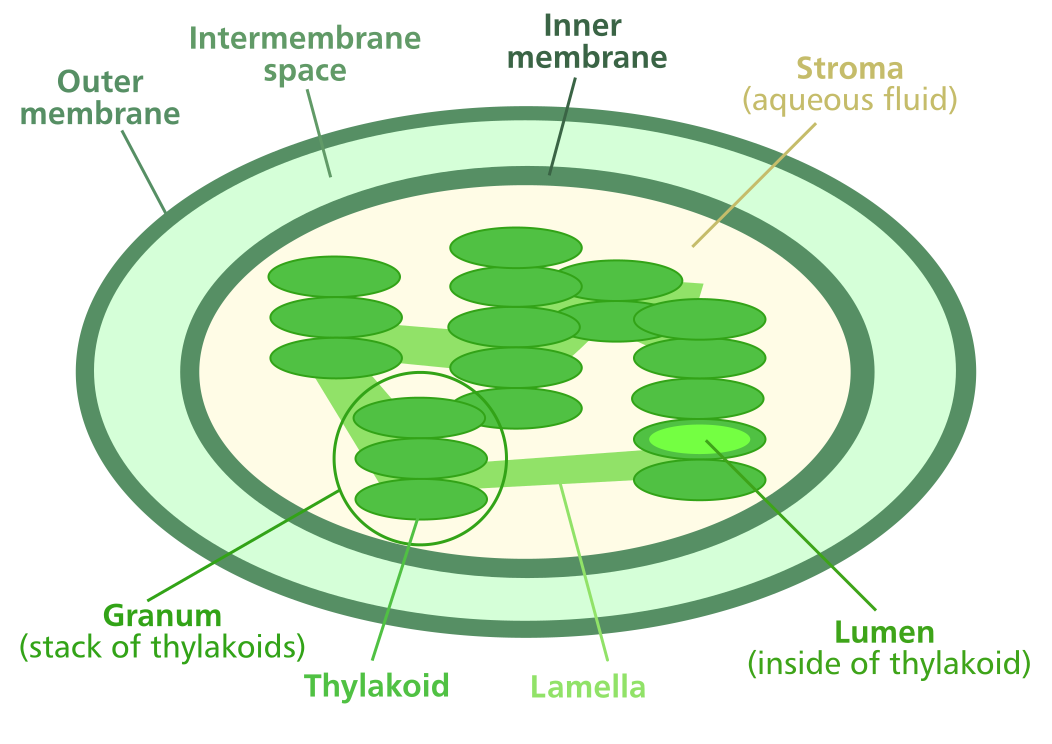

- Describe how NADP is reduced in the light-dependent reactions. (5.3) (2)
- A plant is given water containing a heavy form of oxygen, 18O. Where would the 18O appear first? Explain your answer. (5.1, 5.3) (2)
- Name one substance that must enter a chloroplast through its envelope for photosynthesis, and one product that leaves it. (5.5) (2)
Reveal the mark scheme for part 3
1. Reducing NADP (2)
- NADP gains two electrons from photosystem I (1)
- and a hydrogen ion (from the stroma) (1)
2. Heavy oxygen (2)
- In the oxygen gas released by the plant (1)
- Water is split by photolysis, and its oxygen is released as oxygen gas (1)
- DO NOT ACCEPT "in the glucose"
3. Through the envelope (2)
- Enters: carbon dioxide or water (1)
- Leaves: oxygen or sugars (such as GALP) (1)