The Chromozone / IAL Biology / Unit 4 / Topic 5
Directed study: review
Spaced repetition: back to Units 1 and 2
A spaced repetition sheet: short questions on things you learned weeks or months ago, brought back just when you are most likely to forget them. It takes about 22 minutes and is worth 20 marks. Answer from memory first; only then look back at the lesson. Type your answers in the boxes, then hand them in at the bottom of the page. The mark schemes open after you hand in: then mark yourself point by point and correct your work in a different colour. The spec point and topic in brackets after each question tell you where to revise. Teachers: this is the page to set as homework.
Where these questions come from
Set after the lesson 5.5 Chloroplast structure and photosynthesis. Nothing on this sheet comes from that lesson: every question brings back something you learned earlier, just when you are most likely to forget it. Teach these lessons before students start here:
- Part A, the end of Unit 2: 3.16 The mitotic index; 3.17 Stem cells: totipotent and pluripotent, morula and blastocyst; 3.18 Differential gene expression
- Part B, earlier in Unit 2: 3.3 Eukaryotic cells: ultrastructure and organelles; 3.4 Making and secreting proteins: rough ER and Golgi; 3.5 Prokaryotic cells
- Part C, Unit 1: 2.6 Protein structure: globular and fibrous proteins; 1.11 to 1.13 Blood clotting, CVD risk factors and antioxidants
Part A: the end of Unit 2 (6 marks) 6 min
In teaching order these are the 4 to 7 lessons before this one: the last lessons of Topic 3.
A1. Put these stages in the order they appear as a human embryo develops: blastocyst, 8-cell embryo, zygote, morula. Then name the stage that has an inner cell mass. (3.17, Topic 3) (2)
A2. A doctor counted cells in a sample of normal tissue and in a sample from a tumour. Calculate the mitotic index of each sample, and explain what the difference shows. (3.16, Topic 3) (2)
| Sample | Cells in mitosis | Total cells counted |
|---|---|---|
| Normal tissue | 6 | 500 |
| Tumour | 85 | 500 |
A3. Spot the mistake. A student wrote: "A muscle cell makes actin and myosin because it only contains the genes for muscle proteins." Correct the statement. (3.18, Topic 3) (2)
Check your answers to part A
A1 (2)
- Zygote, 8-cell embryo, morula, blastocyst (1)
- The blastocyst (1)
A2 (2)
- Normal 6 ÷ 500 = 0.012 (1.2%); tumour 85 ÷ 500 = 0.17 (17%) (1)
- Tumour cells divide by mitosis much more often (uncontrolled cell division) (1)
- ACCEPT each answer as a decimal or as a percentage
A3 (2)
- Every body cell contains all the genes (the same DNA) (1)
- Only some genes are switched on (expressed) in a muscle cell, such as the actin and myosin genes (1)
- DO NOT ACCEPT "the muscle cell only has the muscle genes"
Part B: earlier in Unit 2 (9 marks) 9 min
About a month back in teaching order: 15 to 25 lessons before this one, in the first weeks of Topic 3.
B1. Look at the numbered drawing of an animal cell. Give the number of the structure that (a) makes ribosomes; (b) modifies proteins and packages them into vesicles; (c) carries out aerobic respiration and makes ATP; (d) makes lipids such as steroid hormones. (3.3, Topic 3) (4)
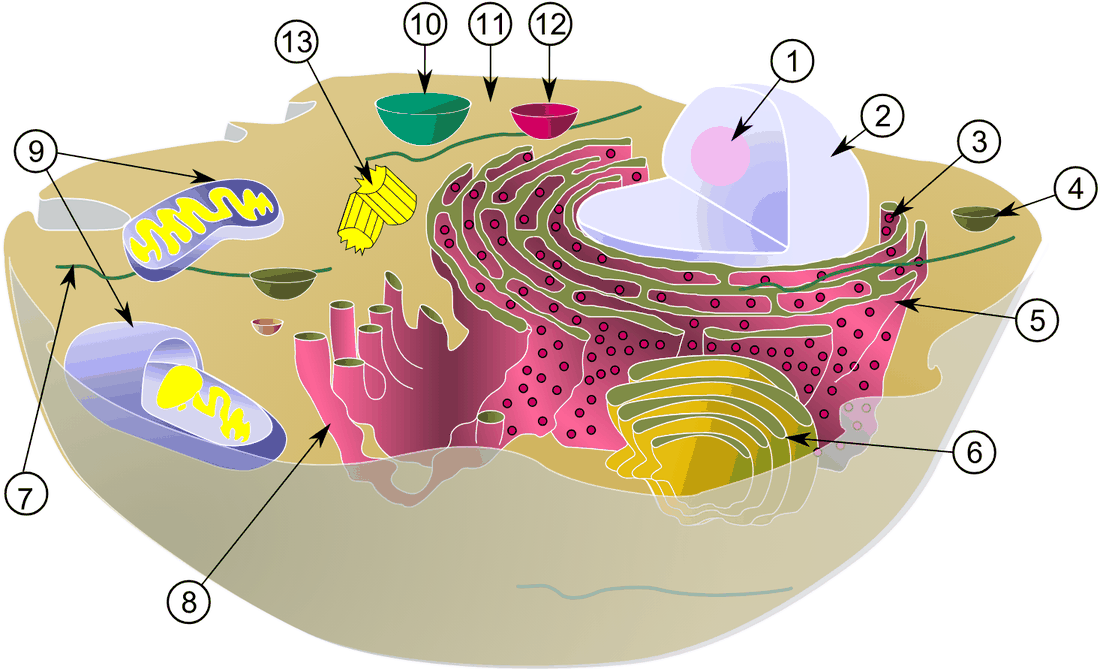

B2. A cell in the pancreas makes and secretes a digestive enzyme. Write the letters P to T in the right order. (3.4, Topic 3) (2)
- P A vesicle fuses with the cell surface membrane.
- Q The polypeptide folds inside the rough endoplasmic reticulum.
- R The Golgi apparatus adds a carbohydrate group to the protein.
- S A ribosome on the rough ER joins amino acids together.
- T A transport vesicle carries the protein to the Golgi apparatus.
B3. Complete the comparison. For each feature, describe it in a prokaryotic cell and in a eukaryotic (animal) cell: (a) where the DNA is, and its shape; (b) the size of the ribosomes; (c) what the cell wall is made of. (3.5, Topic 3) (3)
Check your answers to part B
B1 (4)
- (a) 1 (the nucleolus) (1)
- (b) 6 (the Golgi apparatus) (1)
- (c) 9 (a mitochondrion) (1)
- (d) 8 (the smooth ER) (1)
B2 (2)
- S, Q, T, R, P: all five right (1)
- ALLOW one mark if only one pair of neighbouring letters is swapped
B3 (3)
- (a) Prokaryote: circular DNA, loose in the cytoplasm (no nucleus); eukaryote: linear DNA (chromosomes) inside a nucleus (1)
- (b) Prokaryote: smaller 70S ribosomes; eukaryote: larger 80S ribosomes (1)
- (c) Prokaryote: peptidoglycan (murein); an animal cell has no cell wall (1)
- ACCEPT a plant cell wall made of cellulose for (c)
Part C: Unit 1 (5 marks) 7 min
Two months or more back: Topics 1 and 2.
C1. Egg white is mostly a soluble globular protein. When it is heated to 80 °C it turns solid and white, but its primary structure does not change. Explain why heating changes the protein but not its primary structure. (2.6, Topic 2) (3)
C2. A patient has very few platelets in their blood. Explain why a small cut takes much longer than usual to stop bleeding. (1.11, Topic 1) (2)
Check your answers to part C
C1 (3): max 3
- Heat gives the molecules more kinetic energy, so they vibrate and the weaker bonds break (1)
- Hydrogen bonds and ionic bonds between R groups (and in the secondary structure) break, so the tertiary structure unfolds (denatures) (1)
- The unfolded chains no longer have hydrophilic R groups on the outside, so they tangle together and become insoluble (1)
- The peptide bonds (covalent bonds between amino acids) are not broken, so the sequence of amino acids stays the same (1)
- DO NOT ACCEPT "the peptide bonds break"
C2 (2)
- Platelets release thromboplastin, so less thromboplastin is made (1)
- So less prothrombin becomes thrombin, and less fibrinogen becomes insoluble fibrin to form the clot (mesh) (1)