The Chromozone / IAL Biology / Unit 4 / Topic 5
Topic 5A revision: photosynthesis
Revision for the Topic 5A test: one screen for each spec point, 5.1 to 5.8. On each screen, answer the from-memory question first, then read the key words and key facts, do the quick check and read the common mistakes. Mark the quick checks yourself. The self-check at the end (24 marks) can be handed in online: its mark scheme opens after you hand in. It takes about 65 minutes: you can split it into two sittings, 5.1 to 5.4 and then 5.5 to the end.
Teach these first
This page builds on these lessons. Teach them before students start here:
- 5.5 Chloroplast structure and photosynthesis
- 5.1 to 5.3 The light-dependent reactions
- 5.4 The light-independent reactions (Calvin cycle)
- 5.2 and 5.4 Uses of glucose and ATP
- 5.6 and 5.7 Pigments, absorption and action spectra, and chromatography
- 5.8 Core practical 10: light and the rate of photosynthesis (lesson 1 of 2)
- 5.8 Core practical 10: limiting factors and the results (lesson 2 of 2)
5.1 The overall reaction: from memory first (2 marks) 1 min
Before you read: write the balanced symbol equation for photosynthesis. (2)
Reveal the answer
- 6CO2 + 6H2O → C6H12O6 + 6O2: correct formulae (1)
- Balanced: 6, 6, 1, 6 (1)
Key words: the overall reaction (5.1)
- Photosynthesis
- Using light energy to make glucose from carbon dioxide and water, releasing oxygen.
- Light-dependent reactions
- The first stage, on the thylakoid membranes. Light energy splits water and makes ATP and reduced NADP.
- Light-independent reactions
- The second stage, in the stroma (the Calvin cycle). Carbon dioxide is reduced to sugar using ATP and reduced NADP.
- Reduction
- Gaining hydrogen or electrons. Carbon dioxide is reduced to sugar.
5.1 Photosynthesis stores hydrogen in a fuel: key facts
| Idea | Key fact |
|---|---|
| Energy | Light energy is needed to split the strong bonds in water molecules. |
| Hydrogen | The hydrogen from water is joined to carbon dioxide and stored in a fuel: glucose. |
| Oxygen | The oxygen from water is released into the atmosphere. |
| Two stages | Light-dependent reactions (thylakoids), then light-independent reactions (stroma). |
Quick check 5.1 (3 marks) 2 min
- Which stage of photosynthesis releases oxygen, and which stage uses carbon dioxide? (2)
- Spot the mistake: "Light energy is used to split carbon dioxide." Correct it. (1)
Reveal the answers
1. (2)
- Oxygen: the light-dependent reactions (1)
- Carbon dioxide: the light-independent reactions (Calvin cycle) (1)
2. (1)
- Light energy splits water, not carbon dioxide (1)
Common misconceptions and exam errors (5.1)
- "The oxygen comes from carbon dioxide." All the oxygen released comes from water. The carbon dioxide ends up in the sugar.
- "Light-independent means it happens in the dark." It runs in the light. It needs the ATP and reduced NADP that light makes, so it stops soon after dark.
5.2 ATP: from memory first (2 marks) 1 min
Name the three parts of an ATP molecule. (2)
Reveal the answer
- Adenine and ribose (1)
- Three phosphate groups (1)
- NB all three parts: 2 marks; two parts: 1 mark
Key words: ATP (5.2)
- ATP (adenosine triphosphate)
- A nucleotide with three phosphate groups. It is the immediate source of energy for reactions in cells.
- Phosphorylation
- Adding a phosphate group, for example to ADP to make ATP. It needs energy.
- Photophosphorylation
- Making ATP from ADP and Pi using energy from light, in the light-dependent reactions.
- Hydrolysis of ATP
- Breaking ATP into ADP and inorganic phosphate (Pi) using water. It releases energy.
5.2 Making and using ATP: key facts
| Idea | Key fact |
|---|---|
| Making ATP | ADP + Pi + energy → ATP. In a chloroplast the energy comes from light: photophosphorylation. |
| Using ATP | ATP + water → ADP + Pi, releasing energy. The enzyme is ATPase. |
| Immediate supply | The energy is released straight away, inside the cell where it is needed. |
| What it powers | Active transport, making proteins and other molecules, and the Calvin cycle. |
Quick check 5.2 (3 marks) 2 min
- Photophosphorylation and ATP hydrolysis both happen in a chloroplast. Which one happens in the light-dependent reactions, and which in the Calvin cycle? (2)
- Spot the mistake: "ATP is a long-term energy store, like starch." Correct it. (1)
Reveal the answers
1. (2)
- Light-dependent reactions: photophosphorylation (ATP made) (1)
- Calvin cycle: ATP hydrolysis (ATP used) (1)
2. (1)
- ATP is an immediate energy source, used soon after it is made; starch is the store (1)
Common misconceptions and exam errors (5.2)
- "ATP makes energy." Energy cannot be made. Hydrolysis of ATP releases energy that was used to make the ATP.
- "Phosphorylation releases energy." The opposite: adding phosphate to ADP needs energy. Hydrolysis of ATP releases it.
5.3 The light-dependent reactions: from memory first (2 marks) 1 min
Put these events in order: A electrons pass along the electron transport chain; B light excites an electron in photosystem II; C NADP is reduced; D the electron is excited again in photosystem I. (2)
Reveal the answer
- B, A (1)
- D, C (1)
- NB all four in the right order: 2 marks; one pair swapped: 1 mark
Key words: the light-dependent reactions (5.3)
- Photosystem
- A group of proteins and pigments in the thylakoid membrane that collects light energy: photosystem I (PSI) and photosystem II (PSII).
- Photolysis
- Splitting water using light energy, giving hydrogen ions, electrons and oxygen.
- Electron transport chain
- Carrier proteins in the thylakoid membrane that pass electrons along. The electrons lose energy at each step.
- Chemiosmosis
- Making ATP using the flow of hydrogen ions through ATP synthase, down their concentration gradient.
- Cyclic photophosphorylation
- Electrons from PSI pass along the carriers and back to PSI. It makes only ATP.
5.3 From light to ATP and reduced NADP: key facts
| Step | What happens |
|---|---|
| 1. PSII | Light energy excites electrons in chlorophyll. They leave it and pass to an electron acceptor. |
| 2. Photolysis | H2O → 2H+ + ½O2 + 2e−. These electrons replace those lost by PSII. Oxygen diffuses out of the leaf. |
| 3. Electron carriers | Electrons lose energy. The energy pumps H+ from the stroma into the thylakoid space. |
| 4. ATP synthase | H+ flow back to the stroma through ATP synthase. ADP + Pi → ATP (chemiosmosis). |
| 5. PSI | Light excites the electrons again. With H+, they reduce NADP. |
| Non-cyclic | Cyclic | |
|---|---|---|
| Photosystems | PSII and PSI | PSI only |
| Products | ATP, reduced NADP, oxygen | ATP only |
Quick check 5.3 (3 marks) 2 min
- Explain why no oxygen is released in cyclic photophosphorylation. (2)
- Spot the mistake: "In photolysis, light splits chlorophyll." Correct it. (1)
Reveal the answers
1. (2)
- Only PSI is used; electrons return to PSI (1)
- So no electrons are taken from water: no photolysis (1)
2. (1)
- Light splits water; it only excites electrons in chlorophyll (1)
Common misconceptions and exam errors (5.3)
- "ATP synthase pumps H⁺ ions." Energy from the electrons pumps H+ into the thylakoid space. The flow back through ATP synthase makes ATP.
- "NADP is made." NADP is reduced: it gains electrons and a hydrogen ion. Write "reduced NADP".
5.4 The Calvin cycle: from memory first (2 marks) 1 min
Name the three stages of the Calvin cycle, in order. (2)
Reveal the answer
- Carbon fixation, then reduction (1)
- Then regeneration (of RuBP) (1)
- NB all three in order: 2 marks; all three names, wrong order: 1 mark
Key words: the Calvin cycle (5.4)
- Carbon fixation
- Joining carbon dioxide to an organic molecule (RuBP), so the carbon becomes part of a sugar.
- RuBP (ribulose bisphosphate)
- The 5-carbon sugar that accepts carbon dioxide at the start of the cycle.
- RUBISCO
- The enzyme that joins carbon dioxide to RuBP.
- GP and GALP
- GP (glycerate 3-phosphate) is the 3-carbon compound made by fixation. Reducing it makes GALP (glyceraldehyde 3-phosphate), a 3-carbon sugar.
5.4 Making sugar, and what it becomes: key facts
| Stage | What happens | Needs |
|---|---|---|
| Fixation | CO2 + RuBP → unstable 6C compound → 2 GP | RUBISCO |
| Reduction | GP → GALP | ATP and reduced NADP |
| Regeneration | 5 GALP in every 6 → RuBP, so the cycle continues | ATP |
| Product | Use in the plant |
|---|---|
| Glucose | Respiration, to make ATP. Two GALP make one glucose. |
| Sucrose | Transport, in the phloem. |
| Starch | Insoluble energy store. |
| Cellulose | Strong fibres in cell walls. |
| Amino acids, nucleic acids | Proteins, DNA and RNA: need nitrogen from nitrate ions (and phosphate for nucleic acids). |
| Glycerol and fatty acids | Lipids, for example in membranes. |
Animals and other organisms that eat plants use the same sugars, for respiration and to build their own molecules.
Quick check 5.4 (3 marks) 2 min
- Complete the chain: GALP → ? → starch. Name the missing sugar, and the bond that joins its units in starch. (2)
- Spot the mistake: "RUBISCO reduces GP to GALP." Correct it. (1)
Reveal the answers
1. (2)
- α-glucose (1)
- Glycosidic bonds (made by condensation) (1)
2. (1)
- RUBISCO fixes carbon dioxide to RuBP; reduced NADP and ATP reduce GP (1)
Common misconceptions and exam errors (5.4)
- "GALP is glucose." GALP is a 3-carbon sugar phosphate. Two GALP molecules make one glucose.
- "Carbon dioxide joins GP." Carbon dioxide joins RuBP. GP is the product.
5.5 Chloroplast structure: from memory first (2 marks) 1 min
Name three structures in a chloroplast that are made of membrane. (2)
Reveal the answer
- Outer membrane and inner membrane (the envelope) (1)
- Thylakoids (or intergranal lamellae) (1)
All three: 2 marks. Two: 1 mark.
Key words: chloroplast structure (5.5)
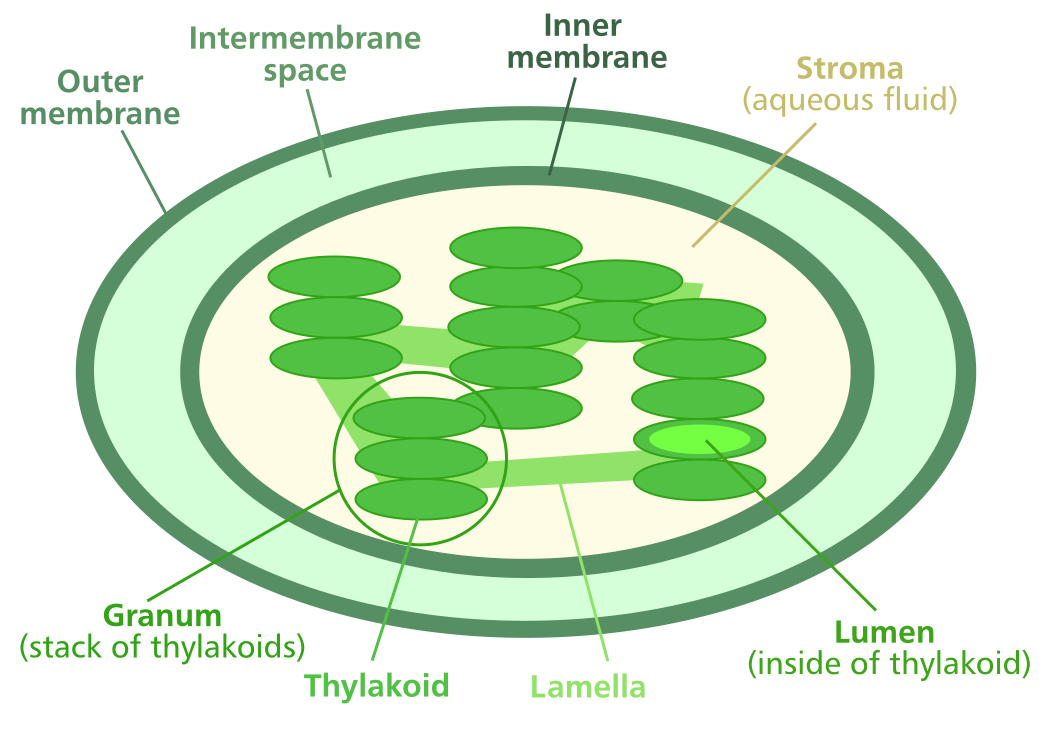
- Chloroplast envelope
- The double membrane (an outer and an inner membrane) around a chloroplast.
- Thylakoid
- A flattened sac made of membrane. Its membrane holds the pigments, such as chlorophyll.
- Granum (plural: grana)
- A stack of thylakoids. Grana are joined by intergranal lamellae.
- Stroma
- The watery fluid around the thylakoids. The light-independent reactions happen here.
5.5 How the structure suits photosynthesis: key facts
| Structure | Role in photosynthesis |
|---|---|
| Thylakoid membranes (grana) | Hold the photosystems, electron carriers and ATP synthase: the light-dependent reactions happen here. |
| Stacking into grana | Packs a lot of thylakoid membrane, with its pigments, into a small space. |
| Stroma | Contains the enzymes of the Calvin cycle, such as RUBISCO. |
| Circular DNA, 70S ribosomes | In the stroma: make some of the chloroplast's own proteins. |
| Starch grains | In the stroma: store the sugar made in photosynthesis. |

Quick check 5.5 (3 marks) 2 min
- Name where in a chloroplast each is found: (a) the photosystems, (b) RUBISCO and starch grains. (2)
- Spot the mistake: "A granum is one flattened membrane sac." Correct it. (1)
Reveal the answers
1. (2)
- (a) The thylakoid membranes (1)
- (b) The stroma (1)
2. (1)
- A granum is a stack of thylakoids; one sac is a thylakoid (1)
Common misconceptions and exam errors (5.5)
- Stroma or stoma? The stroma is the fluid inside a chloroplast. A stoma is a pore in the leaf.
- "The light-dependent reactions happen in the chloroplast." Be exact: on the thylakoid membranes. The light-independent reactions happen in the stroma.
5.6 Pigments and spectra: from memory first (2 marks) 1 min
Name the main photosynthetic pigment, and one accessory pigment. (2)
Reveal the answer
- Chlorophyll a (1)
- Chlorophyll b, or a carotenoid such as carotene or xanthophyll (1)
Key words: absorption and action spectra (5.6)
- Absorption spectrum
- A graph of how much light a pigment absorbs at each wavelength.
- Action spectrum
- A graph of the rate of photosynthesis at each wavelength of light.
- Accessory pigment
- A pigment, such as chlorophyll b or a carotenoid, that absorbs wavelengths chlorophyll a absorbs poorly and passes the energy on to chlorophyll a.
5.6 What the two spectra show: key facts
| Absorption spectrum | Action spectrum | |
|---|---|---|
| Shows | Light absorbed by one pigment, at each wavelength | Rate of photosynthesis at each wavelength |
| Chlorophyll a | Peaks in blue (about 430 nm) and red (about 660 nm) | Rate is highest in blue and red light |
| Green light | Hardly absorbed: reflected, so leaves look green | Rate is low, but not zero |
| Evidence | Each pigment absorbs a different range | Rate is high where only accessory pigments absorb: they pass energy to chlorophyll a |
Quick check 5.6 (3 marks) 2 min
- Look at the graph. At about 480 nm, the action spectrum is much higher than the absorption by chlorophyll a. Explain why. (2)
- Spot the mistake: "Plants cannot photosynthesise at all in green light." Correct it. (1)
Reveal the answers
1. (2)
- Accessory pigments (carotenoids) absorb light at 480 nm (1)
- They pass the energy on to chlorophyll a (1)
2. (1)
- The rate is low but not zero: some green light is absorbed (1)
Common misconceptions and exam errors (5.6)
- Mixing up the two spectra. Absorption: light absorbed by a pigment. Action: the rate of photosynthesis.
- "Chlorophyll absorbs green light." Chlorophyll reflects most green light, which is why leaves look green.
5.7 Chromatography: from memory first (2 marks) 1 min
(a) Why is the origin line drawn in pencil, not in ink? (b) Why is the spot of extract kept small but dark? (2)
Reveal the answer
- (a) Ink would dissolve and separate, mixing with the pigments (1)
- (b) Enough pigment to see each spot, and the spots stay separate (1)
Key words: chromatography (5.7)
- Chromatography
- A way of separating the substances in a mixture as a solvent carries them along a paper or a thin layer.
- Origin
- The pencil line where the mixture is spotted at the start.
- Solvent front
- The furthest point the solvent reaches.
- Rf value
- The distance moved by a substance divided by the distance moved by the solvent, both from the origin.
5.7 Separating and identifying pigments: key facts
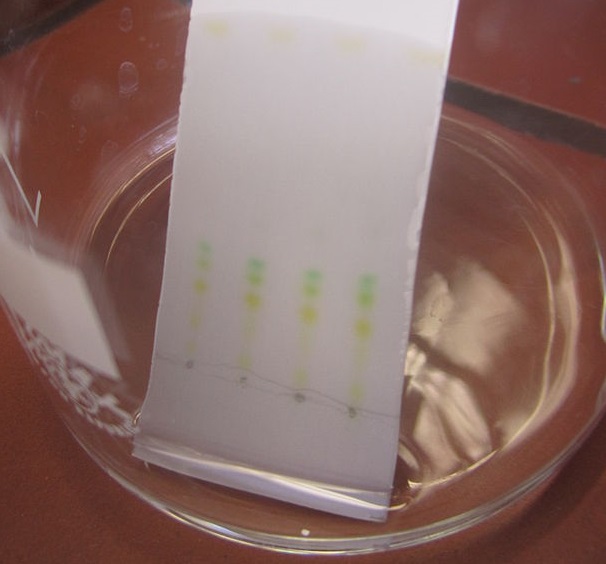
- Grind leaves with propanone; filter the extract.
- Spot it on the origin, 1 cm from the bottom. Dry; repeat until dark.
- Stand the plate in solvent, below the origin. When the solvent is near the top, mark the solvent front.
- Each pigment dissolves and sticks to the plate by a different amount, so each moves a different distance.
| Pigment | Colour | Rf |
|---|---|---|
| Carotene | Yellow | 0.95 |
| Phaeophytin | Grey-brown | 0.83 |
| Xanthophyll | Yellow-brown | 0.71 |
| Chlorophyll a | Blue-green | 0.65 |
| Chlorophyll b | Green | 0.45 |
Rf values change with the solvent, so compare with values for the same solvent.

Quick check 5.7 (3 marks) 2 min
- In this solvent, chlorophyll a has an Rf of 0.65. The solvent front moves 9.0 cm. How far from the origin will the chlorophyll a spot be, and what colour will it be? (2)
- Spot the mistake: "Measure the distances from the bottom edge of the plate." Correct it. (1)
Reveal the answers
1. (2)
- 0.65 × 9.0 = 5.9 cm (1)
- Blue-green (1)
- ACCEPT 5.85 cm
2. (1)
- Measure from the origin line, to the centre of the spot (1)
Common misconceptions and exam errors (5.7)
- An Rf value above 1. A pigment cannot move further than the solvent, so Rf is always less than 1. Check you divided the right way round.
- Solvent above the origin. The pigments would dissolve into the solvent in the dish instead of moving up the plate.
5.8 Core practical 10: from memory first (2 marks) 1 min
Name the four factors that core practical 10 asks you to investigate. (2)
Reveal the answer
- Light intensity and light wavelength (colour) (1)
- Temperature and carbon dioxide supply (1)
All four: 2 marks. Two or three: 1 mark.
Key words: core practical 10 (5.8)
- Rate of photosynthesis
- How fast photosynthesis happens. Here: the volume of oxygen given off per minute (mm3 min−1).
- Photosynthometer
- Apparatus that collects the gas from a water plant in a narrow tube, so its volume can be measured.
- Limiting factor
- The factor in shortest supply. It holds the rate down: increasing it increases the rate.
- Light intensity
- How much light energy reaches the plant. It is proportional to 1/d2, where d is the distance from the lamp.
5.8 The practical and limiting factors: key facts
| Factor | How to change it | Keep the same |
|---|---|---|
| Light intensity | Move the lamp to set distances | Temperature, CO2, wavelength |
| Wavelength | Coloured filters | Lamp distance, temperature, CO2 |
| Carbon dioxide | Different amounts of sodium hydrogencarbonate | Light, temperature |
| Temperature | A water bath | Light, CO2 |
Wait about 3 minutes after each change so the plant adjusts. Measure the gas volume, not bubbles, and repeat each condition to calculate a mean. On a graph, the rate rises while a factor is limiting, then levels off when another factor limits it. Above the optimum temperature, enzymes such as RUBISCO denature and the rate falls.
Quick check 5.8 (3 marks) 2 min
- Look at the graph. Name the factor that limits the rate at point A, and at point B. (2)
- Spot the mistake: "Moving the lamp from 10 cm to 20 cm halves the light intensity." Correct it. (1)
Reveal the answers
1. (2)
- A: light intensity (1)
- B: carbon dioxide concentration (1)
2. (1)
- It quarters it: intensity is proportional to 1/d2 (1)
- DO NOT ACCEPT halves it
Common misconceptions and exam errors (5.8)
- "The plateau means photosynthesis has stopped." The rate is still high; it stays the same because another factor is limiting.
- Counting bubbles. Bubbles vary in size, so measure the volume of gas collected per minute.
Self-check: Topic 5A (24 marks) 24 min
Exam-style questions on every spec point, 5.1 to 5.8. Allow about a minute per mark. Type your answers in the boxes and hand them in at the end.
- 1. Describe the overall reaction of photosynthesis, including the role of light energy. (5.1) (3)
- 2. Which row is correct for what happens to ADP and ATP in the two stages of photosynthesis?
A light-dependent: ATP hydrolysed; light-independent: ADP phosphorylated
B light-dependent: ADP phosphorylated; light-independent: ATP hydrolysed
C light-dependent: ADP phosphorylated; light-independent: ADP phosphorylated
D light-dependent: ATP hydrolysed; light-independent: ATP hydrolysed
Write the letter. (5.2) (1) - 3. Describe the role of the photolysis of water in the light-dependent reactions. (5.3) (3)
- 4. (a) In a leaf, 12 molecules of carbon dioxide are fixed in the Calvin cycle. How many molecules of GP are made, and how many molecules of GALP are used to regenerate RuBP? (5.4) (2)
- (b) A plant cannot make all of its proteins from GALP alone: it also needs nitrate ions from the soil. Explain why. (5.4) (2)
- 5. Explain how the structure of a chloroplast is related to its role in photosynthesis. (5.5) (3)
- 6. Explain why a leaf with several different pigments can photosynthesise faster in white light than it could with chlorophyll a alone. (5.6) (2)
- 7. Describe how chromatography could be used to show that a leaf contains more than one pigment, and to identify one of them. (5.7) (4)
- 8. A student put a lamp at different distances from a piece of pondweed in a photosynthometer. (a) At 20 cm, 1.8 mm3 of gas collected in 3 minutes. Calculate the rate of gas production, with its unit. (5.8) (1)
- (b) When she moved the lamp closer than 10 cm, the rate stopped increasing. Explain why. (5.8) (2)
- (c) Suggest why the student used an LED lamp rather than an ordinary bulb. (5.8) (1)
Reveal the self-check mark scheme
1. The overall reaction (3)
- Light energy splits (the bonds in) water (1)
- Hydrogen is joined to carbon dioxide to make glucose (a fuel) (1)
- Oxygen (from the water) is released (1)
2. Multiple choice (1)
- B (1)
3. Photolysis (3): max 3
- Light energy splits water into H+, electrons and oxygen (1)
- The electrons replace those lost from chlorophyll in PSII (1)
- The H+ add to the gradient for ATP synthesis / reduce NADP (1)
- The oxygen is released (a waste product) (1)
- Max 3
4(a) Calvin cycle numbers (2)
- 24 GP (2 per carbon dioxide) (1)
- 20 GALP (5 in every 6) (1)
- NB 12 RuBP are regenerated; 4 GALP are left to make 2 glucose
4(b) Nitrate (2)
- Amino acids (proteins) contain nitrogen (1)
- GALP contains only carbon, hydrogen, oxygen (and phosphorus): no nitrogen (1)
5. Structure and role (3): max 3
- Thylakoid membranes hold the photosystems (pigments) that absorb light (1)
- Thylakoid membranes hold electron carriers and ATP synthase (1)
- Grana pack a large area of thylakoid membrane into a small space (1)
- Stroma contains the enzymes of the Calvin cycle (RUBISCO) (1)
- DNA and 70S ribosomes make some chloroplast proteins (1)
- Max 3
6. Several pigments (2)
- Each pigment absorbs a different range of wavelengths (1)
- So more of the light energy is absorbed and passed to chlorophyll a (1)
7. Chromatography (4): max 4
- Grind the leaf with a solvent such as propanone to extract the pigments (1)
- Spot the extract on a pencil origin line; dry and repeat (1)
- Stand in solvent below the origin; remove when it nears the top (1)
- More than one spot shows more than one pigment (1)
- Calculate Rf and compare with known values (same solvent) (1)
- Max 4
8(a) Rate (1)
- 0.6 mm3 min−1 (1)
- DO NOT ACCEPT an answer without a unit
8(b) Plateau (2)
- Light intensity is no longer the limiting factor (1)
- Another factor, such as carbon dioxide or temperature, limits the rate (1)
- DO NOT ACCEPT photosynthesis has stopped
8(c) LED lamp (1)
- An LED heats the water less, so temperature stays the same (controlled) (1)
RAG self-assessment by spec point
Rate each spec point, 5.1 to 5.8, in your notebook. Go back to the lesson for anything red or amber before the Topic 5A test.
- Red: I could not answer the quick check or self-check on it without my notes.
- Amber: I knew the facts but lost marks on the explanation or the spot-the-mistake question.
- Green: I got full marks and could explain each answer.
Lessons: 5.5 chloroplasts · 5.1 to 5.3 light-dependent reactions · 5.4 Calvin cycle · 5.2 and 5.4 uses of glucose · 5.6 and 5.7 pigments · 5.8 core practical 10, lesson 1 · lesson 2