The Chromozone / Courses / IGCSE Co-ordinated Sciences / Tests
Part A is multiple choice; Part B is short and long answers, written on the printed paper or in books. The mark scheme is in the teacher area. Questions A8 and A9 are for Extended students only: Core students leave them out and are marked out of 37.
Cambridge IGCSE Co-ordinated Sciences (0654) · Biology · Unit B2
End-of-unit test: cells
- Answer all the questions. If you are a Core student, leave out the two questions marked Extended only.
- Part A: choose one answer, A, B, C or D, for each question. On screen, click it. On paper, put a cross in its box; if you change your mind, draw a line through the cross and cross another box.
- Part B: write your answers in the spaces. Show your working in calculations.
- The marks for each question are shown in brackets.
Part A: multiple choice (10 marks, marks itself online)
Which structure controls which substances enter and leave an animal cell?
Which structure contains chlorophyll?
What is the name for a group of cells with similar structures, working together to perform a shared function?
Which row gives the function of each structure in a palisade mesophyll cell?
| chloroplast | cell wall | mitochondrion | |
|---|---|---|---|
| absorbs light energy | supports the cell | releases energy | |
| makes proteins | supports the cell | releases energy | |
| absorbs light energy | controls what enters the cell | makes proteins | |
| releases energy | supports the cell | absorbs light energy |
Cells in the wall of the stomach make and release large amounts of an enzyme. Enzymes are proteins. Which two organelles would these cells have in large numbers?
Which row shows the structures in a bacterial cell?
| cell wall | circular DNA | nucleus | plasmids | |
|---|---|---|---|---|
| ✓ | ✓ | ✗ | ✓ | |
| ✓ | ✗ | ✓ | ✓ | |
| ✗ | ✓ | ✗ | ✓ | |
| ✓ | ✓ | ✓ | ✗ |
Which row describes a root hair cell?
| has chloroplasts | has a cell wall | absorbs water and mineral ions | |
|---|---|---|---|
| ✗ | ✓ | ✓ | |
| ✓ | ✓ | ✓ | |
| ✗ | ✗ | ✓ | |
| ✓ | ✓ | ✗ |
Extended onlyA textbook photo of a pollen grain is 36 mm wide. The actual pollen grain is 45 µm wide. What is the magnification of the photo?
Extended onlyA drawing of a cheek cell is 54 mm wide. The magnification of the drawing is ×900. What is the actual width of the cell?
Where are the mitochondria in a palisade mesophyll cell?
Total for Part A: 10 marks (Core: 8 marks)
Part B: short and long answers (29 marks, marked by your teacher)
Question B1
Fig. B1.1 shows a diagram of a cell from a leaf.
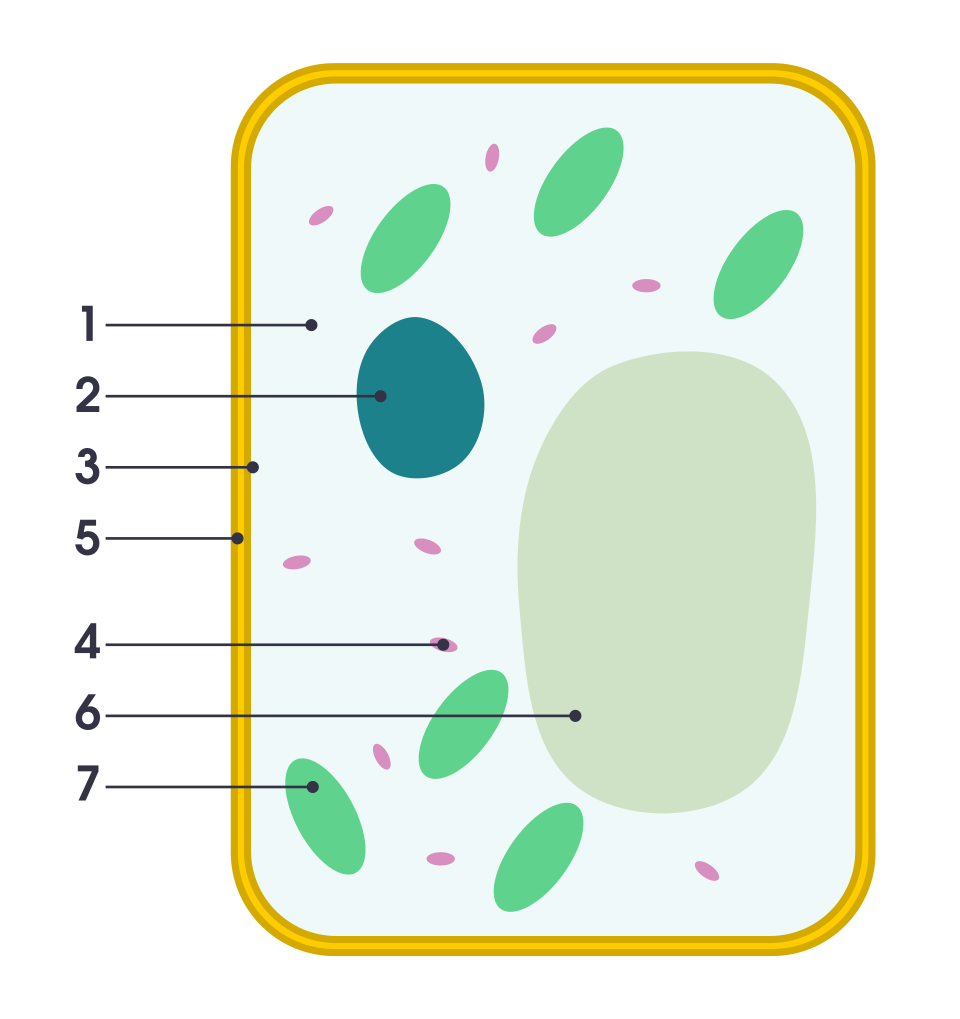

Name the structures labelled 2, 6 and 7.
Give the number of the structure that controls which substances enter and leave the cell, and the number of the structure that is made of cellulose.
This cell carries out most of the photosynthesis in the leaf. State the name of this type of cell.
(1)Put a tick (✓) in each box that is correct. A row may need one tick or two.
Table B1.1
| Feature | Plant cells | Animal cells |
|---|---|---|
| have a nucleus | ||
| have a cell wall made of cellulose | ||
| have mitochondria | ||
| have a large permanent vacuole | ||
| have a cell membrane | ||
| may have chloroplasts |
A muscle cell contracts many times every minute. Name the organelle that you would expect to find in large numbers in a muscle cell. Explain your answer.
(2)(Total for Question B1 = 10 marks)
Question B2
Write the letter of the correct function next to each specialised cell. One has been done for you. One letter is not used.
| Specialised cell | Letter | Function |
|---|---|---|
| ciliated cell | A absorption of water and mineral ions | |
| neurone | B conduction of electrical impulses | |
| red blood cell | F | C movement of mucus in the trachea and bronchi |
| root hair cell | D photosynthesis | |
| sperm cell | E reproduction | |
| F transport of oxygen |
State how new cells are produced.
(1)Put these levels of organisation in order of size, starting with the smallest.
organ · organism · tissue · cell · organ system
(1)Put one tick (✓) in each row to show the level of organisation. The first row has been done for you.
Table B2.1
| Structure | Tissue | Organ | Organ system |
|---|---|---|---|
| the heart | ✓ | ||
| the layer of ciliated cells lining the trachea | |||
| the circulatory system | |||
| the brain |
(Total for Question B2 = 9 marks)
Question B3
Compare the structure of a palisade mesophyll cell with the structure of a bacterial cell. Give similarities and differences.
(6)A baby develops from a single cell, a fertilised egg cell. Describe how this one cell becomes a baby made of many different types of cell.
(2)(Total for Question B3 = 8 marks)
Question B4
A student looks at a palisade mesophyll cell with a microscope and makes a drawing of it. The drawing is 60 mm long. The real cell is 0.12 mm long.
Calculate the magnification of the drawing. Show your working.
magnification ×
(Total for Question B4 = 2 marks)
Total for Part B: 29 marks (Core: 29 marks)
TOTAL FOR TEST = 39 MARKS (CORE: 37 MARKS)