The Chromozone / Courses / IGCSE Co-ordinated Sciences / Biology / B2 Cells
Cambridge IGCSE Co-ordinated Sciences (0654) · Biology · B2 Cells · Revision summary
Revision summary: characteristics of living organisms and cells (B1.1, B2.1, B2.2)
One screen per syllabus point for B1 and B2: the key words, the key ideas as a table and a picture, and a 2-minute "spot the mistakes" check that you mark yourself. Then a list of common exam errors and a self-check of 15 marks (Core 14). Boxes and questions marked "Extended only" are for Extended students; Core students skip them. Type your self-check answers in the boxes and hand them in at the bottom of the page; the mark scheme opens after you hand in. It takes about 35 minutes and you need a calculator. Use it after the last B2 lesson, before the B2 end-of-unit test. B1 has only one lesson, so it is revised here too. Teachers: this is the page to set as homework before the test.
Teach these first
This revision summary covers these lessons. Teach them before students start here:
B1.1 key words
- Movement
- An action by an organism or part of an organism causing a change of position or place.
- Respiration
- The chemical reactions in cells that break down nutrient molecules and release energy for metabolism.
- Sensitivity
- The ability to detect and respond to changes in the internal or external environment.
- Growth
- A permanent increase in size and dry mass.
- Reproduction
- The processes that make more of the same kind of organism.
- Excretion
- The removal of waste products of metabolism and substances in excess of requirements.
- Nutrition
- The taking in of materials for energy, growth and development.
B1.1 The seven characteristics of living organisms
| Characteristic | In an animal | In a plant |
|---|---|---|
| Movement | a cat runs | a flower opens; a leaf turns to the light |
| Respiration | muscle cells release energy from glucose | root cells release energy from glucose |
| Sensitivity | eyes detect light | a shoot detects light and grows towards it |
| Growth | a child gains dry mass | a seedling gains dry mass |
| Reproduction | a bird lays eggs | a plant makes seeds |
| Excretion | the lungs remove carbon dioxide | leaves give out oxygen made in photosynthesis |
| Nutrition | eating food | taking in carbon dioxide, water and mineral ions to make food |
- Breathing is not respiration. Breathing moves air in and out of the lungs. Respiration is a set of chemical reactions in every cell.
- Faeces are not excretion. Undigested food was never made by the body's cells, so passing it out is egestion.
- Growth is measured as dry mass, because the water in an organism can change from hour to hour.

Check B1.1: spot the mistakes (2 marks) 2 min
A student wrote this. Find each mistake and correct it. (2)
"Only animals respire, because plants photosynthesise instead. Plants do not excrete, because they do not make urine."
Reveal the corrections
- Every living cell respires, plant cells included, all the time: respiration releases energy from glucose (1)
- Plants do excrete: for example, they give out oxygen, a waste product of photosynthesis (1)
B2.1 key words
- Cell membrane
- A very thin layer around every cell. It controls which substances enter and leave the cell.
- Cytoplasm
- A jelly-like liquid, mostly water, that fills the cell. Most of the cell's chemical reactions take place here.
- Nucleus
- Contains the genetic material (DNA) in chromosomes. The DNA controls the activities of the cell.
- Mitochondrion (plural: mitochondria)
- The organelle where aerobic respiration takes place, releasing energy for the cell.
- Ribosome
- A tiny organelle in the cytoplasm where proteins are made.
- Cell wall
- A strong layer of cellulose outside the cell membrane of a plant cell. It supports the cell and stops it bursting.
- Chloroplast
- An organelle that contains chlorophyll. Photosynthesis takes place in chloroplasts.
- Permanent vacuole
- A large space in a plant cell, surrounded by a membrane and filled with cell sap.
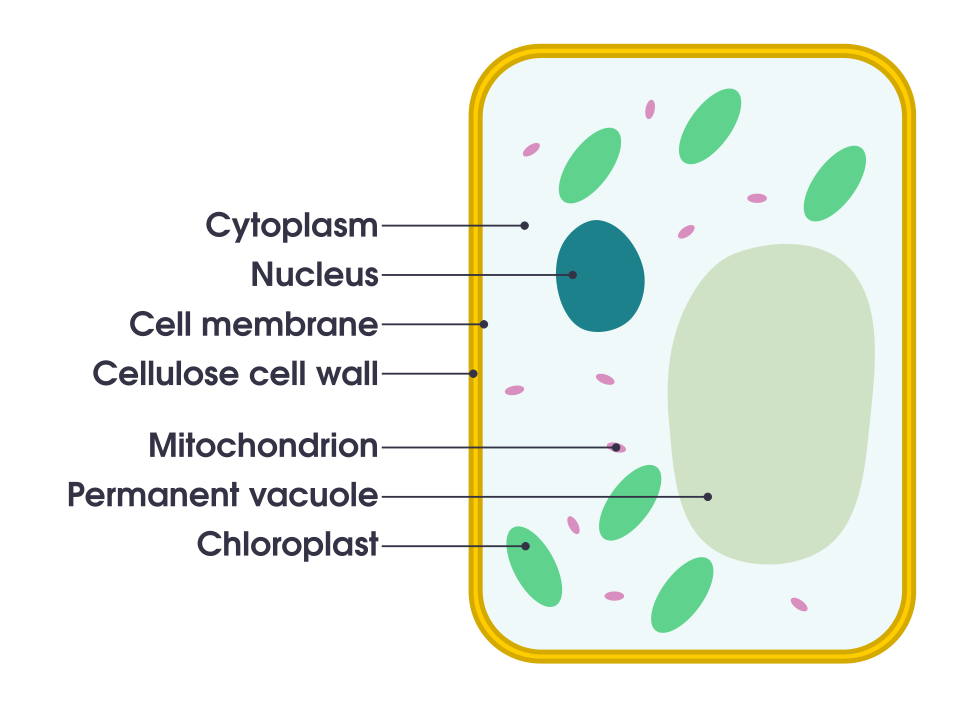
B2.1 Plant and animal cells
| Structure | Animal cell | Plant cell |
|---|---|---|
| cell membrane, cytoplasm, nucleus | ✓ | ✓ |
| mitochondria and ribosomes | ✓ | ✓ |
| cell wall (made of cellulose) | ✗ | ✓ |
| large permanent vacuole (cell sap) | ✗ | ✓ |
| chloroplasts | ✗ | only in green parts, such as leaves |
A full permanent vacuole pushes outwards on the cell wall and keeps the cell firm. Root cells have no chloroplasts: there is no light underground.

Check B2.1: spot the mistakes (2 marks) 2 min
A student wrote this. Find each mistake and correct it. (2)
"Plant cells do not need mitochondria, because their chloroplasts make all their energy. Ribosomes contain the DNA that controls the cell."
Reveal the corrections
- Plant cells do have mitochondria: every plant cell respires to release energy (photosynthesis makes glucose; respiration releases energy from it) (1)
- Ribosomes make proteins; the DNA that controls the cell is in the nucleus (1)
B2.1 key words
- Bacterium (plural: bacteria)
- A single-celled organism whose cell has no nucleus.
- Circular DNA
- The main DNA of a bacterial cell: one long loop, lying free in the cytoplasm.
- Plasmid
- A small extra ring of DNA found in many bacterial cells.
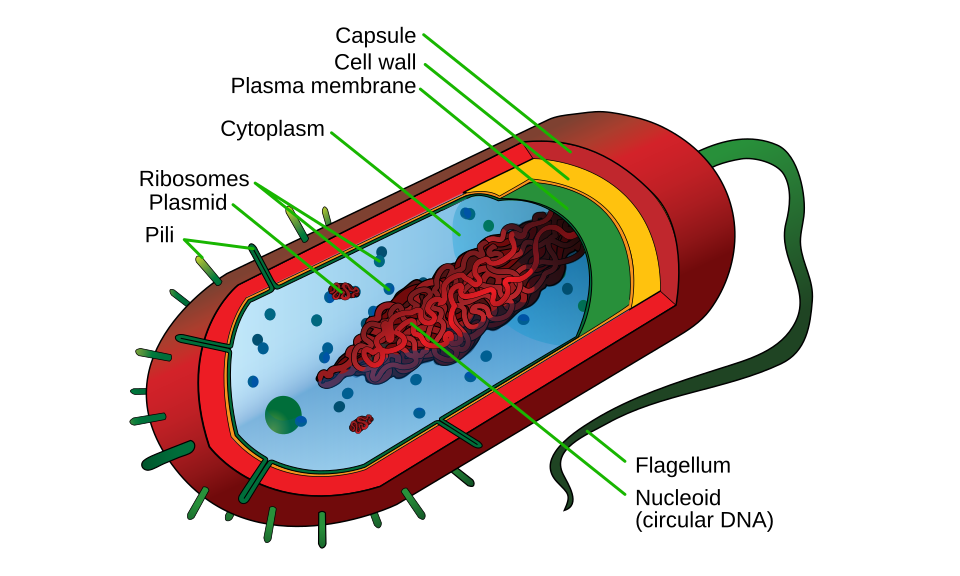
B2.1 Bacterial cells
| Part | Same as in plant and animal cells? |
|---|---|
| cell wall | plant cells have one too, but a bacterial cell wall is not made of cellulose |
| cell membrane, cytoplasm, ribosomes | yes |
| circular DNA, free in the cytoplasm | no: there is no nucleus |
| plasmids | no: only in bacteria |
A bacterial cell is much smaller than a plant or animal cell, and it has no mitochondria and no chloroplasts.

Check B2.1: spot the mistakes (2 marks) 2 min
A student wrote this. Find each mistake and correct it. (2)
"A bacterial cell keeps its DNA in a small nucleus. Plasmids are tiny ribosomes found only in bacteria."
Reveal the corrections
- A bacterial cell has no nucleus: its DNA is a loop (circular DNA) free in the cytoplasm (1)
- Plasmids are small extra rings of DNA, not ribosomes (1)
B2.1 key words
- Specialised cell
- A cell with a shape and structures that suit one particular function.
- Cilia
- Tiny hairs on the surface of some cells. They beat to move mucus along.
- Neurone
- A nerve cell. It conducts electrical impulses.
- Gamete
- A sex cell: a sperm cell or an egg cell.
- Palisade mesophyll cell
- A cell in a layer near the top of a leaf, packed with chloroplasts for photosynthesis.
- Root hair cell
- A cell on the surface of a root with a long, thin root hair, for absorption.
B2.1 Specialised cells
| Cell | Function | A feature that helps |
|---|---|---|
| ciliated cell | moves mucus in the trachea and bronchi | cilia beat to sweep mucus, with trapped dust and microorganisms, away from the lungs |
| root hair cell | absorption of water and mineral ions | long, thin root hair: large surface area; no chloroplasts |
| palisade mesophyll cell | photosynthesis | packed with chloroplasts, near the light |
| neurone | conducts electrical impulses | a very long, thin fibre |
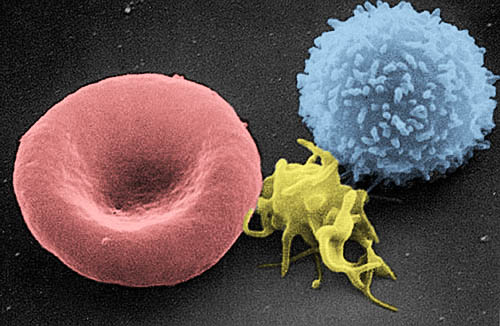
| red blood cell | transports oxygen | packed with haemoglobin; no nucleus, so more room |
| sperm cell | reproduction | a tail to swim; many mitochondria |
| egg cell | reproduction | large, with a food store |

Check B2.1: spot the mistakes (2 marks) 2 min
A student wrote this. Find each mistake and correct it. (2)
"Neurones carry oxygen around the body. Palisade mesophyll cells are found in roots, where they absorb water."
Reveal the corrections
- Neurones conduct electrical impulses (red blood cells carry oxygen) (1)
- Palisade mesophyll cells are in leaves, for photosynthesis (root hair cells absorb water) (1)
B2.1 key words
- Tissue
- A group of cells with similar structures, working together to perform a shared function.
- Organ
- A structure made of a group of tissues, working together to perform specific functions.
- Organ system
- A group of organs with related functions, working together to perform body functions.
- Organism
- One whole living thing. It may be a single cell, or made of many organ systems working together.
- Cell division
- The process in which an existing cell divides to make new cells.
B2.1 Levels of organisation and new cells
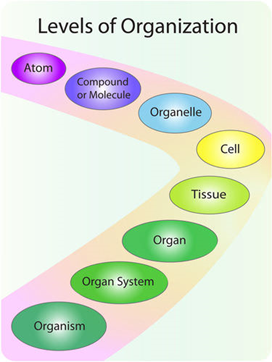

| Level | In a human | In a plant |
|---|---|---|
| cell | a muscle cell | a palisade mesophyll cell |
| tissue | muscle tissue | the palisade layer |
| organ | the heart | a leaf |
| organ system | the circulatory system | the shoot system |
| organism | a human | a sunflower plant |
New cells are made only by the division of existing cells. An organism needs them to grow, to repair damaged tissue and to replace cells that wear out. Many new cells then become specialised.
Check B2.1: spot the mistakes (2 marks) 2 min
A student wrote this. Find each mistake and correct it. (2)
"A leaf is a tissue, because it is made of plant cells. The heart and the blood vessels together make one organ."
Reveal the corrections
- A leaf is an organ: it is made of several tissues (such as the palisade layer) working together (1)
- The heart and the blood vessels make an organ system (the circulatory system): a group of organs (1)
B2.2 key words
- Magnification
- How many times bigger an image is than the real object.
- Image size
- The size of the object in a drawing or photo.
- Actual size
- The real size of the object.
- Millimetre (mm)
- A unit of length: one thousandth of a metre. 10 mm = 1 cm.
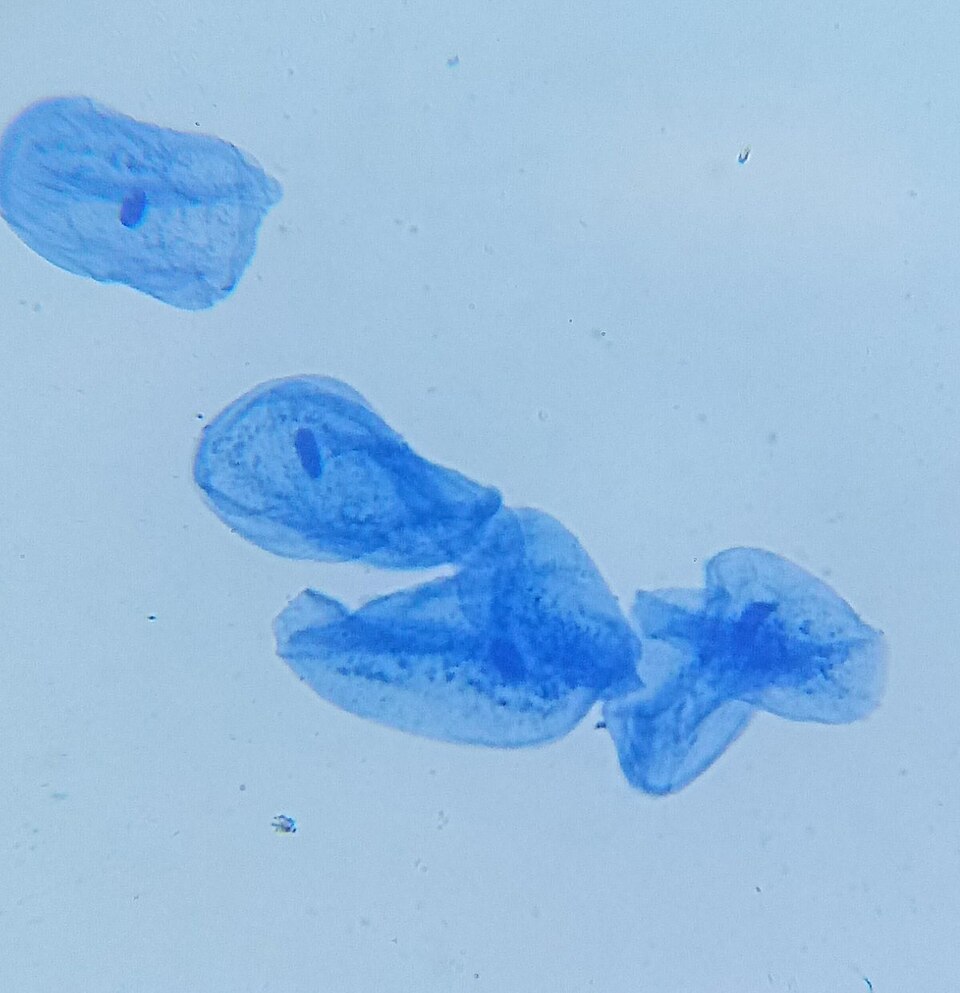
B2.2 Magnification
- Measure the image and write down the actual size. Put both in mm: 1 cm = 10 mm.
- Magnification = image size ÷ actual size. Write it with a × sign and no unit, for example ×40.
- Rearrange when you need to: image size = magnification × actual size; actual size = image size ÷ magnification.

B2.2 key word: an even smaller unit Extended only
- Micrometre (µm)
- A unit of length: one thousandth of a millimetre. 1 mm = 1000 µm.
B2.2 Micrometres Extended only
- Cells are tiny, so their actual size is often given in micrometres (µm).
- mm to µm: multiply by 1000 (0.02 mm = 20 µm). µm to mm: divide by 1000 (50 µm = 0.05 mm).
- Before you use the formula, put the image size and the actual size in the same unit.
Check B2.2: spot the mistakes (2 marks) 2 min
A student wrote this. Find each mistake and correct it. (2)
"A drawing of a leaf is 12 cm long. The real leaf is 40 mm long. So the magnification is 12 ÷ 40 = 0.3 mm."
Reveal the corrections
- Change 12 cm into mm first: 12 cm = 120 mm (1)
- Magnification = 120 ÷ 40 = ×3, with no unit (1)
Common misconceptions and exam errors
- B1.1 Writing "breathing" for respiration, or "getting rid of faeces" for excretion. Learn the seven definitions word for word.
- B2.1 "All plant cells have chloroplasts." Root hair cells and other cells underground have none.
- B2.1 Saying the cell wall controls what enters and leaves the cell: that is the cell membrane. The cell wall lets water and dissolved substances through freely.
- B2.1 Giving a bacterial cell a nucleus. Its DNA is circular and lies free in the cytoplasm.
- B2.1 Mixing up tissue and organ. A tissue is similar cells; an organ is several tissues working together.
- B2.2 Forgetting to put both lengths in the same unit, or writing a unit after the magnification (×40, never 40 mm).
Self-check: B1.1 to B2.2 (15 marks, Core 14) 15 min
Answer without your notes, then hand in. The syllabus section is in brackets after each question. You need a calculator.
S1. A student's revision card says: "Growth: getting bigger. Reproduction: having babies." Rewrite both definitions so that they would get full marks in an exam. (B1.1) (4)
S2. Scientists find a single-celled organism in a lake. Its cell has a nucleus, a cell membrane, a cell wall and chloroplasts. A student says it is a bacterium. Explain why the student is wrong. (B2.1) (2)
S3. Some people are born with cilia in their airways that cannot beat. Suggest why these people get more chest infections than other people. (B2.1) (2)
S4. A red blood cell has no nucleus. Suggest one advantage and one disadvantage of this for the cell. (B2.1) (2)
S5(a). A photo shows one yeast cell. In the photo the cell is 30 mm wide. The real cell is 0.006 mm wide. Calculate the magnification of the photo. (B2.2) (2)
S5(b). Extended only Give the actual width of the yeast cell in micrometres (µm). (B2.2) (1)
S6. A dust mite is 0.4 mm long. A poster shows the dust mite at a magnification of ×250. Calculate the length of the dust mite on the poster, in cm. (B2.2) (2)
Mark scheme for the self-check
S1 (4)
- Growth: a permanent increase (1)
- in size and dry mass (1)
- Reproduction: the processes that make more (1)
- of the same kind of organism (1)
- "Getting bigger" alone gets no mark: the increase must be permanent and in dry mass. Accept "offspring" for "more of the same kind of organism".
S2 (2)
- A bacterial cell has no nucleus, but this cell has one (1)
- Bacteria have no chloroplasts, but this cell has them (a bacterium's DNA is a loop free in the cytoplasm) (1)
- Accept either reason for the second mark if the nucleus is not used for the first.
S3 (2)
- Mucus, with trapped dust and microorganisms, is not swept up and away from the lungs (1)
- So the microorganisms stay in the airways (trachea and bronchi) and can cause infection (1)
S4 (2)
- Advantage: more room for haemoglobin, so it can carry more oxygen (1)
- Disadvantage: with no nucleus (no DNA) it cannot divide, or cannot control its activities and repair itself, so it does not live long (1)
- Accept any sensible disadvantage linked to the job of the nucleus.
S5(a) (2)
- 30 ÷ 0.006 (1)
- = ×5000 (1)
- Correct answer with no working: 2 marks. No mark off for a missing × sign; a unit after the answer loses the second mark.
S5(b) (1)
- 0.006 mm × 1000 = 6 µm (1)
S6 (2)
- image size = 0.4 × 250 = 100 mm (1)
- = 10 cm (1)
- 100 with no unit, or 100 cm: 1 mark.