Slide 1 of 26
Starter 5 min
Answer these three recap questions in your notebook:
1
2
3
The Chromozone / IGCSE Psychology / Topic 1: Memory and forgetting
Syllabus 1.3.2, 1.3.4 and 1.3.550 minutes
1.3, the multistore model (lesson 2 of 2): Murdock's evidence, evaluation and scenarios
| Time | Phase | What happens | Slides |
|---|---|---|---|
| 5 min | Starter | Recap questions in notebooks. | 1–2 |
| flex | Today | Syllabus 1.3.2, 1.3.4 and 1.3.5; | 3–4 |
| 6 min | Class test | Fifteen words and a hands-up tally. | 5 |
| flex | Teach: The study | What Murdock did, step by step. | 6 |
| 3 min | Task | Our demonstration and Murdock's study. | 7–8 |
| flex | Teach: The results | High at both ends, lowest in the middle. | 9 |
| 2 min | Quick check | Read the curve. | 10–11 |
| flex | Teach: The MSM | Each end of the curve comes from a different store; two ways words are lost from STM. | 12–13 |
| 1 min | Quick check | Decay or displacement?. | 14–15 |
| flex | Teach: The MSM | Stored, but not found. | 16 |
| 4 min | Task | Which kind of forgetting?. | 17–18 |
| flex | Teach: Depth of processing | Memory depends on depth, not only rehearsal. | 19 |
| 4 min | Predict, then explain | Repeat it or picture it?. | 20–21 |
| 5 min | Exam-style question | 4 marks; mark scheme on the next slide. | 22–23 |
| extension | Stretch | Long lists and short lists (3 marks). | 24–25 |
| extension | If you have time | 10 marks of exam-style questions, about 10 minutes, with mark schemes. | 26 |
The timed tasks take 30 minutes; the teaching phases (flex) share the other 20.
First and last: talent shows, adverts and instructions, a student page with mark schemes. Students can hand it in online.
Prints on one A4 sheet. The old layout of this lesson is still here.
Name: ______________________ Class: __________ Date: __________
Slide 1 of 26
Answer these three recap questions in your notebook:
1
2
3
Slide 2 of 26
Decay (1)
Two ways to revise (1)
Confidentiality and privacy (2)
Slide 3 of 26
Describe the aim, procedure, results and conclusion of Murdock's (1962) study. (1.3.4)
Explain how Murdock's results support the multistore model. (1.3.2, 1.3.4)
Explain why the multistore model cannot explain depth of processing. (1.3.5)
Murdock (1962)
The multistore model
Against the MSM
Slide 4 of 26
Serial position effect
Primacy effect
Recency effect
Slide 5 of 26
Everyone takes part. Your teacher reads the words, and the class builds one picture of what it remembered.
1
2
3
4
| Position | 1 | 2 | 3 | 4 | 5 | 6 | 7 | 8 | 9 | 10 | 11 | 12 | 13 | 14 | 15 |
|---|---|---|---|---|---|---|---|---|---|---|---|---|---|---|---|
| Hands up |
Then discuss:
Slide 6 of 26
Murdock tested the serial position effect in memory.
Aim
Participants
Procedure
Slide 7 of 26
Copy and complete the table. Then answer the question below it.
| Feature | Our demonstration | Murdock (1962) |
|---|---|---|
| Participants | ||
| Words in a list | ||
| Number of lists | ||
| Time for each word | ||
| Time to recall |
Choose two differences that make Murdock's results more trustworthy than ours, and explain each one.
Slide 8 of 26
Slide 9 of 26
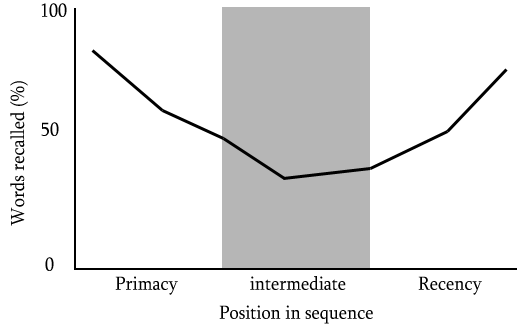
A graph of recall against position is U-shaped.
Primacy effect
Recency effect
Middle

Slide 10 of 26
Look at the curve in the box above.
a
b
c
Slide 11 of 26
Slide 12 of 26
Primacy: LTM
Recency: STM
The argument
Slide 13 of 26
Decay
Displacement
Slide 14 of 26
Match each sentence to decay or displacement.
Slide 15 of 26
Slide 16 of 26
Access problem
The cue
Slide 17 of 26
For each situation, name the kind of forgetting (decay, displacement or an access problem) and explain it using the MSM.
a
b
c
Slide 18 of 26
Slide 19 of 26
MSM
Depth of processing
Craik and Tulving (1975)
Slide 20 of 26
Two groups hear the same 20-word list at the same pace, as in Murdock's study.
a
b
c
Slide 21 of 26
Slide 22 of 26
Dev's teacher says, "Murdock's study of the serial position effect is the best evidence for the multistore model of memory."
Explain why Murdock's (1962) study supports the argument for the multistore model of memory (MSM). (1.3.4) (4)
Slide 23 of 26
Slide 24 of 26
Murdock used lists from 10 to 40 words long. In every list, the last eight or so words were recalled well. Use the multistore model to explain why the low middle part of the curve was much longer for a 40-word list than for a 10-word list. (1.3.2, 1.3.4) (3)
Slide 25 of 26
Slide 26 of 26
For classes that finish early or have a longer period: 10 marks of exam-style questions, about 10 minutes, with a mark scheme after each question, on the student page.
Answer these recap questions in your notebook.
1. Decay (1)
2. Two ways to revise (1)
3. Confidentiality and privacy (2)
Nothing extra for this slide.
This is the specification point, word for word: what you need to know by the end of the lesson.
Nothing extra for this slide.
(a) Usually the first two or three words and the last three or four get the most hands, with the fewest in the middle: a U shape. Any honest description of the tally is right.
(b) One list and one small class means one striking word can stand out by chance. Murdock tested 103 people on many lists, so chance effects cancel out.
Aim: does a word's position in a list affect how likely it is to be recalled? Participants: 103 psychology students.
Lists of 10 to 40 common words, read aloud one at a time, each for one or two seconds.
Straight after, 90 seconds to write down as many as they could, in any order: free recall. Repeated over several days with a new list each time.
Nothing extra for this slide.
Recall depended on position: the graph is U-shaped. This is the serial position effect.
Primacy: the first three or four words were recalled more than the middle. Recency: the last eight or so were also recalled more. The middle was recalled least.
The U shape appeared for every list length. A longer list just had a longer low middle.
Nothing extra for this slide.
The two ends of the curve come from two different stores.
The first words had time to be rehearsed and moved to LTM. The last words were still in STM, so they could be written down at once.
So STM and LTM are separate stores: the argument for the MSM (1.3.4).
Naming the effect but not the store. "Murdock found primacy and recency" is only a start. Say which store explains each end and why: primacy from LTM after rehearsal, recency from STM.
Saying the same point twice. "STM and LTM are separate" and "they are two different stores" earn one mark, not two.
Murdock's middle words were heard but not recalled. The MSM explains forgetting differently for each store (1.3.3).
Decay: an unrehearsed word is lost from STM within about 18 to 30 seconds. Displacement: STM holds 5 to 9 items, so each new word pushes one out.
In a 15-word list, the middle words are pushed out before they can be rehearsed.
Nothing extra for this slide.
A word can also be lost from long-term memory.
Access problems (LTM): the word is still stored in LTM, but it cannot be retrieved without the right cue.
It may come back when you see the list again: the list is the cue.
Nothing extra for this slide.
When researchers tried (b), the recency effect did disappear while the primacy effect stayed.
Nothing extra for this slide.
In the MSM, the more a word is repeated, the better it should be remembered. The levels of processing model (1.2) says depth matters.
Craik and Tulving (1975) found that thinking about meaning gave better recall, with the same time on every word. The MSM cannot explain this: the argument against (1.3.5).
Ask: why does this show rehearsal is not the whole story?
"Repeating something always makes it stick." Repetition is shallow processing, so it may not help. That is the depth of processing point against the MSM.
Nothing extra for this slide.
Question (4)
1 mark for each relevant point (× 4)
Max 4. Do not credit a point that only repeats an earlier one (for example, "STM and LTM are different" said twice).
Teacher note: Mirrors the 2027 specimen paper 1, question 2: "Explain why the study about serial position effect (Murdock) supports the argument for the multistore model", 4 marks, one mark for each relevant point, AO1 and AO2. The mark scheme asks for both ends of the curve and the link to a store. Ask for the effect, the store and the reason each time.
Nothing extra for this slide.
1 mark for each relevant point (× 3)
Nothing extra for this slide.
If there is time: 10 marks of exam-style questions, about 10 minutes, on the student page (the same link students have).
This tab is written for students: share the link and they see this tab only. Students enrolled in a class can see this page independently after it has been taught.
Answer these three recap questions in your notebook:
1. Decay (1)
2. Two ways to revise (1)
3. Confidentiality and privacy (2)
Everyone takes part. Your teacher reads the words, and the class builds one picture of what it remembered.
| Position | 1 | 2 | 3 | 4 | 5 | 6 | 7 | 8 | 9 | 10 | 11 | 12 | 13 | 14 | 15 |
|---|---|---|---|---|---|---|---|---|---|---|---|---|---|---|---|
| Hands up |
Then discuss:
Aim: to investigate the serial position effect in memory: does the position of a word in a list affect how likely it is to be recalled?
Participants: 103 psychology students, male and female.
Procedure:
Copy and complete the table. Then answer the question below it.
| Feature | Our demonstration | Murdock (1962) |
|---|---|---|
| Participants | ||
| Words in a list | ||
| Number of lists | ||
| Time for each word | ||
| Time to recall |
Choose two differences that make Murdock's results more trustworthy than ours, and explain each one.

Recall depended on position, so a graph of the results is U-shaped: the serial position effect.
Look at the curve in the box above.
Murdock concluded that the two ends of the curve come from two different stores.
So STM and LTM are separate stores. This is the argument for the multistore model (MSM) on the syllabus (1.3.4).
Murdock's middle words were heard but not recalled. The MSM explains forgetting in a different way for each store (1.3.3).
Match each sentence to decay or displacement.
A word can also be lost from long-term memory.
For each situation, name the kind of forgetting (decay, displacement or an access problem) and explain it using the MSM.
When researchers tried (b), the recency effect did disappear while the primacy effect stayed.
Two groups hear the same 20-word list at the same pace, as in Murdock's study.
Dev's teacher says, "Murdock's study of the serial position effect is the best evidence for the multistore model of memory."
Explain why Murdock's (1962) study supports the argument for the multistore model of memory (MSM). (1.3.4) (4)
Question (4)
1 mark for each relevant point (× 4)
Max 4. Do not credit a point that only repeats an earlier one (for example, "STM and LTM are different" said twice).
Murdock used lists from 10 to 40 words long. In every list, the last eight or so words were recalled well. Use the multistore model to explain why the low middle part of the curve was much longer for a 40-word list than for a 10-word list. (1.3.2, 1.3.4) (3)
1 mark for each relevant point (× 3)
Rate yourself red, amber or green for each objective.
Exam-style questions for when you finish early: about 10 minutes.
1. A student reads a list of 10 common words aloud, one every two seconds, to 25 classmates. Straight afterwards the classmates write down as many words as they can in any order. The table shows how many of the 25 classmates recalled the word at each position in the list.
| Position | 1 | 2 | 3 | 4 | 5 | 6 | 7 | 8 | 9 | 10 |
|---|---|---|---|---|---|---|---|---|---|---|
| Classmates | 20 | 16 | 12 | 9 | 7 | 6 | 8 | 12 | 17 | 21 |
2. Mia reads a list of 30 words to a group. She says that the word at position 14 was recalled by very few of them.
3. Ravi revises by reading his notes over and over. Kai writes down what each idea means and links it to his own life. Both spend the same time.
Question 1(a) (1)
1 mark for calculation
(21 ÷ 25) × 100 = 84
Question 1(b) (1)
1 mark for calculation
(9 + 7 + 6 + 8) ÷ 4 = 30 ÷ 4 = 7.5
Question 1(c) (1)
1 mark for identification
Do not credit recency effect.
Question 1(d) (1)
1 mark for outline
Max 1.
Question 2(a) (2)
1 mark for each relevant point (× 2)
Question 2(b) (1)
1 mark for identification
Do not credit decay or displacement.
Question 3(a) (2)
1 mark for suggestion
1 mark for explanation
Kai with no reason: Max 1.
Do not credit "repetition always makes it stick".
Question 3(b) (1)
1 mark for identification
Do not credit semantic.